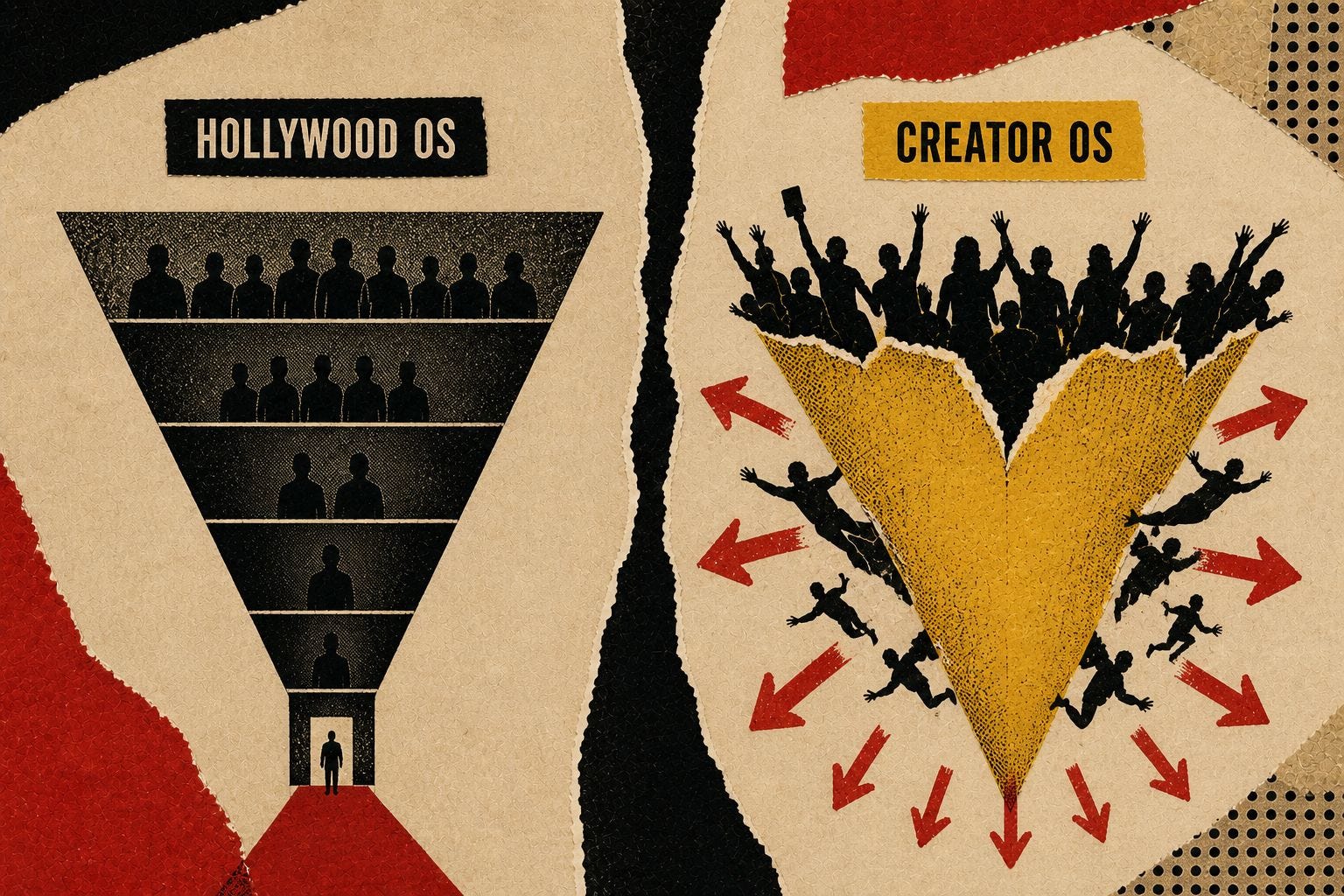
A major studio decided to share creative control of a tentpole project with a creator’ with a 31-million-person community. A production label is taking development capital from 2,000 fans instead of a studio. A showrunner just left a major streamer to own his own YouTube channel because ownership matters more than distribution size. Three different structures showing the same rupture: the trade that built Hollywood—capital in exchange for control—is collapsing. The question isn’t whether studios give up creative control. It’s when.
So here are three trends I’ve been noticing, emerging from our Garden Harvest posts since January that get me excited about the future in the Open Garden OS…
1. Hollywood Is Importing the Creator OS
Sony announced at CinemaCon in April that it’s developing a Bloodborne animated feature. The detail worth focusing on isn’t the IP. It’s who they brought in alongside it.
Jacksepticeye — the YouTube gaming creator with over 31 million subscribers — is joining the project as a producer. Not as an “executive producer” credit attached for marketing reach. As a creative stakeholder during development.
Producer credits get handed out generously, so the title alone doesn’t tell you much. What makes this one structurally different is who he is to the IP. Jacksepticeye has been a public Bloodborne advocate for years, and his community knows that. By bringing him into the creative process rather than into the marketing rollout, Sony is moving the audience’s representative into the room before the creative is locked. The 31 million people who follow him aren’t being courted at release. They’re effectively seated at the table during development.
That’s not Hollywood logic. That’s creator-economy logic — imported into a Hollywood structure.
And it’s not isolated. A whole layer of plays across the industry is moving in the same direction.
In February, Utopia, the independent distributor, launched the Utopia Screening Room as a $5/month Patreon membership. Each screening is positioned as “a digital stop on each film’s release tour” — the city-by-city indie release model converted from a touring schedule into a recurring community ritual. The audience isn’t buying tickets. They’re funding the tour.
In mid-March, Linden Lane Films — founded by Hollywood actor Stephen Kunken with the Stokes Twins and Ben Azelart on the talent roster — launched around a two-arm model. The Films arm handles traditional theatrical and streaming distribution. The Labs arm is the creator incubator that responds to trends in real time on the creators’ existing platforms. The Labs work isn’t promotional. It’s where audience signal feeds creative decisions for the bigger projects.
At SXSW in March, Brass Knuckle Films — Robert Rodriguez and Alexis Garcia’s fan-investor action label — unveiled its first five-project slate. Two of the five came directly from investor-pitched ideas. The label has now raised $2M from over 2,000 individual investors, and announced a “Best Logline Wins” contest where the community competes to have its own idea developed. The audience isn’t a marketing target. It’s the cap table and the writers’ room.
Each of these looks like a quirk on its own. Together they form a pattern.
The pattern is that Hollywood used to define itself by what it kept out. The audience was outside the wall. They showed up at the box office or they didn’t. The capital, the creative, the decisions — all inside. The audience’s job was to consume the result.
The creator economy was built on the opposite assumption. The audience is in the room from day one. They vote with watch time, comments, and memes. The creator iterates against that signal. The audience is not the customer at the end of the funnel. They’re a co-creator of what gets made.
The smartest Hollywood operators are importing that posture. Sony brings the community’s representative in as a producer. Utopia brings the audience in as distribution. Linden Lane brings them in as ongoing creative input through the Labs structure. Brass Knuckle brings them in as capital and as development.
The audience used to be outside the wall. The smart Hollywood plays are now tearing down sections of the wall on purpose.
This rewrites a piece of what the producer job actually is. The old job was to gatekeep on behalf of capital — decide what gets made, who makes it, who sees it, when. As Hollywood imports the creator-economy posture, the gatekeeping function shrinks. You don’t need a $30M P&A budget if the audience funded the production and the distribution is the audience. You don’t need a development executive to validate a script if 2,000 fan investors greenlit it. You don’t need a marketing team to manufacture awareness if the creator-producer’s community is already inside the project.
The studio role doesn’t disappear. It gets smaller and more specialized. Less middleman, more partner. Less gatekeeper, more amplifier. The producer who figures out how to operate inside a creator-economy structure — bringing craft and capital without insisting on the gatekeeping — is the one who keeps working.
2. The Pilot Is Dead. The Pre-Production Is the Product.
YouTube published a Culture and Trends report on independent animation earlier this year, and yes, you have to discount any platform’s report on itself. But there’s one number worth taking seriously: more than half of Gen Z animation fans now watch animatics weekly.
That’s a structural change disguised as a stat.
An animatic was always an internal step. A storyboard timed to scratch dialogue, used to vet a pitch before anyone spent real money. It existed inside the studio’s vetting layer — the place where ideas got killed cheaply so the expensive ideas could be greenlit with confidence. The animatic was development infrastructure. It wasn’t a product.
Now it is. Glitch Productions ships them publicly. The Amazing Digital Circus released animatic scenes with green-screen backgrounds specifically so fans would meme them. Vivienne Medrano’s Hazbin Hotel pilot — released as a YouTube video — became the proof of demand that landed the Prime Video series.
What the animation pipeline did first, the rest of the industry is doing now.
Adam Neuhaus, the documentary producer, spent a few weeks getting yelled at on Twitter for telling filmmakers they should build sixty pieces of content around their movies before release. His clarification was sharper than the original take. He wasn’t talking about marketing. He was talking about the production process itself becoming the audience-development engine. Production diaries. Crew portraits. The work of making the work.
Jonah Feingold’s new company Romantical raised $3M on a thesis that branded short-form content for Hinge, Tinder, and BetterHelp isn’t a marketing buy. It’s the proof of concept, the audience build, and the creative R&D for his rom-com features happening simultaneously. The shorts and the films feed each other.
Brian Robbins — who just left the Paramount co-CEO job — raised $100M to develop IP first on YouTube and TikTok and let the data tell him which projects deserve theatrical money.
These look like different stories because they come from different corners of the industry. They’re the same story.
The development funnel has inverted. The old model was: pitch a script, greenlight a pilot, hope it works, scale into series. The cost of failure lived inside the studio — a failed pilot was a $5M loss, a failed greenlight was a bigger one. The infrastructure of development was built around ranking pitches before money got spent.
The new model is: build community in public, prove demand iteratively, scale into long-form once the audience exists. The cost of failure has moved earlier and lower — out of the studio’s balance sheet and into the creator’s daily content. By the time the long-form swing happens, the audience is already there.
Structurally, that means a layer of the studio’s value proposition is being unbundled. The development executive — the person whose job was to read pitches and bet on which ones deserved a pilot — is being replaced by a community whose collective viewing is the bet.
This is the production-side mirror of the rented-vs-owned shift. Studios used to rent out the development pipeline to writers and producers. Now creators are building owned development pipelines that sell long-form swings to studios on better terms. The studio’s role moves from validator to amplifier. From “do you have the script” to “do you have the community.”
For producers, this reorganizes the job. The next generation of showrunners isn’t pitching scripts. They’re shipping animatics and production diaries. Whoever brings craft to that pipeline wins. Whoever insists on the old greenlight model finds themselves rewriting decks for a buyer that no longer needs to read them.
3. Legacy Talent Is Adopting the Creator Job
Phil Rosenthal — the creator of Everybody Loves Raymond, in his mid-sixties — just signed a Banijay Americas deal that moves new episodes of Somebody Feed Phil to a dedicated YouTube channel starting in 2027. The eight-season back catalog stays on Netflix. Going forward, YouTube is the primary home, alongside a slate of short-form material built around the show.
The reasons Rosenthal gave matter. He said he always loved that Everybody Loves Raymond was free to watch everywhere, and that the YouTube move is a return to that ethos. Reach, directness, ownership. Global audience without a gatekeeper. More direct engagement with the people who actually watch. Greater control over what gets made.
That’s not a streamer pitch. That’s a creator job description.
This is what’s quietly happening across the talent layer of Hollywood. The job description for “talent” is being rewritten to include the things creators have been doing for a decade.
Mark Wahlberg’s production company Unrealistic Ideas — behind HBO’s Wahl Street and McMillion$ — just launched 4AM Club Challenge, a ten-part YouTube series putting creators through his brutal early-morning workout. The first season includes Druski, Dhar Mann, the Stokes Twins, Airrack, and Ben Azelart. That’s a deliberate map of the creator landscape, not random booking. He’s using his own production infrastructure to build a YouTube presence with the audiences he doesn’t yet have.
Jake Johnson, on his independent podcast We’re Here to Help getting picked up by Hulu: “Licensing to a streamer was never even a thought.” He almost sounds like a creator describing the moment a platform came calling.
And Jim Louderback wrote recently about athletes — Faatimah Amen-Ra, Hayden Tyler Ancheta, Diana Flores — building “portable communities” that follow them across teams, leagues, and sports. The career insurance for a modern athlete isn’t being good at the sport. It’s owning an audience that travels.
The parallel makes itself. If athletes can carry their audience from team to team, actors and showrunners can carry theirs from project to project. In a world where buyers obsess over built-in IP and de-risked bets, a portable audience is leverage at the table.
This is the talent-layer version of Trends 1 and 2. Studios are bringing the audience inside the production. Development is being rebuilt around audience signal. And now talent itself is treating audience-building as part of the job — a prerequisite for the better deals, not a side activity.
For producers, this changes who you cast, who you sign, who you go into business with. An actor who can deliver 5 million people on opening weekend through their own channels is structurally different from one who needs a $30M P&A campaign to do the same job. The economics flow toward the first one.
The harder version of this question is what happens to the talent that doesn’t make the transition. The actors, writers, and showrunners whose visibility was always mediated by the studio’s marketing apparatus, and who don’t have a public-facing presence beyond press junkets. Phil Rosenthal at 65 figured out the answer is to behave like a creator. Plenty of his peers won’t.
Where the three meet
Read the three together and one through-line shows up.
Hollywood is bringing the audience inside the production. The development pipeline is being rebuilt around community signal. Legacy talent is taking on the creator job to keep working.
Every one of these shifts costs Hollywood the same thing: creative control.
For a century, the studio system has run on a single trade — capital for control. We provide the money, we keep the notes, the greenlight, the final cut, the marketing approvals. That trade is what built the system. It’s also what every legacy operator has refused to let go of.
The trade isn’t holding anymore.
Markiplier released Iron Lung in theaters with no studio and no distributor. Lighthouse Studios is putting real capital behind Cole Bennett’s Lyrical Lemonade with the kind of creative freedom Hollywood would have demanded oversight on. Whalar can finance projects against creator audiences. Brass Knuckle can raise $2M from fans.
That puts a real question in front of every studio executive: when does Hollywood have to give up creative control to survive?
The talent, the IP, and the audiences are migrating toward the people who’ll fund them without insisting on control. So what does Hollywood actually have to offer that creators can’t get elsewhere? Capital and institutional know how for sure (having the knowledge doesn’t mean you have to have the control).
But the producers and executives who thrive in this environment are going to be the ones who make peace with the trade earliest. Less control. More partnership. Fund the work, support it, get out of the way. The job becomes amplification, not validation. The notes become a conversation, not a command. The creative control that legacy Hollywood has guarded for a century gets handed to the filmmakers and storytellers who actually know what they’re making.
That’s a hard transition. It cuts against muscle memory built over generations. It’s also the only one that keeps a seat at the table.
Markiplier going directly to theaters with Iron Lung is a small move. The leading indicator is how soon studios realize the trade has flipped — and that the creative control they’ve held for a century is now the price of staying in the room.


