


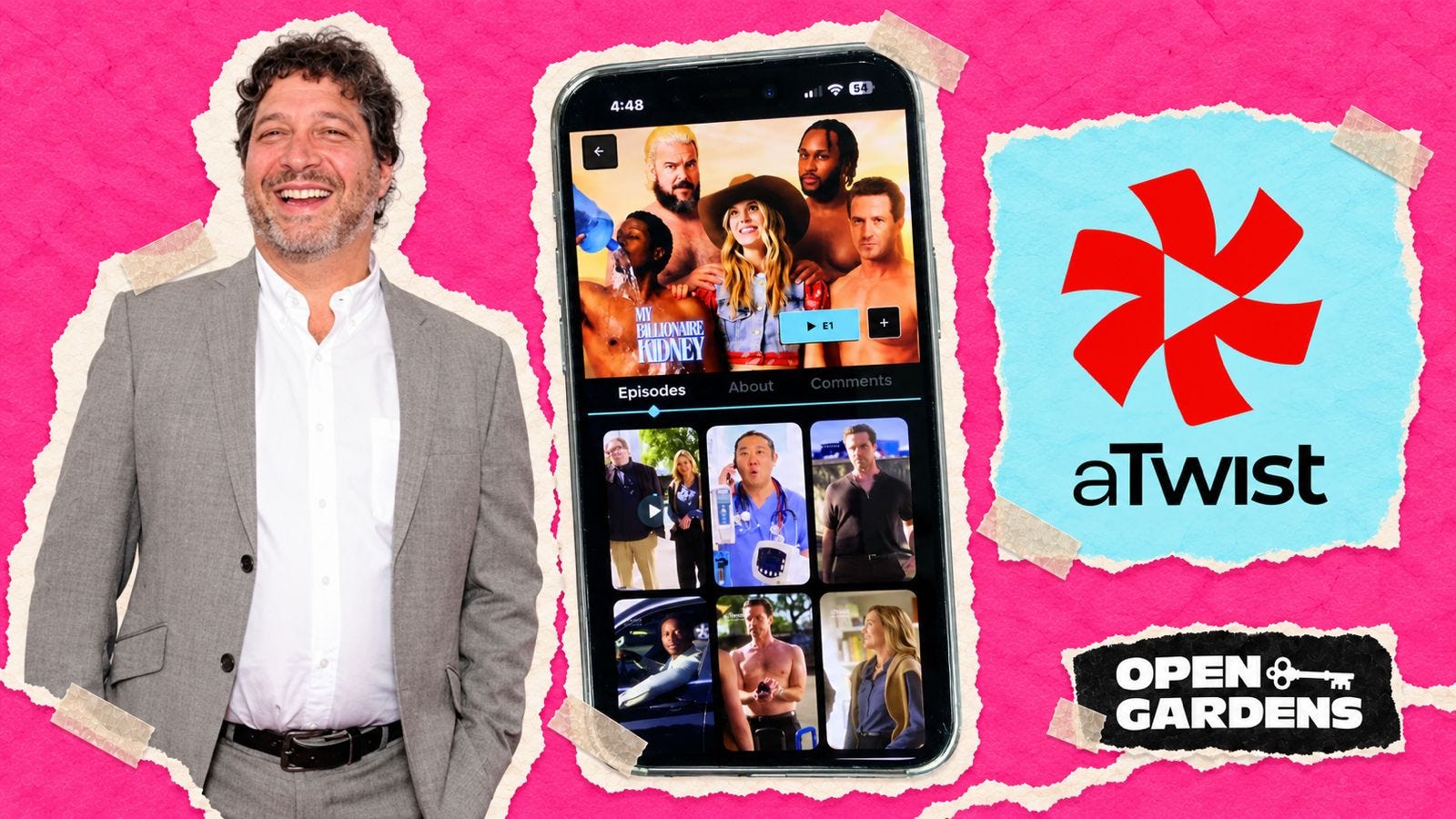
As I was exploring microdramas for my own company, I tried to meet with every platform in town. That eventually led me to MicroCo—now aTwist.
They told me what they were looking for, and I pitched a few ideas that seemed to intrigue them. They also wanted to explore comedy, which almost no one in microdramas was doing at the time. So I suggested they meet with Jon Stern, an old friend and former producing partner of mine. Jon is a prolific writer-producer of low-budget comedy series including Wet Hot American Summer and Childrens’ Hospital, plus much more. He has exactly the right mix of curiosity and chutzpah. It turned out Susan Rovner (one of its founders) and Jon went way back.
They passed on my ideas, hired Jon, and I didn’t even get 10 percent. Karma points, maybe.
So I guilted him into writing about the experience. Then, just to torture him, I made him rewrite it three times.
Today, a seasoned (i.e., old) comedy writer-producer on what he learned making—wait for it—My Billionaire Kidney.
And yeah, it’s pretty damn funny. Watch it at aTwist. At least the first seven episodes that are free...
The Executive Rejected My Pitch—Then Asked for a Kidney
Does a vertical have to be a melodrama? What about a comedy? Combine comedy with short-form and ultra-low-budget and I’m right at home. Also, I’m unqualified for every genre except comedy (and even that is highly debatable).
After a decade producing low-budget indie films, I discovered the world of “web series” (that’s what we used to call YouTube videos when “streamer” was only a term used in pornography). I noticed that exponentially more people were viewing these shorts than any indie film I’d ever made.
So twenty years later, I’m still doing it. In the form of a vertical for a new American-based vertical company called aTwist, started by TV execs Susan Rovner, Jana Winograde and Lloyd Braun. They raised some real money to launch a platform and commission original series.
Susan asked me to make a comedy. I pitched her a handful of ideas from my drawer of aborted movie script concepts. She didn’t outright verbalize “meh,” but I got the message. Then she added, “Why don’t you just do a parody of a microdrama,” which was the right path.
But how do you parody something that – let’s be honest – so often feels like a parody already, even if unintentionally? I wasn’t sure I could crack it.
First step: ingest a bunch of existing microdramas, many of them from other countries. I jotted down bits as I watched. I needed a premise, no matter how thin, to build a structure around. How about kidney donations?
Nothing gets a laugh like someone needing an organ transplant.
My Billionaire Kidney.
I wrote a season outline and the first ten pages.
Susan convincingly acted as if she liked it. aTwist gave me a standard vertical series budget and instructions to make at least 35 episodes totaling 60 minutes.
I hired myself to be the writer, director and producer through my production company, Abominable Pictures. Doing all these jobs at once was necessary to make the most of our resources. (In other words, there wasn’t enough money to hire someone better.)
This had a remarkable parallel to my first endeavor with Susan. Eighteen years and three corporate owners ago, Susan was an exec at Warner Bros. Television. Rob Cordry, David Wain and I talked WBTV out of a little cash to make Childrens’ Hospital, a web series for a short-lived Warner Brothers digital platform. Its low-stakes under-the-radar-ness allowed us to drop our inner censor and just try something different. That led to a slate of low-budget parodies as well as other alt comedies.
Which brings us back to My Billionaire Kidney. As you’re no doubt aware, microdramas are required to end each episode with a cliffhanger…
And what I’m about to tell you will BLOW YOUR MIND!
[Buy 1,000 coins for $9.99 to continue reading]
Four Unions, Four Days, and Very Few Shirts
My gameplan was to combine my specific mainstream producing M.O. with the scale of a vertical. Starting with the unions…
Since I’m DGA and WGA we had to go that way. It was an IATSE crew because I appreciate the benefits of working with these great people from so many other Abominable Pictures productions, large and small. Kidney was quantifiably more efficient, more collaborative, and more fun because of this team. Also, I believe everyone should get health insurance.
The other union was SAG-AFTRA. Shooting in Los Angeles comes with an enormous advantage: the best pool of comedic talent in the world lives here. If you want access to that pool, you need to be a SAG-AFTRA production. And if you want to be truly accessible to these actors, it’s vital to shoot locally.
All the unions have structures for low-budget new media that applied to Kidney. Some have too much paperwork, if you ask me, but it enabled me to work with a bunch of people I already know and love as well as some that I had always wanted to work with.
I figured a four-day shoot – 15 pages per day – would be the right speed to fit the budget and to make the commitment more doable for the actors.
To fit that schedule, I wrote to three locations (including my house and my son’s school, to save money), with each location playing for three or more sets. Day exteriors are the fastest to shoot and light. Day interiors are in second position. Night scenes were not even on the table.
I experimented with iPad teleprompters to help speed things up and take the memorization pressure off the actors. It turns out that verticals and teleprompters are as good together as Laverne & Shirley. Or if you’re under 50, I guess Rhett & Link.
Because these things are so cutty, an actor rarely had to deliver more than one or two lines in a row. Plus, given the vertical format, the prompters could be very close to the actors and still out of frame.
It wouldn’t matter how smoothly the production ran if the show wasn’t funny, though. There are a bunch of common microdrama tropes that made me laugh:
Throwing a drink at someone
Cutting to a fancy watch to illustrate how wealthy someone is (in Kidney, the more wealth, the more watches)
Knocking something out of someone’s hand (do people ever do this in real life?)
Having a man take his shirt off to impress a woman
Proposing marriage fast and loose
Introducing pretty much every character by starting at their shoes and tilting up (I guess you can tell a lot about someone by their shoes?)
Cringey sex scenes
Characters having only two modes of transportation: private jet or the back seat of a limo
Characters introducing themselves by running through their bio as if they’re in a job interview in an elevator
Every male romantic interest having a scary, dark side
People dropping and shattering their drinks whenever something dramatic happens (I learned that characters breaking things on purpose is a satisfying way to wrap a show.)
There’s another common trope I played with. Prepare yourself. What I’m about to tell you… COULD CHANGE YOUR LIFE!
[You’ve earned 450 coins for binging two chapters in a row! Buy 2,000 more coins for $12.99 to continue reading]
I Heard His Inner Thoughts—and They Were All in Extreme Close-Up
A unique device in microdramas is hearing the inner thoughts of every character via voiceover.
A lot of narratives shortcuts happen there.
Kidney would need to do this too, but only for jokes. Before we started filming, I wasn’t sure if it would play better for the actor to look neutral while VOing or whether their expressions should reflect what they were thinking. I was planning to shoot it both ways. After the first scene, it became clear they should act out every thought.
Through trial and error, we picked up formal guidelines too. At lunch on the first day, our DP Frank Barrera and AD Julian Petrillo and I put our heads together. We all come from traditional TV (often working together), so these observations might seem obvious to an experienced vertical director (i.e. – not me):
Master shots are almost always useless.
Action works better moving from foreground to background and vice-versa, rather than left-to-right, since there is hardly any left or right in the frame to work with.
Characters enter a scene, plant themselves in a group, and deliver their dialogue completely before moving. Basically, no walk-and-talks.
Just shoot medium-wide shots and blow up to MS, CU or ECU in post. Once I started taking advantage of that in the edit, I recognized that traditional TV was missing out. Thanks to the visual language of the genre, there’s no limits on the exploitation of push-ins, snap-zooms, jump cuts, irises and stings.
Even two-shots can be punched in to be two singles. But two-shots don’t work so well anyway, except as 50-50s.
Camera moves can be difficult to watch on an iPhone screen. Fast camera moves even more so.
One stop-and-go take with pickups became the default for each setup.
Tone. Every project has its own tone, no matter what genre. A movie or TV show will have table reads and rehearsals. Sometimes it takes a TV series an entire season to land on it. You need alt readings in the edit. We didn’t have time to do that on Kidney. If you ask me the biggest challenge, it was expediting the tone-journey.
Here comes the EXCITING CONCLUSIONS!
[Your coin balance is 220. Buy 3,000 coins for $29.99 or watch 15 minutes of ads to continue]
The Blog Post Finale
Going into this, my “dramatic question” was: Can the short-form serialized format work creatively for comedy AND find an audience. Can the jokes work for an audience unfamiliar with microdramas as well as the microdramas faithful? Will people enjoy poking fun at the very format they also take seriously?
It’s too soon to tell about the audience.
If you ask me, however, I’m now convinced that this format is tailor-made for comedy. Episodes’ shortness aren’t dissimilar than the length of a standard TV scene, or a Funny or Die short, or a sketch comedy piece.
We all are already using our iPhones for quick hits while we’re waiting in line (or, in the case of my kids, riding in the car, eating dinner, or having any conversation with me). That seems to me to be the perfect viewer to enjoy quick, funny bits.
How to monetize is an open question. The microdramas model relies on serialization. Though Kidney pretends to have a driving narrative, it’s really just the pretense of one. I tried to pull the viewer along by regularly introducing new characters and different sets, but are people going to spend money to see what happens next? Maybe the comedy verticals will adapt to be more ad-driven or subscriber-based.
As for my creative experience, the limits were assets, as is so often the case. It forced me to focus on the jokes and the viewer experience. To be efficient with the words, images and editing. To try things I wouldn’t otherwise have the opportunity for.
There always needs to be an under-the-radar way to experiment and develop ideas. If we do this enough, new voices and material are guaranteed to break out.
[Congratulations! You finished this blog and earned a 120 coin bonus! Purchase more coins to continue]