


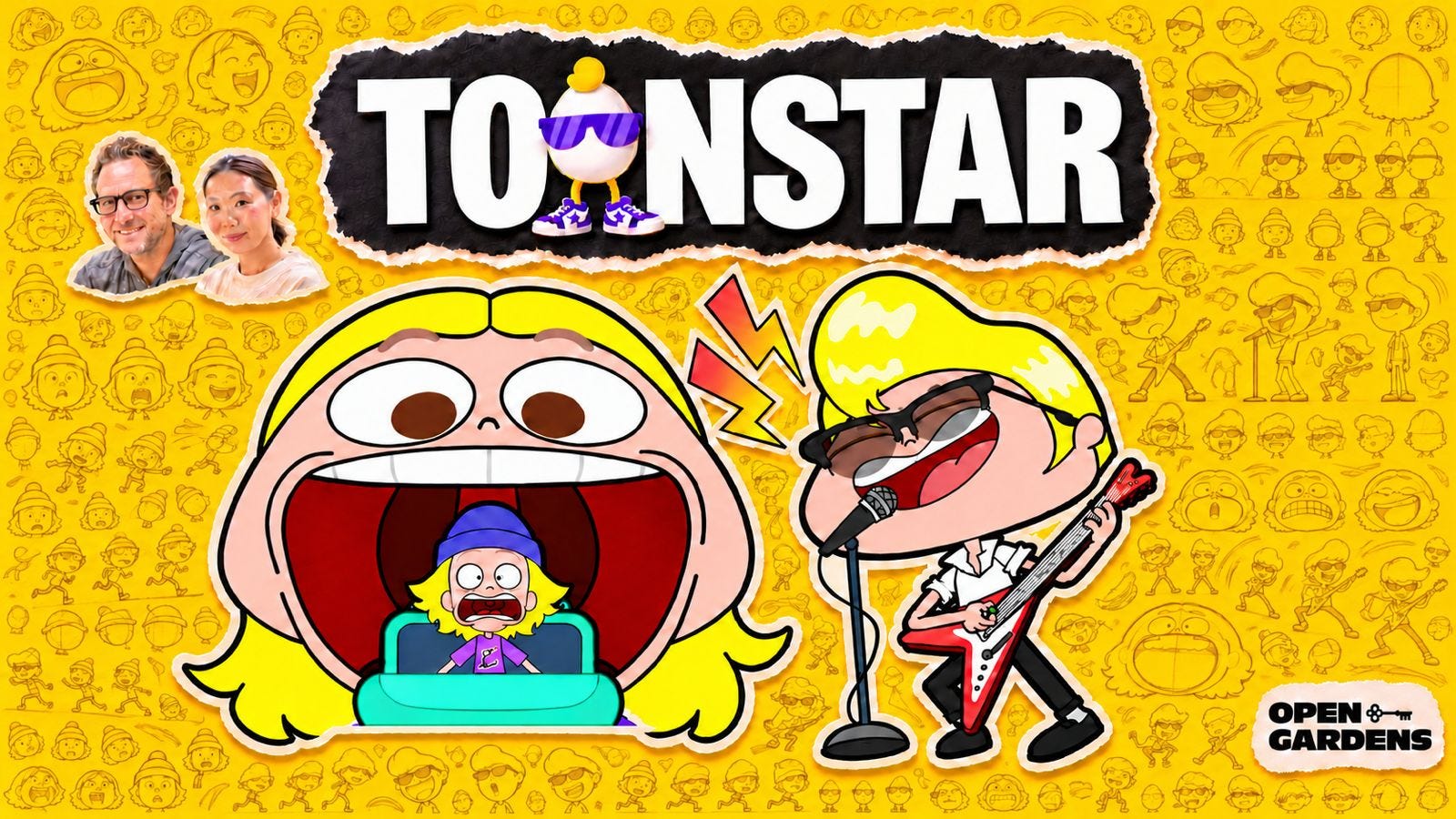
I’m not a TV animation producer. I’ve produced a few animated series, but I don’t think that gets me in the club.
Still, my conversations with Toonstar founders John Attanasio and Luisa Huang gave me a lot to think about for my own company. They’re working on a question I keep coming back to: how do you build a studio now? How do you keep making good work, across multiple projects, at a cost the business can support in this moment of convergence and disruption?
Animation makes that problem especially clear. The audience is there, but production takes time, specialized talent and a lot of labor. A show can become too expensive to make before viewers ever get a chance to decide whether they want it.
AI offers ways to bring those costs down but it can’t replace human creativity. Yeah, I believe that, and I’m not going to caveat it with “for now”… for now.
But somebody still has to invent a character worth watching, find the story and know how long to hold a reaction before the joke dies. Making images cheaper doesn’t answer any of those questions.
What interested me about Toonstar was how it had put the business together.
The company works with creators who bring a distinct voice and a relationship with an audience. It helps them develop animated shows for platforms where those audiences already spend time, using a production system built around what the shows can earn.
The audience and the production costs have to make sense together. Having millions of followers doesn’t automatically make an animated series a good business.
Toonstar is trying to make those things line up. I learned a lot talking to them.
Two studio executives and a stubborn thesis
Attanasio and Huang came from the business side of Hollywood. He worked at DreamWorks Animation during the Shrek years, then at Warner Bros. on franchises including Harry Potter, DC, LEGO and Looney Tunes. She worked in digital strategy and operations at Disney and Warner Bros.
They knew how studios worked. They also saw creators building audiences without them.
Toonstar launched in 2015. So did a lot of social-focused media companies, many of them started by Hollywood executives. Most didn’t last. Some had built the wrong model, like many of the MCNs. Others walked away when the streaming wars took off. Covid kept everyone at home, streamers were buying everything, and the old model looked like the better bet. Executives went back to Hollywood. Companies like Broadway Video shut down their digital businesses.
Toonstar survived that first wave and kept building as the great convergence began in earnest after Covid. That is part of what makes the company interesting.
Getting there took a few attempts.
“An ocean of UGC does not make franchise IP,” Attanasio said. They learned that long before a lot of us did.
The app made it easy to produce cartoons. It didn’t give them a reliable way to build shows people would keep watching.
Next came The Gimmicks, a wrestling comedy co-produced with Mila Kunis. Fans used blockchain tokens to vote on the plot, helping decide what the writers would do next.
The breakout was Steven & Parker, built with Parker James, a creator outside Dallas whose comedy featured an unruly character and a voice changer. The franchise now has nearly 20 million followers across platforms and more than 10 billion views.
A Random House graphic novel series followed. Their slate now includes an Uncle Roger adaptation with Nigel Ng, The Friendship List with HarperCollins, and a kids slate with Gotham Group. FOX sells advertising against their shows.
The audience came first. They built the business around it.
Who are you competing against?
Like everything built in the open operating system of the creator economy, animation has room for many different kinds of businesses.
A creator making a show, a company buying old characters, a startup building production tools and a studio financing new series can all be pursuing the same audience from different directions.
So who does Huang consider competition? She pointed first to independent creators putting original animation on YouTube.
Glitch Productions, the Australian studio behind The Amazing Digital Circus, is the big example: more than 1.3 billion YouTube views, with its finale released in theaters doing $36 million globally according to semi-reliable Box Office Mojo.
Then there are the companies raising money to tackle the economics with AI. Paris-based Animaj buys established children’s brands, including Pocoyo and Maya the Bee, and rebuilds them for YouTube. It raised $85 million in 2025 and added Google as an investor this year. The brothers behind JibJab and StoryBots have started an AI studio, also with Google backing.
Chronicle Studios, co-founded by former DreamWorks Animation president Chris deFaria, uses AI to grow audiences for animated YouTube series. Studio Jadu launched in September to back creator-owned shows.
The giants are circling too.
Amazon set up a fund this year for creators with digital audiences and ordered three animated series from it for Prime Video. Jeffrey Katzenberg told TheWrap in September that he is “fired up” to build either a studio or a platform for AI-made animated films and television.
He also offered a reminder: “Pixar could never have been created inside Disney animation.” True. Legacy can’t innovate easily. This moment makes that point clearer than ever.
Nobody seems to doubt there is an opportunity. They have different ideas about how to make it work. Toonstar has spent years testing its version, and five things stood out to me.
1. Start with what the audience can support
An app. Blockchain. AI. Toonstar’s history could read like a tour of the last decade’s investor enthusiasms.
But the founders kept coming back to the same problem: how do you make original animation for audiences outside the traditional studio system?
“What has changed is we’ve experimented with different ways to do that,” Attanasio said.
YouTube gives you distribution and access to an enormous audience. It doesn’t give you a television budget. Bring a traditional production model with you and there will be a fairly obvious hole in the spreadsheet.
Toonstar knew what a show could earn and worked toward a way to make it for less. According to the founders, StEvEn & Parker became cash-flow positive on YouTube advertising alone in roughly six to eight months.
This sounds painfully obvious. Anyone who has spent years developing a project and then tried to find someone willing to pay for it knows how often we do the reverse.
We need to be thinking about who will watch, where we’ll reach them and what that can earn while we’re developing the show. Those decisions affect what we can afford to make.
Huang describes a StEvEn & Parker crew of roughly five to eight people, compared with 30 to 50 on a traditional television animation production. She says the savings are substantial.
The smaller crew raises a real question about employment. I don’t think we should brush that aside. But a 40-person version of this particular show might never get made on YouTube revenue.
Lower costs can let us put something into production that we couldn’t otherwise finance. Then we have to make it good enough to keep those people working.
2. Bring creators something they need
Parker James had a voice, a character and an audience. He also wanted an animated series and was, in Attanasio’s words, “way out of the Hollywood jet stream.”
Toonstar could help him make something he couldn’t easily produce alone.
James understood what made his fans laugh. Toonstar had artists, development experience and a way to produce animation consistently at a manageable cost.
That is an adjustment for those of us who grew up in a business that sold access. Creators already have access to their fans. They can publish today. We need a good answer when they ask what we bring.
Can we help them tell a longer story? Produce consistently without burning out? Make their work connect in another language or culture?
We also have to choose the right partners. A huge following doesn’t guarantee that fans will follow a creator into a different format.
“The tech unlocks a lot, but if you’re not working with great creators and storytellers, the tech isn’t going to mean anything,” Attanasio said.
Obvious, perhaps. But it’s easy to get distracted by a follower count. You have to understand why those people are there and what else they might want from that creator. I wrote about this in an earlier piece on measuring communities.
The same offer can work for a company that owns stories. HarperCollins has books, characters and readers. Toonstar offers a way to adapt those stories for digital audiences, with creators involved in bringing them to life.
The Friendship List partnership is a co-production. HarperCollins’ graphic novel imprint will also publish a book based on the animated series. Each company has a way to help the story reach people the other might struggle to find on its own.
3. Let the audience help you get better
On The Gimmicks, every episode ended on a cliffhanger. Fans voted on what should happen next. The writers then had about 36 hours to turn the result into a script for the next release.
They kept it up for 26 episodes.
No one other than the South Park guys have been able to move that fast.
But it tested something useful: what happens when the audience can affect a show while you are still making it?
Toonstar’s proprietary audience feedback system, SPOT, brings audience response from platforms into the creative process. Because the team can produce roughly an episode a week, the feedback can arrive in time to matter. A conversation, a cultural moment or something fans notice about a character can find its way into the show while people still care about it.
That gives them a chance to work at the speed of culture. In movies and television, we’re often hoping the thing that interested us three years ago will still interest everyone else when we finally release it.
As creators, that is a choice we have to make about what we’re making and who it’s for. A show that can join the conversation while they’re having it offers a different relationship from one that arrives years later. Our production schedules help determine which kind of connection we can offer.
Toonstar can respond quickly enough for viewers to see that they’ve been heard. The lower cost gives the team room to try things. Someone still has to decide which suggestions are worth pursuing. A popular comment isn’t a script.
Huang described the habit people like me have to unlearn: “the perfecting of the content within the walls before it ever leaves the walls.”
We are accustomed to protecting unfinished work. StEvEn & Parker shares storyboards, voice-booth outtakes and bloopers. Sometimes a blooper becomes an episode.
Younger audiences, Huang says, are “looking for the journey and the imperfection.”
They get to watch the show being made, recognize their contribution and come back to see what happens next.
4. Know which creative decisions need a person
“The tech does not enter the picture until the human point of view gets set,” Huang said.
This part of the conversation has stayed with me as we work out how to use AI at 3Pas. At Toonstar, characters begin with artists and a blank page. The team decides what it wants to make before bringing the technology into it.
Toonstar’s in-house production system, Ink & Pixel, uses machine learning and generative AI to speed up animation. But they still make animatics—the rough, timed version of an episode—because that is where editors figure out whether the action and the jokes work.
Anyone who makes comedy understands this. A pause can make a line funny. Another half-second can kill it. AI can’t figure that out. Half of comedy’s power is the surprise. The surprise comes from innovation. AI looks backward, and you don’t find the unexpected by repeating what’s already been done. Take that philosophy to every creative decision. All human.
Localization works much the same way. AI helps translate and deliver dialogue in the original performer’s voice. Native speakers review it and rewrite jokes that don’t travel. If the Spanish version needs two more seconds for a joke, they can extend the scene.
5. Take responsibility for your own production technology
Toonstar has been developing its production system since the company began. Huang compared it to “that house that you keep adding onto.”
They can decide what to add because the system is theirs. It “was built with the creator economy in mind,” Attanasio said.
This is the lesson I am acting on. At 3Pas, we are making a live-action series and building our own AI system alongside it to bring down costs and improve the visual effects. There is nothing especially mind-blowing about what we’re doing. We’re looking for practical ways to shorten parts of the schedule, using rough digital environments to work out decisions earlier and reduce expensive work later.
The bigger realization for me was that we couldn’t keep waiting for someone else’s technology. Some tools are being developed inside studios, and we can’t assume we’ll have access. With outside vendors, we have to ask how much of the savings survives their fees.
We also need to understand where the underlying material comes from and whether we can use it in a commercial production.
And finally, we can solve the problems the way we want to solve the problems.
Building our own system doesn’t mean inventing every tool from scratch. It means taking responsibility for which tools we use, how they work together and what goes into them. We still have to investigate their rights and limitations. But we can do that as we build, with our actual production in mind.
We’ll find out what works by using it on the show. Whatever helps us should make the next production easier too. I suspect that is how you end up with Huang’s house.
Attanasio sees another reason to participate. If creative people stay away, other people will decide how the technology gets used.
“We want a seat at the table.”
Don’t we all.
Even with the tools doing the heavy lifting, they still cut a timed rough version because that's where you find out whether the joke lands. Micro-drama is the same: the cut is where an episode lives or dies, and it's usually the first thing people try to squeeze. The weekly feedback loop interests me too. Real viewer response on each episode is worth more than a big follower number, because you can see where people drop and fix the next one. A popular comment isn't a script, but a drop-off curve is a pretty good note.