


This week, El Juicio, a show my company 3Pas Studios produced in Mexico, in Spanish, reached #4 in the world on Amazon. We were doing a little victory lap.
Then I attended an event full of some of the most powerful agents, managers and executives in Hollywood. They all seemed to know each other. I knew only a few of them.
I’ve spent much of my career making content for US Hispanic and Latin American audiences. My accomplishments tend to live outside their rubrics of measurement. The reaction was what it has so often been: indifference. At times, rudeness.
I introduced myself to one agent who asked about my credentials. After I answered, he nodded and literally walked away.
Going from celebrating a show reaching audiences around the world to a room where that work barely registered was familiar. It brought me back to one of our first meetings when Eugenio Derbez and I were launching 3Pas Studios.
Eugenio had just made Instructions Not Included, a $5.5 million movie that earned over $100 million at the worldwide box office. He had been a major star in Mexico and among US Latino audiences for years. But at 50, after 25 years of work, he had finally become an overnight success in the eyes of Hollywood.
We were looking for a first-look deal to pay our overhead and get us started. The president of one of the major studios greeted us at his door. As we sat down, he pointed to Eugenio and said, “You, I want to meet.” Then he looked at me and said, “You, I don’t give a shit about. Sit over there.” He pointed me to a chair off to one side and literally didn’t acknowledge me the rest of the meeting.
In his defense, not that I feel the need to defend him, I had spent ten years as a screenwriter in Colombia, another ten producing small films independently, mostly in Spanish, and five years running production for Lionsgate’s Latino label, Pantelion Films. My credentials meant nothing to someone producing billion-dollar franchises.
The caste system was clear. His rudeness was acceptable, even expected.
When I was in college, social life at this small liberal arts school was built entirely around the Greek system. I pledged a fraternity, the Animal House of its time. They were literally disbanded a few years after I graduated. Pledging was brutal and humiliating. The worst part was taking orders from the fraternity brothers you least respected. They were always the most abusive.
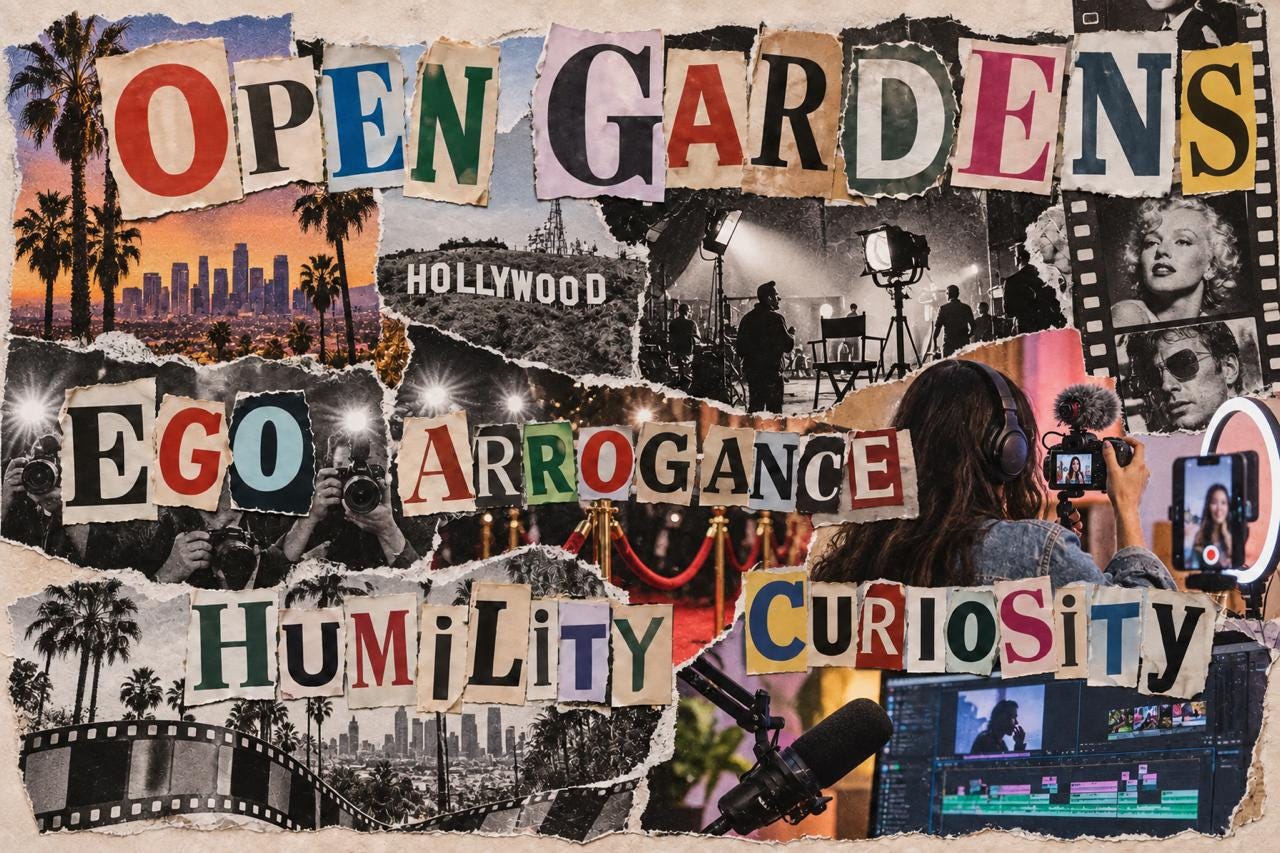
In those situations, I imagined a little man sitting on my shoulder who was actually the target of the abuse. Made it easier. And he never left my shoulder as I moved to Los Angeles. Arrogance and ego has been a baseline to our industry. It was an unspoken law that you watched the movie Swimming for Sharks to prepare for it.
Im not sure it ever really served our industry but it certainly doesn’t now.
When I get passionate about something, I tend to lose objectivity. I can only see the positives. My wife reminds me of this all the time. And I have to be cautious about my love affair with the creator economy because I’m definitely in the honeymoon phase.
But as I’ve become closer to its architects and creators themselves, one thing I’ve noticed among many of the most successful is humility.
Last year I went to a Press Publish event in New York City. I dreaded it. Here I am, the middle-aged legacy producer, walking into this world of creators and the infrastructure that supports them. My guard was up because I expected the very kind of caste system I had fought so hard to climb, but now starting as a newbie.
I had my creator businesses going and ideas about opportunities I wanted to pursue. But I didn’t have the experience or recognition in this world that would give me a leg up.
Instead, I found a world that was highly accessible. The speakers from one event would be sitting in the next. Everyone was open to chat. I quickly made inroads to financiers, managers and heads of platforms. Follow-up emails were answered. Meetings were set. Business came out of those encounters. If you brought value or ideas to the table, they were worth exploring.
There are enormous egos in the creator economy too. I’ve met a few. And I’m aware that being welcomed into a room can color your judgment of everyone in it. But I’ve been thinking about whether there’s a business reason for the openness. So much is being figured out that people seem more willing to hear what someone else is working on.
I’ve had to make that adjustment myself. I’ve spent decades learning how to develop, produce and sell stories. I know what that experience is worth. But a creator who already writes, shoots, edits, distributes and markets their work may have very little use for the thing I walked in expecting to offer.
Calling them “talent” barely describes what they do. They’ve built businesses and relationships with audiences that I need to understand before I can be useful. I might see a way to help shape a story or develop something longer. They might have an entirely different ambition.
That takes some getting used to when you’ve spent years being paid for your judgment. You’re accustomed to having an answer. I’m finding myself asking more questions.
The willingness to reconsider seems especially useful in a business where you can put something out, see what happens and build from there. A short can become a series. Something that doesn’t connect can remain a one-off. You haven’t necessarily spent years getting it approved before finding out whether anyone wants it.
But you still have to accept what you’re seeing. I know how easy it is to decide that the audience didn’t understand something. Sometimes that may even be true. Creative work requires conviction, and I wouldn’t want to make everything by polling the audience. I do think there’s a problem when your first instinct is always to explain why your judgment was right.
We also bring very specific ideas about quality from Hollywood. I’ve spent my career developing those judgments. They matter to me. But they don’t explain every kind of work that people care about, and they can make it easy to dismiss something before you’ve bothered to understand its appeal.
Eugenio’s audience existed long before Hollywood took an interest. He had spent years building that relationship. The box office finally made it legible to people who hadn’t been paying attention. Yet in those meetings, we were still somehow waiting for their approval.
I keep thinking about how much you can miss that way.
And now, as AI and technology transform everything again, I’m finding that people in legacy media and the creator economy are questioning the future in similar ways. That’s been the most interesting part of these conversations for me.
I came into the creator economy expecting to learn how this newer business worked. I’m doing that. But the people I’m learning from are also trying to figure out what happens to their own businesses next. Having built something successful on YouTube doesn’t mean you know what AI will do to it. Having produced successful films and television doesn’t answer that question either.
We’re coming at it with different experience, but we’re asking many of the same things. What will people want to watch? What will they pay for? How much of what we know how to do will still be valuable, and where do we need to start learning again?
I don’t think anyone has particularly satisfying answers yet. That gives us a reason to talk to each other. It also makes the insistence on establishing who matters more in the room seem like a strange use of everyone’s time.
I spend at least one day a week at the Lighthouse in Venice, surrounded by people in the creator economy. I want the energy, curiosity and openness I find there. I meet someone every week I end up exploring business opportunities with. And they’re curious about what we bring from legacy media too.
It’s hard to single out one conversation because it’s the repetition that has made an impression. I keep going back, and I keep finding people willing to spend time on an idea before they know whether anything will come of it. Some of those conversations turn into business. Others help me understand something I hadn’t understood before.
That’s what I mean by humility here. You can have built a substantial business and still be interested in how someone else does it. You can know your work has value without assuming that makes you the authority on theirs.
None of this is an abandonment of legacy. I’m still passionate about film and TV. I’m just less tolerant of the bullshit.
We had a good week with El Juicio. I want to keep making work like that, and I want to understand where else our experience could take us. Increasingly, that means spending time with people whose accomplishments I might not immediately recognize either.
I’d rather ask what they’re working on and stay for the answer.
Hmm, we are fraternity brother and I know it wasn’t me, as u r my main man Benny.