


As a legacy producer of film and television, I sometimes find the constant drumbeat that content must become more interactive or participatory to reach younger audiences a little daunting.
We were trained to believe that if you created a water-cooler moment—if everyone showed up Monday morning to the office talking about your movie or show—you had achieved all the participation you needed.
But alas: evolve or die.
A few weeks ago, a colleague called to ask whether I would explore a new movie technology that is interactive in the most literal sense. A theatrical movie driven by audience voting. I was hesitant. He persisted.
“This one is different,” he told me. “The tech is amazing.”
Then he mentioned the proof: an animated movie in Japan that had broken box office records on a remarkably small number of screens.
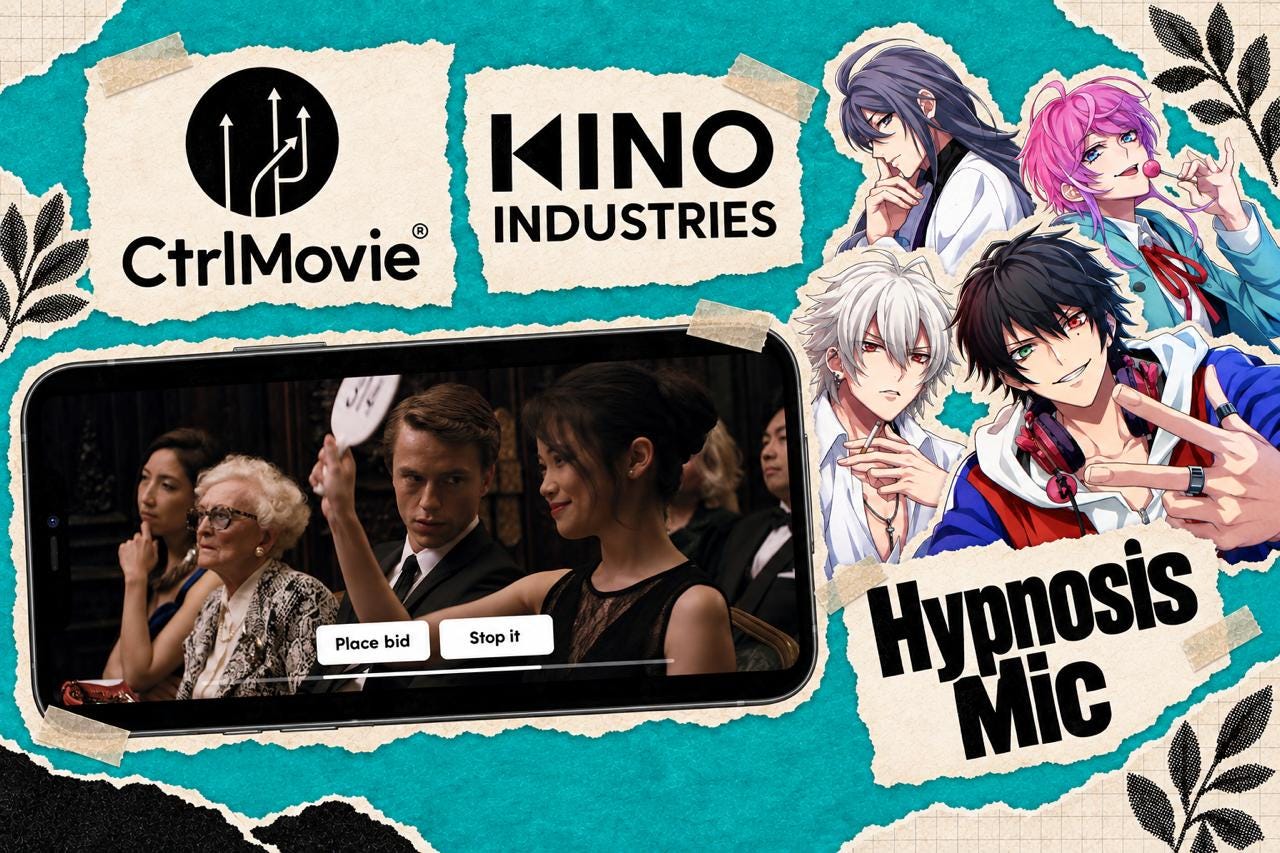
When Hypnosis Mic: Division Rap Battle opened in Japan on February 21, 2025, audiences used their phones to vote on the winners of the film’s rap battles. Each vote changed the version playing for everyone in the theater. Kino Industries president Scott C. Silver told me the movie went on to earn nearly ¥3 billion ($19 million US) after opening on roughly eighty-five screens.
That got my attention. So I agreed to a demonstration.
Seeing CtrlMovie in action clarified what my colleague had been trying to tell me. Kino had not removed the filmmaker or handed the story over to the crowd. It had created a tightly controlled form of collective choice—one that could change the movie without stopping it.
“Interactive entertainment” is often presented as a broad demand from younger audiences, even though the term covers very different experiences. A fan decoding clues, a player building a Fortnite island and a theater voting on the next scene are all participating.
They do not have the same power over the work.
How We Got Here
I can see a few reasons why participating in entertainment has become so familiar.
Video games, obviously. There are plenty of arguments about when games and storytelling really came together, but Final Fantasy VII feels like a hinge point: PlayStation’s 3D graphics and the storage capacity of CDs made room for elaborate cinematic sequences and a world you could spend dozens of hours inside.
Then social media made commenting, voting and telling creators what to do next practically a full-time occupation.
And the tools for making things reached far more people: you could edit a video, remix a scene or build a world using the device already in your pocket. of this fed an appetite to get inside the entertainment we love—to influence it, play with it and make something of our own from it.
I’ve been creating things since I was a kid, starting with animated flip pages, then clunky video cameras in college, and eventually screenwriting and producing. But when I watch a movie, my instinct is still to surrender to it. I want someone else to take me somewhere. My habits were already pretty well formed by the time story-driven gaming and social media took hold. Younger audiences grew up with participation as part of the deal. Worth remembering before I mistake my preferences for what a moviegoing experience should be.
Five Forms of Participation
CtrlMovie sent me down a rabbit hole. We call almost anything “interactive” now. But what does that mean? I realized they kind of fell into five broad categories.
Clue Hunting: The audience searches for answers without changing the story itself.
After Gravity Falls ended, creator Alex Hirsch organized Cipher Hunt, an international trail of clues that led fans to a real-world statue of the show’s villain. Severance inspired a less formal version of the same behavior. Between episodes, viewers gathered on Reddit, TikTok and other platforms to compare evidence, test theories and argue over what it all meant. The story stayed fixed. The audience kept digging.
Fan Remixing: Fans take a story they love and turn it into something new.
During the 2020 lockdown, TikTok users began posting songs, choreography, costumes and designs for an imaginary Ratatouille musical. No one had assigned them roles or coordinated the production. They simply kept adding pieces until producers assembled their work into a streamed benefit performance. E. L. James followed a more individual path: Fifty Shades of Grey began as Twilight fan fiction before she changed the characters’ names and published it as an original novel. In both cases, the original story became raw material for another one.
Crowd Control: An audience acts together to influence what gets made or how it is shaped.
By now we all know this one but it’s the clearest example: Youtuber Markiplier treated his community less like customers than partners in the life of his self-financed horror film, Iron Lung. He bypassed the traditional studio system, built anticipation and participation in the building of the movie through his own channels and asked fans to contact theaters that had not booked the movie.
World Weaving: Players use a platform’s tools to build much of the entertainment themselves.
Roblox lets users create and distribute their own games. Fortnite Creative gives players the tools to design custom islands and experiences. Minecraft is a sandbox for constructing and sharing entire worlds. In each case, the company built the framework—the tools, rules and distribution system—while players fill it with things to do. The platform provided the loom. The audience weaves.
Plot Power: The audience gets a say in the story before the story is finished.
The scripted science-fiction series Artificial was produced on Twitch and went for four seasons. The show followed Sophie, an artificial intelligence learning how to become human. During live broadcasts, viewers answered polls, questioned characters and helped make decisions that the writers carried into later episodes. Their choices did not always alter the story on the spot. But they entered the writing process while the season was still taking shape.
For creators / filmmakers and execs / studios alike, some of these opportunities can be designed into a project. Others depend on audiences taking the initiative. You can plant clues, invite votes or provide tools to build with. But you can’t plan on fans turning your movie into a musical. The producers of the Ratatouille performance recognized something that was already happening and found a way to bring it together.
So it’s understandable why a movie that requires participation from its very inception would be appealing. Audience involvement becomes part of the creative premise, something filmmakers can write for and build around.
Kino’s CtrlMovie brings that into a single theatrical screening: the audience makes choices together, the majority wins and the movie changes in front of them. Participation has a defined place in the work from the beginning.
Why Earlier Interactive Movies Stalled
Kino isn’t the first company to hand the audience the controls. A couple of earlier attempts were ahead of their time, though for very different reasons.
At Expo 67 in Montreal, Kinoautomat let audiences vote with red and green buttons on how a hapless man should navigate an increasingly disastrous day—including whether to let a neighbor wearing only a towel into his apartment before his wife got home. The film’s star appeared live to referee the decisions. It was a hit, but required a specially equipped theater and a live performer. And whatever the audience chose, the building caught fire. You could vote your way into trouble, but not out of it.
Then came Mr. Payback in 1995. Forty-four North American theaters installed three-button controls so audiences could vote roughly every 90 seconds on how a cyborg should punish rude and selfish people. Bob Gale wrote and directed it. The audience’s job was essentially to decide how sadistic the cyborg should get. Who said fascism can’t make for great comedy?
It bombed. (but I kinda wanna see it.)
Technology was clearly a factor in both cases. But my hunch is that even if these experiences could have scaled, the demand wouldn’t have been there. It took the evolution of story-driven gaming and social media to get audiences used to having a hand in their entertainment.
The Birth of Kino
Tobias Weber trained at the London Film School and worked as a commercial director before developing CtrlMovie. The idea joined his filmmaking background with an early interest in Dungeons and Dragons and story-driven games such as Monkey Island.
Weber’s first proof of concept played on an iPad, later reached consoles and appeared at roughly 50 film festivals. Its defining idea was already in place: a timed decision could change the story without stopping playback. When Fox invited Weber to present the technology, a conversation about the studio’s Choose Your Own Adventure rights opened a route into Hollywood.
“I wanted to build a narrative that allows an audience to find their own point of view in a matter,” Weber told me.
Weber met producers Chady Eli Mattar and Scott C. Silver in Los Angeles in 2017. Mattar and Silver had attended the AFI Conservatory and founded Silvatar Media which was producing genre movies. They supplied the production, financing and studio relationships needed to turn Weber’s invention into a company.
Weber focused on the system and interactive story design, Silver on production and finance, and Mattar on studio and exhibitor partnerships. Together they formed Kino Industries around the Swiss CtrlMovie operation.
Building a System Theaters Could Use
The first full proving ground was Late Shift, an interactive heist thriller made for about $1.5 million with outside investors. It demonstrated that a feature could move through authored branches without visible pauses, won a BAFTA Cymru award and reached console, PC and mobile platforms. It also showed the limits of a successful demonstration. The technology still had to fit the equipment, schedules and economics of commercial theaters.
Kino continued developing the platform as it pursued studio and exhibition partners. The company raised additional funding shortly before the pandemic, then built a streaming version when theaters shut down as they continued to focus on the theatrical experience. As cinemas reopened, Kino returned its attention to fixed theatrical installations and now has multiple movies in the pipeline for release.
Silver described the practical case for leaving the equipment in place: “Look, the machine is not all that expensive to begin with, so install it, leave it.”
The engineering problem was the branch itself. Earlier systems often exposed a pause while an optical drive searched for a new segment or a stream buffered.
Weber’s patented approach separates the audio and video streams. At a decision point, the system can move to a different video segment while continuous sound masks the transition. If the vote fails, ties or attracts no response, a default path keeps the movie running.
The audience sees only a phone interface. The screen stays black during the film, then lights for four or five seconds when a choice appears. A server collects the votes and sends the winning path to the playback system. The theater does not pause, and people who choose not to vote can keep watching.
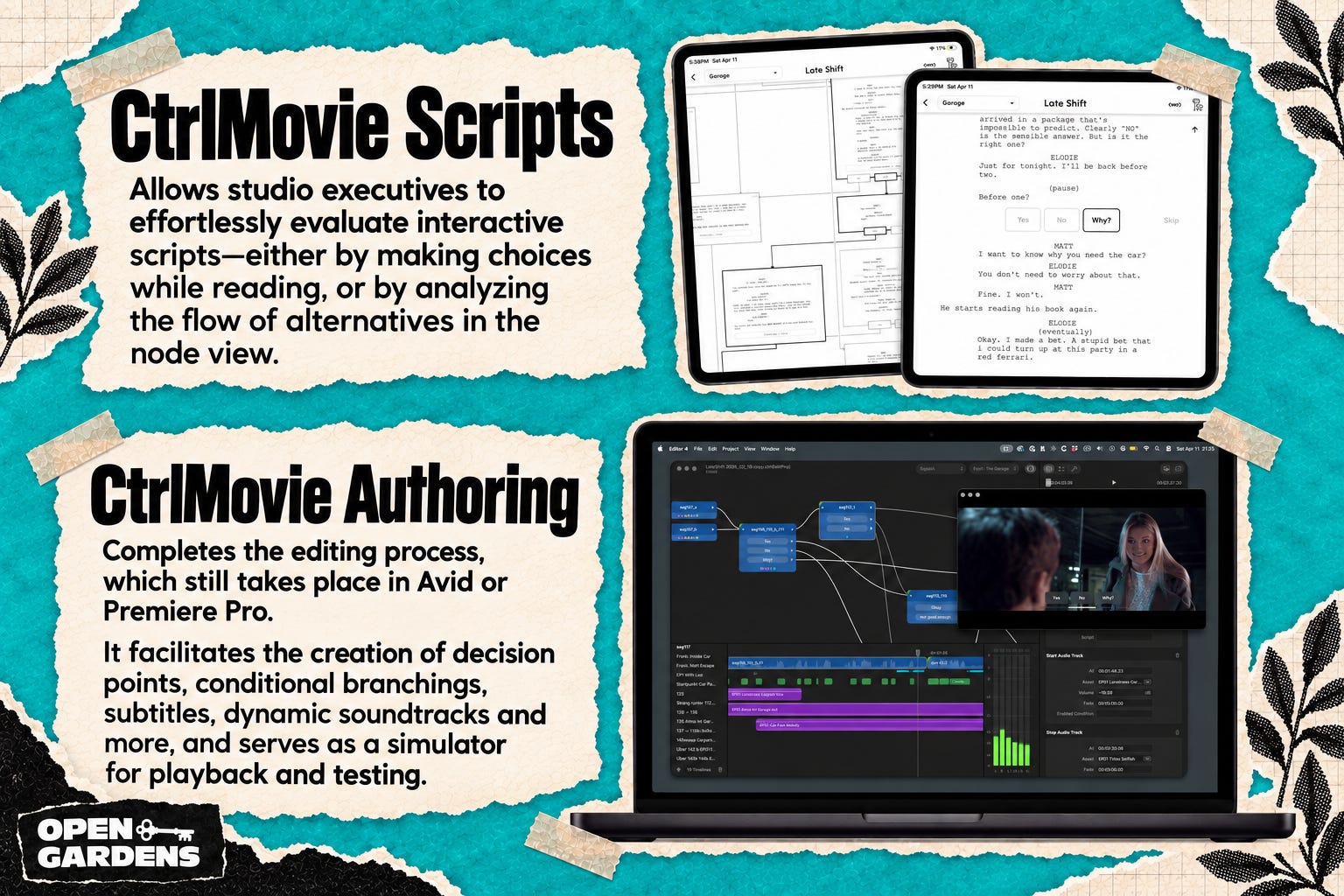
You can also see the filmmakers behind the technology in the tools they’ve built. There’s a screenwriting program—think Final Draft with alternate paths—that lets writers build choices into the script, and an editing system that lets editors work with those branches. They’ve thought about how you write and cut one of these movies, as well as how you play it. As a producer, that part matters to me.
Less Choice and Better Constraints
Kino stands by the philosophy MAYA – “most advanced yet acceptable.” Currently viewers get a fixed set of options and a short voting window.
The company also favors stories in which a collective decision already belongs to the premise. A rap battle or survival scenario gives a crowd a legible question with an immediate consequence. An open-ended moral decision inside a conventional drama is harder to resolve by majority vote without weakening the character or the story.
The consequences can also arrive much later. Demonstrating the software, Silver pointed to a choice involving a knife: “This knife could come back at the end of the movie two hours later, and since you made that choice, you don’t have your knife. Then you know you’re out of luck.”
The system also makes the room part of the experience. After a CtrlMovie screening, viewers can receive a record of their choices, including how often the rest of the audience agreed with them and how often they were overruled. Weber described the feeling of being outvoted: “Sometimes you’re sitting in an audience, and they’re going against you all the time, and you go like, ‘Who are you, people?’”
Weber argues that this does not require abandoning a filmmaker’s point of view. As he put it, “we tell one story, or we tell it in variations. But there is one story, there is definitely one theme, and there is one message.” The audience gains agency inside an authored structure rather than becoming responsible for inventing the structure itself.
Testing their Premise
This is where Hypnosis Mic comes in.
King Records, a Japanese music and entertainment company, had already begun developing an interactive film when it approached Kino. The film was based on Hypnosis Mic: Division Rap Battle, King Records’ multimedia franchise about six teams of voice-acted characters who face off in rap battles.
The project began with music in 2017 and developed an unusually direct relationship with fans, who had already helped determine the winners of earlier battles.
Silver said the production team had already mapped the film’s voting points, branching paths and possible endings, although the final animation was still being completed. Kino’s job was to turn that structure into something theaters could reliably run.
Kino integrated the film with its software and worked on the rollout with Toho, one of Japan’s largest film companies and the operator of the nationwide TOHO Cinemas chain. Toho served as both distributor and exhibitor, helping equip theaters across Japan. The release extended beyond its own circuit and eventually reached roughly 85 screens. Installation moved forward while King Records finished the animation, and the film opened on February 21, 2025.
Silver said a Toho executive had hoped the film might reach 500 million yen at the box office. By the time of the interview, it had earned nearly 3 billion yen. That result came from a relatively small theatrical footprint, although the film also had two significant advantages: an established fan base and a premise naturally built around choosing winners.
As reported by The Wrap, fifty-one percent of the “Hypnosis Mic” audience returned for repeat viewings, encouraged by an app that allowed fans to see if their favorite group was winning in screenings across all theaters showing the film.
And it’s still going. In a follow-up, Silver told me Hypnosis Mic was still getting one or two screenings a day in Japan. A recent week-long re-release packed theaters again, he says, while its Taiwan run was extended three times. King Records is also closing deals in Korea, the Middle East and Latin America. For a movie built around choosing what happens next, people apparently keep coming back to choose again.
The release also changed what Kino built around the film. Silver said the company had added “more collectibles, more achievements, a leaderboard system” to its app—rewards that extended participation beyond the vote itself.
Hypnosis Mic offers a specific lesson rather than a universal formula. CtrlMovie made the voting quick and unobtrusive, while the rap battles gave audiences a clear reason to vote.
The film remained authored, but each theater could produce a different shared version of it. Interactivity was not an interruption added to the movie. It was the event audiences had come to see.
Where it Goes from Here
The next test is already in post.
Silver says Kino has two films at that stage: Slay Day, a throwback slasher in which every main character can live or die, in any combination, and Control Your Fear, a working title for a ghost-hunting experience filmed at a location he describes as one of the most haunted in the US.
Deciding who survives a slasher seems like a pretty natural use of the format.
The announced slate also includes Alice Is Missing, based on the role-playing game, the stalker thriller Girl Crazy, and the haunted-house film Nightmare Manor. Horror is clearly getting the first crack at this. I’m curious about what else filmmakers might do with it.
Technology creates new ways to tell stories, but sometimes a storyteller has to push it along. Tobias wanted to tell stories in a way that required different tools.
My first instinct remains: filmmakers should tell the stories they want to tell. I like being in the hands of someone with a point of view. But why do I assume giving audiences choices means surrendering that point of view? The filmmaker still decides what we can choose, what we know when we choose it, and what happens next. That’s authorship, too. Gaming may have already settled this. I’m not a gamer.
Sure, this could become a roller coaster with the audience voting for the next drop. That could be fun.
But I’m more curious about sitting with strangers at a moral fork in the road and having to decide together. What happens when the room makes a choice we find appalling—and we have to sit through the consequences? The right filmmaker could reveal something about us that’s hard to get at any other way.
For creators whose work grows out of a relationship with their communities, participation could bring that relationship inside the movie. I’d be curious to see what Kinigra Deon or Alan Chikin Chow would do with it. Or filmmakers like Curry Barker and Kane Parsons, who came up making things for online audiences. What happens when those audiences get a say in the story?
And how might those choices change across cultures, genders, ages or political affiliations? Would the same moral dilemma send different rooms down entirely different paths?
Imagine a theatrical run generating three or four versions of a movie based on audience decisions. A distributor sells them all to Netflix. Would you want the version that reflects your instincts—or the one shaped by people who see the world differently?
Silly, perhaps. But fun to think about. For me, the exercise is to stay open. We don’t have to pursue every new way of telling a story. But this one might earn a place in theaters, bringing a different audience out for a different kind of night at the movies.
Crazy how fast it is all changing!
Reminds me of the best CYOA game ever, Until Dawn, where you may (or may not!) be able to save all the characters as you play. It's an older game, but as someone who loves the genre, nothing else has reached that peak.