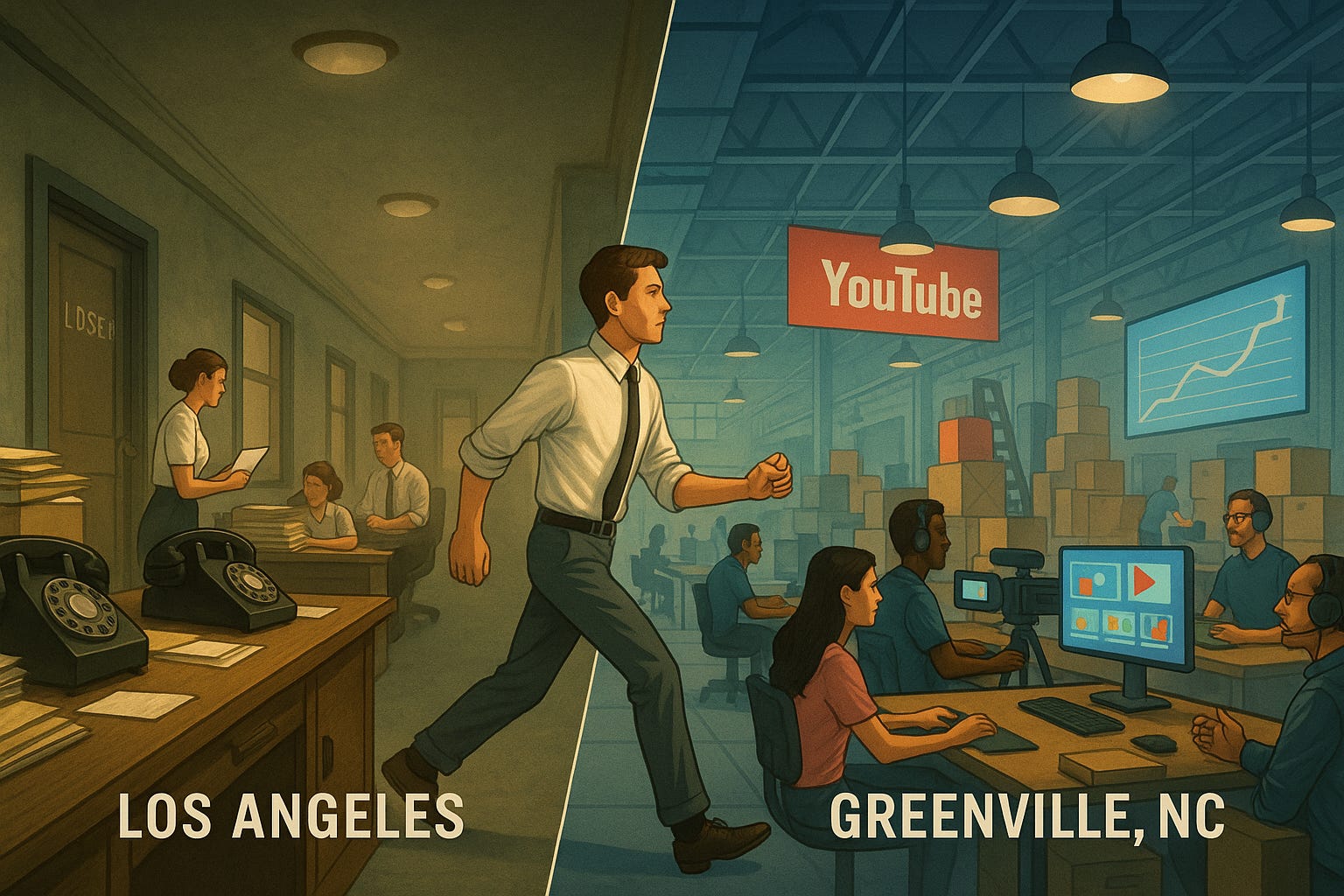
For decades, Hollywood had a single piece of advice for anyone trying to break in.
Go to the mailroom.
William Morris. CAA. UTA. Those narrow hallways were the farm system. If you survived the chaos and learned the culture, you could climb. That pipeline produced Geffen, Diller, Meyer, Ovitz, Emanuel, Lourd. The people who built the old entertainment world started by sorting envelopes.
But the ladder they climbed no longer leads to the same place. The studio system still matters, but it is no longer the center of gravity. The speed is different. The opportunities are different. The ceiling is different.
If you are trying to launch a career in media today, the most valuable mailroom is not on Wilshire.
It is in Greenville, North Carolina.
The MrBeast operation is, unintentionally, one of the most effective training grounds in modern media. It is where the architects of the next era are being shaped. Not because it is glamorous. Because it is unforgiving.
Inside the Beast universe, the feedback loop is immediate. Every upload is a real-time experiment. You learn what audiences respond to and what they reject. You learn how to build at scale with no safety net. You learn how to operate under pressure and still deliver. The pace resembles a startup more than a studio. The stakes resemble a network more than a classroom. And the reach eclipses both.
What comes out the other side is a different kind of talent. People who can build, operate, analyze, scale, and adapt. People who leave with instincts the legacy system has only started to value.
Some of the most interesting players in modern media came through that pipeline.
Here are a few of the top “graduates” of the Beast School of the Creator Economy.
Reed Duchscher: From Sports Agent Energy To Creator Industrialist
Old world equivalent: Junior agent who eventually starts a boutique shop.
New world version: Manage one creator, then build an entire studio system around them.
Reed Duchscher is the closest thing the creator economy has to a classic power agent. He started in sports, moved into digital, then built Night Media and its related arms around the idea that creators are not talent to book. They are companies to build.
Night started as a management firm and expanded into venture, capital, and original programming. The company now runs talent management through Night Media, seed investing through Night Ventures, and a larger investment vehicle called Night Capital in partnership with The Chernin Group.
Reed began managing MrBeast in 2018. For six years he sat at the center of the most important case study in creator history. That period saw the rise of the main channel into global dominance, the launch of Feastables as a CPG brand that competes with legacy candy in Walmart, and the experiment and eventual collapse of MrBeast Burger as a ghost kitchen brand.
The key insight was structural. Instead of taking a commission on Pepsi ads, Night structured deals where the creator owns the Pepsi equivalent. Hence Feastables. That is not a brand deal. That is a cap table.
In 2024, Jimmy and Reed ended their exclusive relationship. Jimmy chose to centralize more control in house and work with multiple managers and agencies. Night kept operating and now manages a roster that includes Kai Cenat, Hasan Piker, Safiya Nygaard, and others across YouTube and streaming.
If the WME mailroom taught you how to service studio clients, the Beast years taught Reed how to build a studio from scratch around a single channel. Night’s current slate is the proof. The playbook he refined with Beast is now being run across a whole portfolio.
Jess Cervellon: From Customer Support To Retention Architect
Old world equivalent: CX lead at a big CPG brand, buried inside a call center org chart.
New world version: Early Feastables hire who turns support into a growth engine, then productizes that playbook.
Jess Cervellon joined Feastables as Employee Number 4. Her job on paper was customer experience. In practice, she built the system that kept Beast fans coming back after the hype faded.
She treated CX like content. QR codes and smart links pulled receipt data into digital funnels. SMS and DMs were not just “your order has shipped” messages. They were in character touchpoints that felt like the MrBeast universe, not a help desk. She mapped the difference between a fan buying a bar as a souvenir and a shopper grabbing a snack, then built different retention flows for each.
After Feastables, she did not just jump to the next brand. She founded Open Late Collective, a consultancy that acts as fractional CMO or Head of CX for multiple high growth companies. Her pitch is simple: in a world where paid ads are harder to target, retention is the new acquisition.
The Beast warehouse was her mailroom. The companies she advises now are the studios.
Ryan Quinn: From Action Sports CPG To Creator Commerce Architect
Old world equivalent: Senior consumer products exec at a studio or lifestyle brand.
New world version: Operator who builds creator led brands from scratch.
Ryan Quinn is what it looks like when a traditional CPG brain walks into the creator economy. He cut his teeth at Reef and Vans, helped turn Stance into a nine figure lifestyle brand, then ran consumer products at Rooster Teeth and Night Media, where he helped incubate MrBeast’s Feastables as a real candy brand that could sit next to Hershey in Walmart, not just a piece of creator merch.
His job in the Beast orbit was to do the unsexy work: find the white space, build product with taste, lock in supply chain, and then use Jimmy’s audience as distribution. Now he does the same thing at DRIP, building joint venture brands with creators instead of licensing their names for a royalty. In mailroom terms, he skipped the part where you hope to one day touch a consumer products deal and went straight to being the person who designs the deal and the product around the creator.
Dan Mace: From Festival Circuit To CCO Of Beast Philanthropy
Old world equivalent: Commercial director who eventually gets a prestige doc or a cable series.
New world version: Filmmaker who runs a philanthropy channel inside a creator empire and uses that shop as a calling card.
Dan Mace came in with traditional credentials. He is a filmmaker with Cannes Lions wins and major commercial credits. He spent time collaborating with Casey Neistat’s 368 studio in New York. He did not start as a vlogger. He started as a director.
When he joined the Beast operation, it was specifically to bring a filmmaker’s eye to Beast Philanthropy. Dan now serves as Founder and CEO of JOE Films and Chief Creative Officer of Beast Philanthropy.
The job was not just to give away more money. It was to change the tone.
Under Dan, Beast Philanthropy projects like “I Helped 2000 Amputees Walk Again” are structured like short documentaries. They use three act arcs, original scoring, and careful color grading. The focus is on the emotional journey of the people being helped, not the pyrotechnics of the stunt.
For Beast, this solves a real problem. It answers criticism that the main channel’s hyper capitalist spectacle is dystopian. For Dan, it builds something else entirely.
Inside JOE Films, he has a full stack production company that can point to Beast Philanthropy as proof that they can marry cinema with audience scale. The shop now sits at the intersection of creator work, commercials, and longer form storytelling.
A decade ago, the “right” move for a director like Dan would have been permanent residence in the commercial world while trying to get a feature greenlit. Instead, he took a detour through YouTube. Now his credits include one of the most watched philanthropy channels on the planet and a company that can sell both to brands and to streamers.
Mario Joos: The Retention Scientist
Old world equivalent: Junior exec in research at a network, looking at overnight ratings.
New world version: Retention director who can literally engineer watch time and then turn that expertise into a consultancy.
Mario Joos is one of the clearest examples of a new creative role that did not exist ten years ago.
He was Retention Director at MrBeast from late 2020 to mid 2023, helping shape some of the channel’s highest profile uploads, including the Squid Game recreation. His title was not “editor” or “producer.” It was a job that sits halfway between data scientist and showrunner.
Mario has spent the last couple of years arguing against the “goldfish brain” myth. In interviews and posts he points out that attention spans are not collapsing. Viewers will happily stick with three hour podcasts and long series. The difference is that they bail faster from bad openings because there is so much to choose from.
Inside the Beast machine, that insight turned into a practice. Heavy scripting and testing for openings. Retention graphs treated as creative feedback, not just reporting. A bias for cuts that remove anything that is not progression or payoff.
After leaving Beast, Mario took that playbook to clients like the Stokes Twins, where he helped them hit stretches of growth that sometimes outpaced Jimmy’s own channel in raw subscriber velocity.
This is the modern version of an NBC research job, minus the bureaucracy and plus a direct line to the cut. It is also portable. Mario is now a free agent who can drop into creator teams, brands, or streamers and improve retention on day one. The Beast years are the Rosetta Stone.
Hayden Hillier Smith: Writing The New Grammar Of Editing
Old world equivalent: High end trailer editor or TV editor who eventually teaches at AFI.
New world version: YouTube editor who helps define the visual language of the platform, then institutionalizes it in a course.
Hayden Hillier Smith is not a full time Beast employee, but he belongs in this conversation because he is one of the editors who helped codify how high level creators cut.
He is best known for his work with Logan Paul, but he has also cut for MrBeast on big tentpole videos, including the “curing blindness” upload. His public talks and breakdowns have heavily influenced the broader creator editing culture.
Hayden has joked that he “blames MrBeast for ruining YouTube” because the obsession with retention can crush any sense of emotional breathing room. But his own “Editing Recipe” tries to synthesize both sides.
His course, Edit Like An Artist, is basically a film school for the creator economy. It teaches intermediate editors how to become “in demand” by combining retention principles with storytelling grammar.
The career path is telling. Instead of a quiet life building network promos and maybe retiring into academia, he is a public figure with his own educational IP, a community of students, and a direct line into creator and brand work. That is a new kind of editing career. The connective tissue runs directly through high pressure work with creators like Logan and Jimmy.
Jay Neo: From Shorts Lead To AI Founder
Old world equivalent: Junior development exec who bounces into a tech startup later.
New world version: Shorts strategist for the biggest creator on earth who spins out an AI company trained on that experience.
Jay Neo is one of the clearest “Beast mailroom to founder” stories.
He worked as a content lead for short form inside the Beast operation, with credits on hits like “Would You Fly To Paris For A Baguette?” and other Shorts that refined the “stair step” hook format.
Now he is cofounder of Palo, an AI platform that raised roughly 3.8 million dollars to help creators make better videos. The target customer is the mid tier creator with at least one hundred thousand followers who cannot afford a full time retention scientist.
Palo ingests videos, analyzes hooks, pacing, and structure, and then suggests optimizations based on patterns seen across a large dataset of successful content. It can also assist with scripting and ideation.
Strip the buzzwords away and you get something simple. A young guy who learned how to structure Shorts inside the most intense YouTube shop in the world is now selling that instinct as software.
If you are trying to understand what the “new UTA mailroom grad” looks like in practice, this is it. You go through Beast. Then you turn the learning into a product that everyone else can rent.
Talia Schulhof And Pufferfish: Engineering The Viral Moment
Old world equivalent: Junior creatives at a stunt agency hoping to crack one big campaign.
New world version: MrBeast content strategist and creator who sell cultural flash mobs as a service.
Talia Schulhof worked as a content strategist inside the Beast machine, staring at retention graphs and pitching ideas that had to justify massive production budgets. A video was never “just a video.” It was an event, a spectacle, a reason for millions of people to show up.
Anthony Potero, known as Anthpo, was running his own YouTube channel, pulling thousands of people into Washington Square Park for a Timothée Chalamet lookalike contest that became a minor internet legend and catching brand attention with Crocs campaigns that turned New York statues into 3D printed billboards.
Together they co-founded Pufferfish, a marketing startup focused on viral stunt campaigns.
Their breakout moment was the Timothée Chalamet lookalike contest in Washington Square Park. On the surface, it looked like a chaotic fan meetup. Underneath, it was pure Beast logic: a simple memeable premise, a clear call to gather in real life, and a payoff moment when the real Timothée showed up.
Pufferfish’s whole thesis is lore. They do not place #ads. They invent stories the internet wants to participate in, online and offline. Strong hooks and clear stakes. Real world spectacle that reads well in a thumbnail. Emotional payoffs that go beyond cleverness.
Talia is the creative version of a Beast alum. She learned how to engineer attention inside Greenville and now sells that skill to brands that want moments, not media plans. The long term arc is familiar now. Time in the creator machine. Proof that you can move culture. Then a studio of your own.
Brady Edwards: From Beast Director To BIGGEST
Old world equivalent: Commercial director who eventually opens a boutique agency.
New world version: MrBeast video director who spins those lessons into a B2B content agency and studio.
Brady Edwards worked as a video director for MrBeast. In interviews he talks about mastering storytelling, audience engagement, and high impact digital marketing while inside the operation.
He left to found BIGGEST Agency, a shop that takes Beast style thinking and sells it to CEOs and brands. The core thesis is that attention is the real currency and that leaders need to become creators themselves.
BIGGEST’s positioning is very upfront. You are not just hiring an editor. You are hiring a team that has seen what it takes to get millions of people to care. The Beast stamp is the credential.
This maps onto an older Hollywood pattern. Plenty of agency creatives used to jump out to start their own shops after a few Super Bowl spots. The difference is that Brady’s reel is not a case study montage that aired during one football game. It is a run of videos that the entire planet has already seen.
Danie Feld: From Theater Kid To Operational Backbone
Old world equivalent: Operations manager at a snack company trying to survive Black Friday.
New world version: CX operator (customer service) who builds systems that can withstand a MrBeast drop on a random Tuesday.
Danie Feld came out of traditional CPG (consumer packaged goods), including time at RxBar, before entering the Feastables blast radius. Her job was to make sure the company did not break when Jimmy pointed a camera at a bar and millions of kids decided they needed one that day.
Working CX operations at Feastables meant designing standard operating procedures for chaos. One video could turn an ordinary week into a surge that looked like a holiday season. She built processes, dashboards, and hiring plans that could flex with that kind of volatility.
When Jess founded Open Late Collective, Danie followed as Director of CX Operations. Jess sets the retention strategy. Danie builds the machine to execute it: AI workflows for repetitive tickets, training and scripts for the human ones, and the plumbing that turns “vibes” into systems.
She is the archetype of the operator alum. Not everyone who comes out of Beast is a founder or a face. Some are the people every agency now wants in the room when they say, “We are about to scale.”
Rachel Skidmore: From Network Reality To Beast Games
Old world equivalent: Executive producer on big network reality formats.
New world version: EP who translates YouTube spectacle into a hundred million dollar streaming show.
Rachel Skidmore comes out of traditional unscripted TV. Credits like Extreme Makeover: Home Edition and Celebrity IOU gave her the muscle memory of union sets, large crews, and emotional reality storytelling.
As Executive Producer on Beast Games, she is one of the people bridging Greenville and Hollywood. Her job is to take the core Beast format with high stakes challenges, fast pacing, and giant casts and execute it at Amazon scale, with all the safety, legal, and logistical complexity that implies.
In a way, she is the inverse of the other alumni. They took creator skills into the wider world. She brought network skills into the creator world, and then back out again through Beast Games.
If the old dream was “get staffed on a network show,” Rachel represents the new version: use your TV chops to build the first generation of creator led series at streamer budgets.
The Road Ahead
The old mailroom path taught you how to read a coverage grid, how to roll calls, how to sit quietly on a notes call. It trained you for a version of Hollywood where access was controlled by a few buildings on Wilshire and a few logos on studio lots.
The new mailroom teaches different instincts:
How to read a retention graph and know what went wrong in the first 30 seconds
How to build a product that survives beyond the hype of a launch video
How to run a crew and a budget at internet speed
How to turn audience, not just attention, into something durable
That is the real shift. The most valuable early-career training no longer lives inside agencies or studios. It lives inside creator companies that operate at scale, velocity, and direct accountability.


