


FRESH CLIPPINGS
Instagram goes long
Hernan Lopez broke down Instagram’s new long-form format this week. The format is called Features, and it lets creators post horizontal video, reportedly up to 90 minutes, and it will also show up in Instagram’s TV app.
Lopez traces how Instagram got here. In March of last year he wrote about the rise of media super apps, with YouTube as the most complete example and Instagram and Spotify likely to expand next. Instagram stayed measured about TVs because Reels had just reached a $50B annual revenue run rate, up 5x in barely two years, after finally monetizing at the same rate per hour as the main feed.
So why go long now?
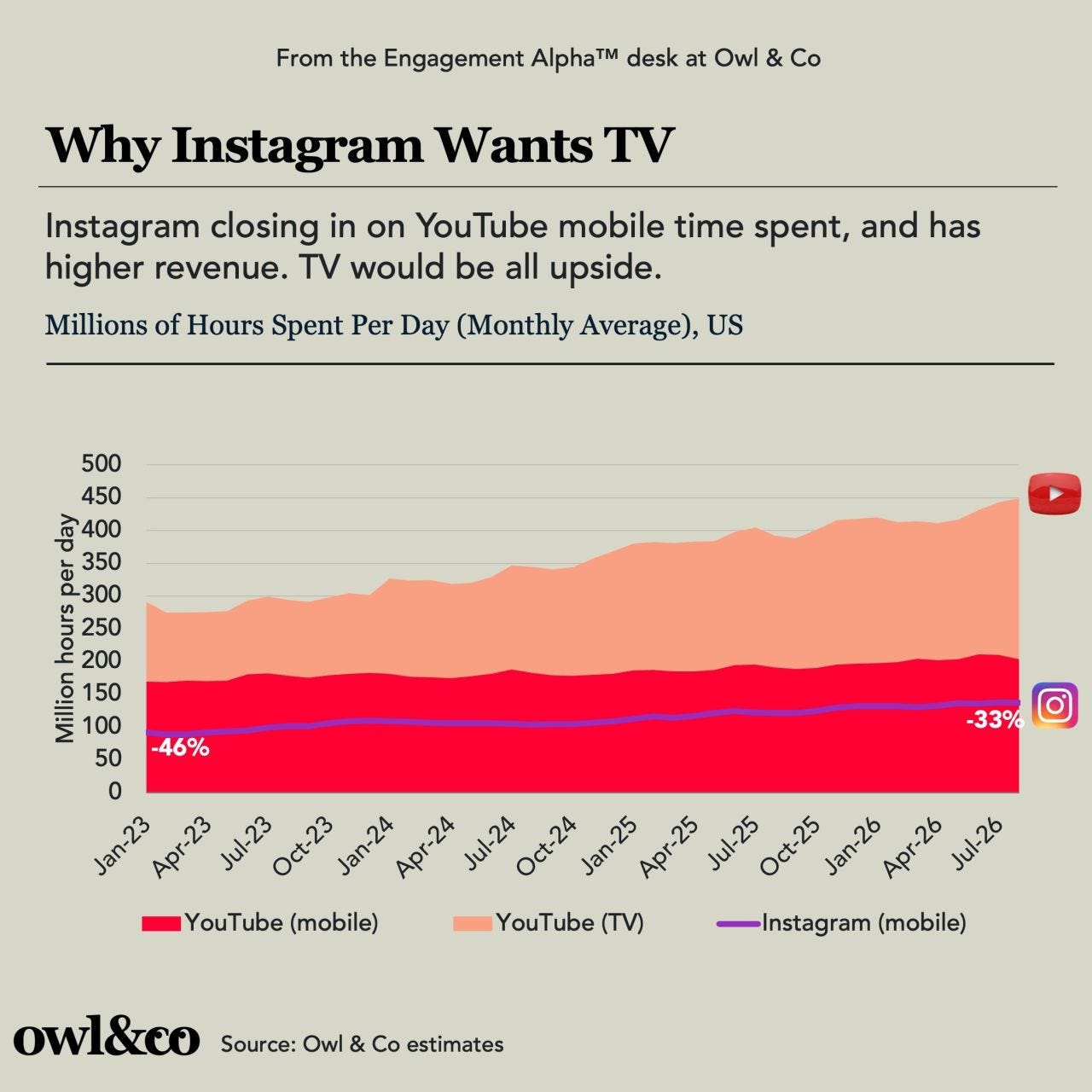
Adam Mosseri told Colin and Samir (interview below in Garden View section) that YouTube’s US mobile time spent looks flat and all of its growth is coming on TV, adding that it is about cultural relevance as much as time spent. Lopez’s chart shows Instagram going from half of YouTube’s mobile time spent in early 2023 to two thirds today, while YouTube’s time on TVs has overtaken mobile. As Mosseri put it, Instagram has to show up where people are. He also admitted he had been against long-form video on Instagram.
The pushback from the creator side has been about money. (Example 1, Example 2, and there’s a lot more where these came from). Because the thing is, Instagram does not plan to share advertising revenue from Features with creators, though it has left the door open to changing that later. Mosseri said that a revenue share would only be considered if it breaks even, while a Meta spokesperson said it is too early to share a long-term monetization model.
The lack of a platform-native revenue share could make talent hesitant to upload high-investment long-form content to the app.
That is why Lopez says podcasters and creators with baked-in sponsorships should be the most excited. It is also why creators whose income depends on YouTube’s revenue share have little reason to move their main uploads.
The worry sits with anyone who thinks premium streaming and the creator economy are separate ecosystems that don’t compete. YouTube is about to add premium TV, film, and sports in the US through its wholesale Peacock deal, and Instagram is now building a long-form home for the same living room audience.
Sony Pictures’ Creator Hiring Spree
Sony made two interesting hires over the past few weeks.
The first one is Fede Goldenberg taking over Screen Gems, the label behind Resident Evil, Underworld, and Easy A. Goldenberg spent 15 years at YouTube, most recently as head of film and TV partnerships, and is credited as a guiding hand in the rise of Curry Barker, Kane Parsons, and Markiplier. He also worked on Markiplier’s digital release of Iron Lung and on the Oscars deal. Under the new strategy, Screen Gems will keep making traditional genre films and will also develop theatrical projects from digital-native filmmakers.
This is the first time a studio division has reoriented itself toward this talent pool. Ashley Brucks, who has run the label since 2023, moves into a producing role.
Sony’s Sanford Panitch described Goldenberg as someone who has spent his career at the intersection of online creators and entertainment, which is exactly the relationship book a studio needs right now.
But is it an overcorrection?
The second hire is Lauren Glaubach, who joins Sony Pictures Television in a newly created role as EVP of distribution, digital and social platforms. She spent more than a decade at YouTube, most recently as global head of kids and family content partnerships, where she managed a portfolio of over 500 channels spanning traditional media and YouTube-first creators. She then moved to Pinterest to lead global content partnerships.
Her mandate is to expand Sony’s presence across YouTube and other digital platforms and to get more value out of its film and TV library.
Taken together, the two hires cover both directions of the convergence. Goldenberg brings creators into the theatrical pipeline. Glaubach takes the library out to the platforms where audiences already spend their time.
Will other studios follow?
Minimum Wage Breaks the Format
Netflix released the first 14 episodes of Minimum Wage on October 26, with a second batch of 14 to follow. The workplace comedy started as phone-shot shorts from American High. Those shorts drew more than 30 million views across YouTube, TikTok, and Instagram. The cast is the creator team, and most of them also wrote and directed the episodes.
The format is what stands out. Episodes run between 12 and 20 minutes, in a catalog where typical shows run 30 or 60. The Hollywood Reporter’s review opens with Quibi, whose executives were probably right that shorter episodes are a key part of storytelling’s future. Netflix has the eyeballs, and a creator-built show is the first real test of the instinct.
The review is mixed. It finds the show energetic and quick, and says it looks cheap on a big TV. That last point is the open question. A series built for phones now has to hold up in the living room, which is where more and more viewing happens.
If short episodes work here, expect more creator shows to arrive in the length they were born in, with no stretching to fit a 30 or 60 minute slot.
GARDEN VIEW
HARVEST QUOTE
"Consumers used to be programmed to know the difference: 12 o’clock on Monday vs. 9 p.m. on Thursday meant completely different things. We knew it because the distributors told us so and programmed/sold advertising accordingly."
— Bloomberg’s Lucas Shaw
This analogy is more prescient than ever as creators never worked inside a schedule. A 12 minute episode, a 90 minute podcast, and a Short all sit side by side, and the viewer decides what each one is worth. But now that Netflix is putting short comedies, publisher clips, and creator shows next to its prestige originals, it has to find a new way to tell viewers what each thing is.
Have a great weekend.