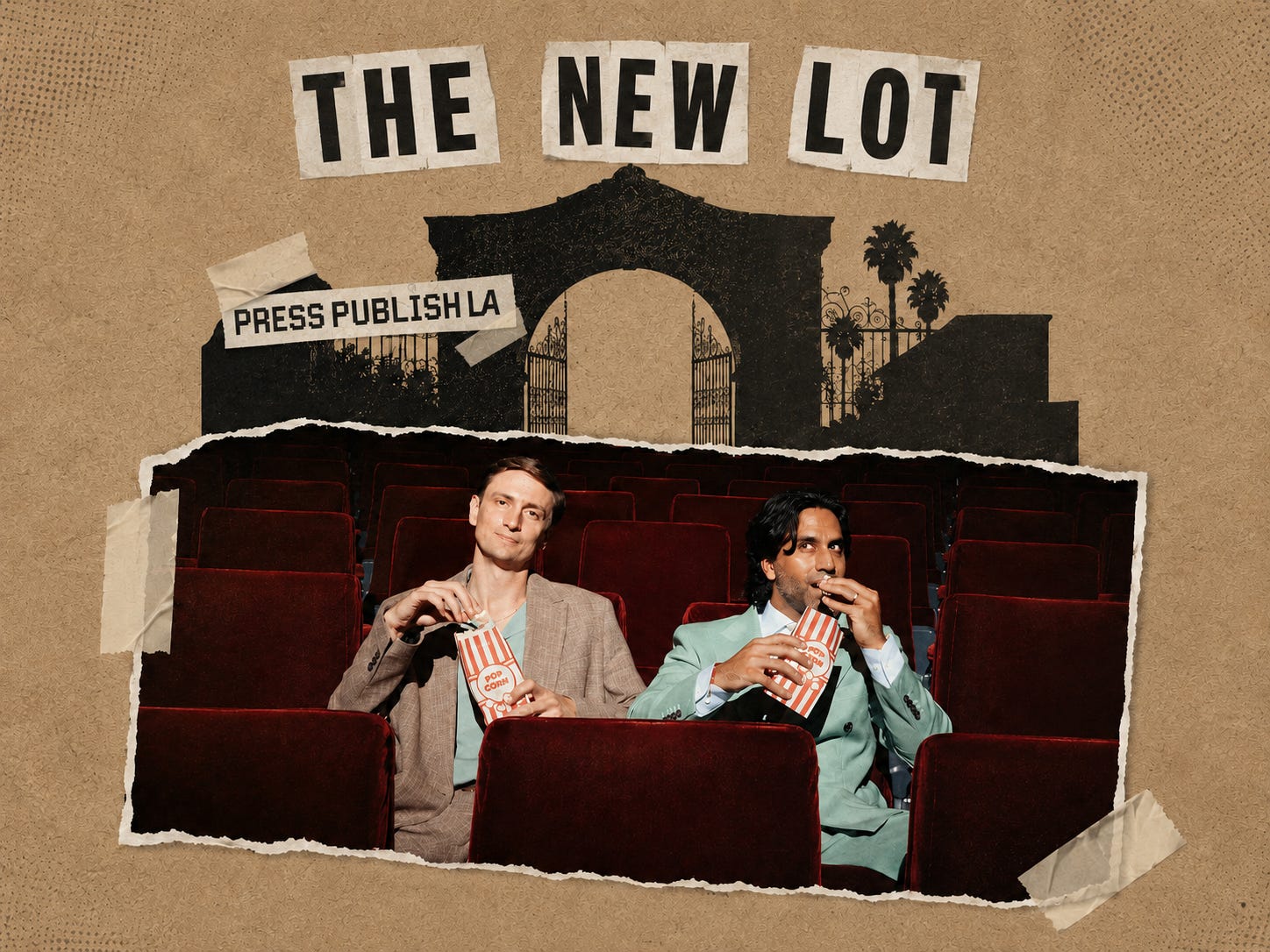
The New Lot: 5 Takeaways from Press Publish LA and the Real State of the Creator-Hollywood Convergence
When the acceptance to Press Publish LA came through I booked my flights right away.
Ben raved about the NY version enough that I wasn’t about to skip LA. The conference was on the Fox Studios lot, same soundstage where The Public Enemy shot in 1937 and where It’s Always Sunny In Philadelphia just wrapped its final season.
Nearly 700 creators, operators, and industry folks showed up, some flown in from Amsterdam, Switzerland, Hong Kong. Tim Katz from YouTube, Markiplier, Tom Segura, Billy Parks who runs Fox Creator Studios, Johnny Harris fresh off an Emmy win, Michelle Khare, and the operators behind MrBeast, Mark Rober’s Crunch Labs, and Smosh. The room represented $1.3 billion in combined subscribers across 17 countries.
You could feel it the moment you walked on the lot. This is where Hollywood had built its walled garden for ninety years. Now it’s where creators come to talk about owning their own work. As Ben likes to say: ‘the walls have been breached’.
Nobody on the panels was still arguing about whether the convergence is real.
They were past that. Deep into the actual mechanics: who owns the IP, how does craft scale from a video to a feature, what it takes to build a company around an audience. The real questions. Half the value was in the conversations that happened between sessions anyway.
Here are five things I took away.
1. “We’re not editing your videos, we’re not giving you notes. You own it, you do what you want. You don’t have those gatekeepers in the same way.”
— Tim Katz, VP Americas, YouTube | Session: The Future of YouTube + Surprise Guest
Katz opened the day and drew the line every other panel kept circling back to. The difference between YouTube and Hollywood isn’t the living room, the production values, or the brand dollars. It’s the IP. Creators keep it. YouTube takes a revshare and that’s the whole deal. It hasn’t changed even as the slate announced at Brandcast, Michelle Khare’s Challenge Accepted, Kareem Rahma’s Keep the Meter Running, starts to look like network programming.
Every creator in that room has heard the Hollywood pitch. We’ll fund it, we’ll make it, we’ll own it, you’ll get a fee and a back-end that never shows up. Katz was offering the opposite. The living room is now YouTube’s biggest surface in the U.S. and its fastest growing. The shows can cost as much as anything on broadcast. The IP still belongs to whoever made it.
He paired it with the advertiser side, which is what made the slate possible in the first place. “We just kept hearing from advertisers that we need to get closer to creators. We know this is the new Hollywood, this is where creativity is happening, this is where cultural relevancy is happening.” And the ask was specifically for the old structure. “We want to see this in the same way that TV historically has worked, where you’re buying a season of a show.” So you’ve got premium format and predictable buying, the things TV always sold, except now the person who made the show still owns it. I can’t think of another point where all three of those were true at the same time.
Own the IP and every distribution decision is a strategic one. Don’t, and you’re a vendor with a credit.
2. “I enter YouTube coming from a doubtful place and I’m addicted to overcoming that doubt.”
— Markiplier | Session: The Future of YouTube + Surprise Guest
Markiplier was the surprise guest, and he could have spent the whole time on the Iron Lung numbers. The single-location horror feature made over $50M in 4,200-plus theaters on a budget under $5M, and it dropped on YouTube as a transactional buy the day of the summit. Remarkable on its own. But he kept pulling the conversation back to craft, which is the part worth sitting with.
He doesn’t think a feature is far off from a YouTube video. “I don’t think that there’s all that much difference from a technical perspective of making a movie versus a YouTube video. It’s just the scale with which it is done, and the margin of error with which your skills have to be good enough to succeed at.” He wrote it, directed it, financed it, starred in it. Controlled the frame the same way he does on his channel. Webcam in a hotel room. Jump-cut self-critique. Audience trust standing in for production design. Colin called it self-reliance on stage and the word stuck.
Johnny Harris hit the same note in his own session, “Reimagining the Travel Show,” less than 24 hours after winning his Emmy in New York. “YouTube is a volume game.” He spent years getting reliable for his audience before pivoting to his new show The Human Element, which needed more planning and more development time. “I started to put more time in development. I think this show is a more intentional vision that underpins it.” The years of volume are what bought him the room to slow down and make something bigger, and the audience he’d built doing it didn’t go anywhere when he did.
The creators making this jump, to features or shows or franchises, aren’t switching careers. They’re scaling the one they already run. Same skills, same audience, just at a budget and a stakes level that punishes mistakes a lot harder.
3. “We’re literally in a golden age right now. If you have ambitions to be doing movies or television — it’s never been more accessible and possible than right now. This is the best time in history for somebody that doesn’t have a traditional entertainment path to end up with something like that.”
— Tom Segura | Session: What Hollywood Actually Wants From Creators, with Billy Parks, Head of Fox Creator Studios
That was Segura’s closing charge to the room. The infrastructure that used to gatekeep entertainment, the studios and agents and distribution and capital, isn’t the only path anymore. The alternatives are real enough now to build a career on, not just a viral moment.
Segura would know. He walked his own arc on stage. Stand-up in 2002. A podcast in 2010 because Joe Rogan kept pestering him. Live touring podcasts at $10 a ticket that sold 45,000 seats during the pandemic. A pay-per-view platform built out of necessity when touring shut down. Three short films shot in 11 days that became a 35-minute pilot. That pilot sold to Netflix and became Bad Thoughts, now in season two and currently #5 in the country. A vodka brand. A bakery. And now a multi-project deal with Fox Creator Studios. The day of the summit, FCS announced the partnership exclusively with The Publish Press: a stand-up showcase, a horror animated series, a live-action comedy, with FCS and Segura’s YMH Studios splitting ownership and the projects living on YMH’s platforms instead of Fox channels. The whole thing went from introductory dinners in March to a signed deal in six weeks.
Billy Parks, who runs Fox Creator Studios, described the posture in terms you almost never hear from a legacy studio. “We’re hyper-focused on working with IP, working with formats where we can say, here’s capital, make it on your channels, you drive the creative, you produce it. We’re not hiring producers and making it for you. You’re not shooting on our stages.” That’s a studio offering up its capital and its distribution and a hundred years of knowing how to monetize a thing, and then getting out of the way on the part it used to control most, the ownership and the production itself.
Segura talked about momentum like it was the whole ballgame. “Momentum is an undervalued piece of creativity. When I have an idea, it’s pretty fragile if I wait too long. There’s an energy to ideas, and when you find yourself in a group of people that all feel the momentum, it’s on you and the group to keep it going. If you let it fade, the idea fades as well.” That’s why the Fox deal matters. It moves at the speed the idea needs. Iron Lung doesn’t get made in 1995. Bad Thoughts doesn’t sell to Netflix without a pay-per-view platform that didn’t exist back then. A webcam and an audience can now make things the old timeline would have killed in development.
His closing advice tied it together. “Don’t shut down any avenue. Figure out your goals. Sometimes people listen to what someone else is doing and think that that’s the goal. That might not be what you want to do.” When you finally have options, the trap is chasing somebody else’s version of success because the path looks familiar.
4. “Formatting is world-building.”
— Michelle Khare, Host and Creator of Challenge Accepted | Session: Pushing YouTube’s Limits
This was the best craft conversation of the day, and it gets at the question the rest of the convergence talk keeps dodging. What actually separates a creator video from a creator show?
Khare walked through the format development on her seven marathons on seven continents series, which went through several cuts before she landed on three parts. The single 90-minute version lost the storylines about her fellow runners, which were the emotional core. A seven-part version ran too loose. Three parts held the tension. She wasn’t decorating the thing after the fact. The number of parts, where the breaks fell, what each episode had to carry, that was the storytelling, as much as anything that happened inside the runs.
None of this fits on a deck. Tim Katz can announce a slate. Billy Parks can write a check. YouTube can build a multi-season playlist tool. None of that tells you how long the show should be, how many episodes it needs, where the cliffhangers land, what the emotional architecture is. Those calls belong to the creator. And the ones figuring it out are doing it by trial, testing a 90-minute cut against three parts against seven, watching what the audience actually holds, rebuilding from there.
Markiplier made the same point from a different angle. “It’s harder to lose something that you care a lot about. And so we have to make people care about it.” He was talking about Unus Annus, the channel he and Ethan Nestor built for one year and deleted in front of 1.7 million people watching live. Same principle. Format is how an audience comes to care in the first place. Khare’s three-part cut works because the structure itself does the emotional work.
YouTube is offering season-level distribution. Brands are buying season-level commitments. Studios are putting up capital for season-level IP. The money and the reach are basically solved at this point. What isn’t solved is the thing Khare was describing, the actual decision of what the show is and how it’s built, and the creators who win the next chapter are going to be the ones who treat that the way a director treats a shot.
5. “I can’t teach someone to care about the work that they’re doing, but I can teach YouTube.”
— Kara McCloud, Director of Recruiting, MrBeast | Session: Meet the Operators Scaling the World’s Top Channels
McCloud was employee #12 at MrBeast. By the morning of Press Publish, Beast Industries had over 780 people. Her session, with Smosh CEO Alessandra Catanese and Crunch Labs Chief Content Officer Scott Lewers, moderated by Kim Larson, who heads YouTube’s Creator and Gaming team, was the most useful hour of the day. It was the only one that took the next question seriously. What happens after the creator becomes a company?
The answers were unglamorous and clarifying. McCloud A/B-tests hires the same way the team A/B-tests packaging. “There’s no other place you can go to that gets people ready for YouTube… I did whatever a good packaging person did. I A/B tested.” Her real point is that mindset is the constraint, not skill. “I can’t teach someone to care about the brand and about the work that they’re doing, but we can teach YouTube.” Beast has built what is basically the first talent incubator the creator economy has had, with alumni like Anthpo and Ernesto Perez. Crunch Labs runs most new hires through an hourly contractor period first. Smosh built a strict 9-to-6 with a 5:50 Slack message that tells people to go home. All three landed on the same diagnosis. Legacy media is departmentalized, camera here, post there, creative somewhere else, and that structure doesn’t survive creator-economy speed.
McCloud’s fix. “We need to get to the pyramids of Egypt. So everybody kind of needs to know what’s gonna go on. We put everybody in the same room.” Producers, camera, creators, post, all in the same room. Catanese hires for personality diversity at Smosh using a survey called Culture Index. Lewers’s team at Crunch Labs screens for pitching ability, because the delivery matters as much as the idea.
Here’s the part I didn’t expect. Most of the talk around creator-to-company assumes the hard part is the content. Make more of it. Make it bigger. Make movies. The operators in that room were saying the opposite. The content was never really the problem. The company is. You can’t scale the work until the org underneath it can actually carry the weight, and getting there means doing the unsexy stuff, figuring out what you’re hiring for, saying it out loud, and not just hiring your cousin because he’s around.
The Takeaways Behind The Takeaways
Call it leverage, not takeover: The cleanest story, the one I was tempted to write on the flight home, is that the whole thing has flipped. Hollywood comes to the creator now instead of the other way around. I don’t fully buy it. And I’d be suspicious of anyone who spent one day in a room full of creator-economy operators and walked out sure the old model was finished. Of course it looked flipped from inside that room. What I’ll actually stand behind is smaller and more durable. Creators have a real second path now, and a credible alternative changes the terms whether or not anyone takes it. The Fox deal with Segura isn’t Hollywood surrendering. It’s Hollywood competing for something it used to be able to assume. The studios still treating creators like supplicants are the ones who haven’t noticed the floor moved under the negotiation.
The audience is the asset, and everyone in that room knew it: Every operator kept landing on the same idea in different words. Markiplier: one person’s time is the most valuable thing we have. Segura: the audience is the boss, of all of us. Katz: they want relevancy and that connection. McCloud: I can teach YouTube but I can’t teach mindset. A studio deal can’t hand you that relationship, and no amount of capital builds it for you. It’s the one thing that doesn’t show up anywhere on a balance sheet. Every creator at Press Publish has built their whole business around protecting it. Every studio was trying to figure out how to get at it without breaking it.
For a long time the hard part of all this was the content itself, and somewhere along the way that stopped being true: The bottleneck moved to the company. That’s what surprised me most. I went out expecting a conversation about formats and platforms and budgets. I left with a notebook full of org-design lessons. The creators winning right now aren’t winning because they cracked YouTube. They cracked YouTube ten years ago. They’re winning because they figured out hiring, culture, work-life balance, partner selection, format, and pace. The next decade of this business won’t be decided on the platform. It’ll be decided in the back office, and on the cutting room floor, where Michelle Khare is deciding whether a story is three parts or seven.
What I took home is simple. The people winning didn’t wait for permission. They built something real and let the industry come to them. And the stuff that used to be the hard part, raising the money, getting distribution, finding an audience, is mostly handled now in a way it just wasn’t a few years ago. What’s left is the part that was always going to be hard, which is knowing what your story actually is and making it well enough that people show up and stay. That’s the whole game now, and I left more optimistic about it than I’ve been in a long time.


