


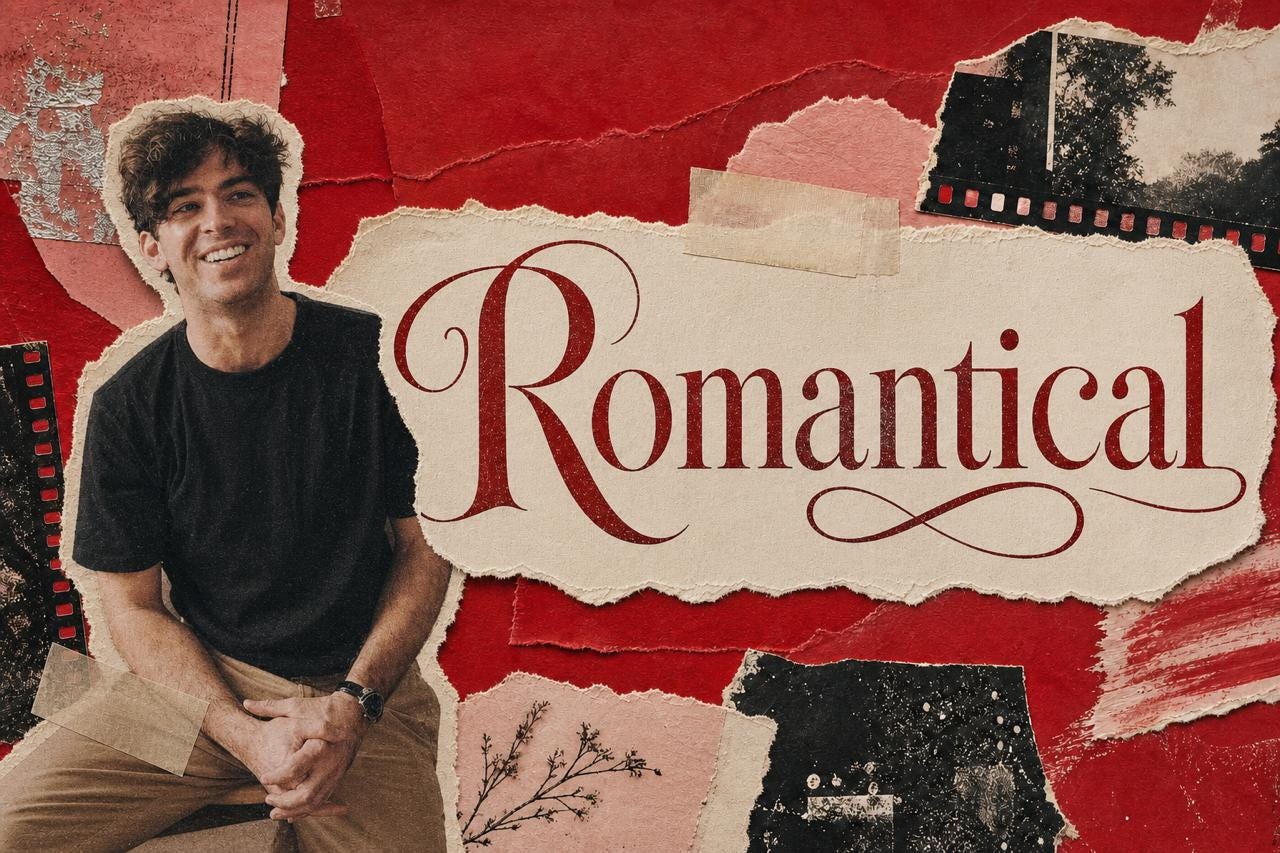
“In five years I want Romantical to be an emotion and an adjective. I want you walking down the street, looking at a couple sharing a martini in a window at a restaurant, and thinking to yourself—damn, that’s romantical. That’s all I care about.”
That’s Jonah Feingold describing the company he is building. Not a slate. Not a production shingle. A word he wants people to use when they see something that makes them believe in romance again.
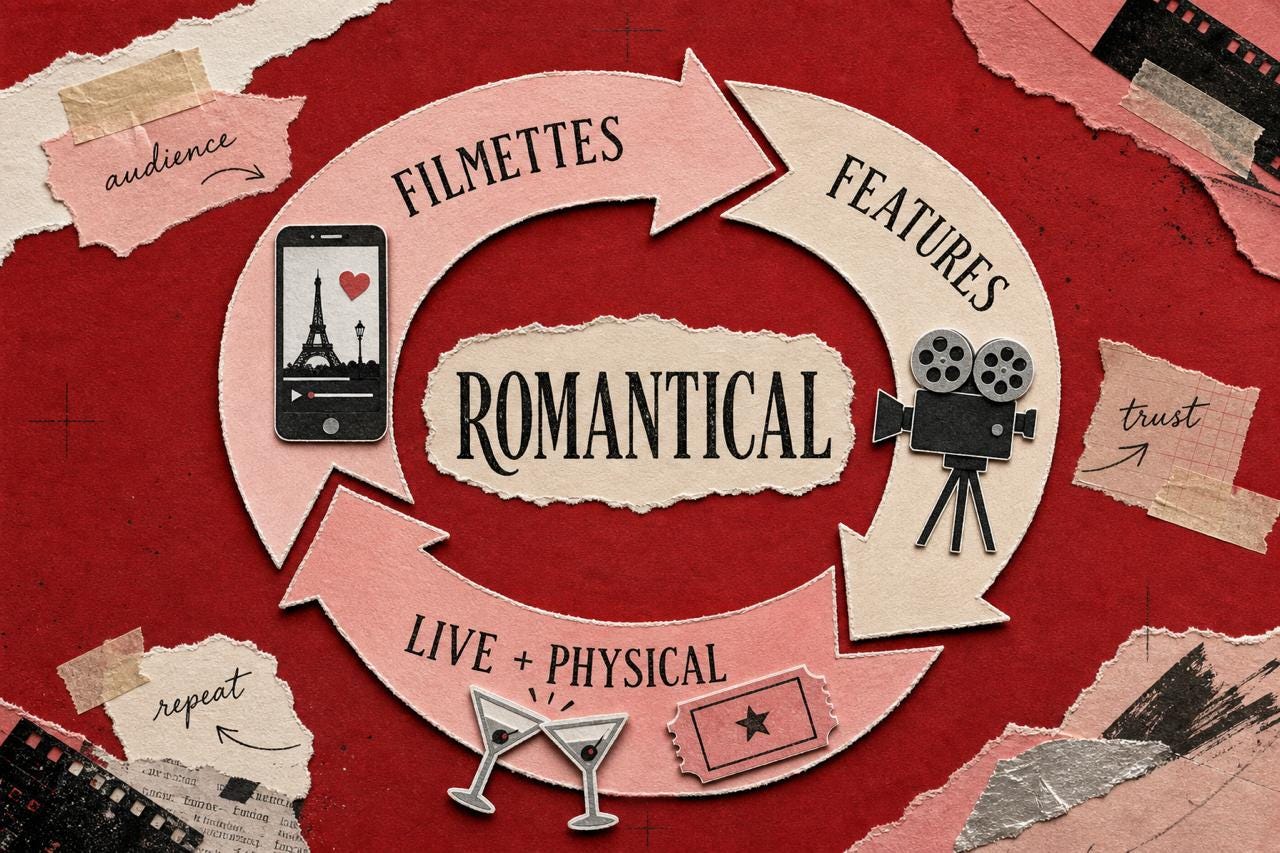
It sounds soft until you look at the business underneath it. Romantical is designed to make films, short-form digital series, brand partnerships and live events, all built around one genre identity and one audience. The movies are an output. They’re not the whole business.
Nora Ephron created in two sandboxes—first books like Heartburn, then movies. When Harry Met Sally, Sleepless in Seattle, You’ve Got Mail. Her characters were smart but accessible, funny but grounded, romantic without being overly sentimental. Her name guaranteed a feeling.
Today a writer or producer might pitch something as “Nora Ephron-esque.” That means the work has an essence, a recognizable emotional DNA. The Nora Ephron of right now wouldn’t stop making movies. She’d raise a round and build a company around that feeling so it could live in more places than a movie theater.
That’s what Jonah is attempting. The company is called Romantical.
Jonah the Founder
Jonah is a USC film school grad. He has directed five features already at 35—four of them rom-coms—plus a growing body of work on social. And he has stopped introducing himself as a director.
“Today as a professional, I’ve sort of started introducing myself as a founder. Five years ago I was a director, five years before that I was an aspiring director, and five years before that I was a video editor—which maybe speaks to where we are today.”
I’d been hearing about Jonah and Romantical for a while. As is often the case in the creator world, it took one introduction and a text to get us on Zoom. Jonah pointed out how different that is from Hollywood. Try getting to the head of Sony. First you have to find a path to the person. Then you get an opening in November. Then the meeting gets canceled three times. In this world you text, get on Zoom the next day and might be doing business together a week later.
We talked a few times. He sent me his fundraising deck. I watched his work. He has already raised a meaningful chunk of capital, mostly from friends and family with a few strategic people mixed in. The company is still early enough that some of what follows will change. That is part of what makes it worth looking at now.
Jonah loves the classic rom-coms. He talks about Ernst Lubitsch, Frank Capra and Billy Wilder as much as Nora Ephron or Nancy Meyers. But he is just as fluent in creator culture, understands algorithms and knows how to wrangle brands into funding content. In other words, he is the Open Garden—the convergence on two feet.
In One Word: Enchantment
I’ve written before about how the biggest creator businesses can be boiled down to a single emotion. MrBeast is survival. Dude Perfect is wonder. The emotional idea travels across movies, television, social, live events and merchandise even when the formats have nothing else in common.
When I asked Jonah for his, he didn’t give me a mission statement. He gave me the couple sharing a martini.
My word for it is enchantment. That’s my word, not his. It’s a real belief in romance and a conspicuous lack of cynicism. It also comes from a genuine place in Jonah. The first movie that made him want to make movies was Hook. He was four, watched it a thousand times, dressed as Captain Hook—the whole thing. Then came L.A. Story, Albert Brooks, Big and You’ve Got Mail. He eventually worked his way backward to Billy Wilder, Lubitsch and Capra.
There is also his doctorate in the creator side. In 2015 he worked at BuzzFeed alongside the Try Guys and Quinta Brunson.
“Everyone gives MrBeast credit for titling and thumbnails. This is all shit that BuzzFeed was teaching us. BuzzFeed invented proprietary software that would put fake thumbnails onto our videos on the BuzzFeed site and rate which ones did better—and then we’d update the YouTube video after. This is before YouTube even allowed thumbnail testing.”
Classical Hollywood on one hand. Thumbnail A/B testing on the other.
The Machine
Romantical is built around Jonah’s simple conviction that it’s silly for a movie to live and die on an opening weekend. So true. I always compare movies to opening a restaurant. You design the menu and the room. You hire great people. You market it. The place starts filling up—and two months later you shut it down. Then you wait two years and hope those patrons find you when you open a completely different restaurant somewhere else.
That’s what a movie is like. So much work goes into building an audience that the business then treats as disposable. Romantical is an attempt to keep the restaurant open.
There’s a personal version too. Jonah was tired of moving from job to job without owning anything—the director-for-hire life, in and out of someone else’s production, no equity, little upside, on to the next one. Almost nobody working on a movie is truly invested in whether it succeeds long term. Backend points exist on paper. They rarely pay out.
Romantical is partly built to change that: give the people making the work real participation, not only a credit and a wrap gift. That is not a minor detail. It’s the commerce part of the system working backward into the community part. Jonah is trying to build ownership into the foundation instead of negotiating for it once everybody is successful.
The machine has three broad engines.
1. Filmettes
Filmettes are short cinematic rom-coms released natively on YouTube. He has already made pieces like Twixmas and I Dumped Four People in One Day. They sit somewhere between an Instagram Reel and a feature, and they function as creative laboratories with an audience attached. You find out whether a character or comic idea lands before anybody commits a feature budget. Each one can be cut into ten or more short-form assets and anchor a month of distribution.
They are also largely paid for upfront by brands. Twixmas was made with Tinder. Skylark funded a location shoot in London for Good to See You 2. The distinction Jonah is drawing is important: the brand isn’t placed into the plot after the fact. It helps create the reason for the plot. The IP gets built without Romantical carrying the entire cash burn.
“Half the time people just want to be cool. They want to send their boss the video on a Monday and say, hey, look what we made.”
He is equally blunt about why the money is hard to close.
“I’ll be talking to the product placement team, the digital brand marketing team, the commercial production team. They’re all different people, sometimes in different states, sometimes in different companies, but representing the same company.”
Every producer who has chased brand money recognizes this. The budgets exist. The people controlling them live in different buildings and operate on different clocks.
2. Features
The features will be financed outside the traditional system where possible: Romantical capital, outside investors, brand partners and economically priced production. Then theatrical distribution and the downstream windows.
One of the first is For the Boys, an R-rated rom-com Jonah describes as Some Like It Hot and Mrs. Doubtfire meets Wedding Crashers and The Hangover. Two women disguise themselves as men and infiltrate a bachelor party in Key West. The project came sideways out of Busboys, the R-rated ensemble comedy he made with David Spade and Theo Von.
The interesting part is what surrounds the movie. Jonah plans to shoot a digital series in the same production orbit—roughly forty episodes released weekly, all connected to the wedding at the center of the film.
“And of course, if for whatever reason people don’t make that connection, it’s at least in service to Romantical as a brand.”
I love this idea. It has been tried before, but the timing was wrong. Brands have trouble betting on features because the production and release cycles are too long for annual marketing budgets. They will bet on a series. If a brand funds the series leading into the movie, and the series works, Romantical can return as the release approaches and make a much stronger case for marketing dollars. That is a real bridge between the speed of brand media and the long clock of a feature.
3. Live and Physical
Quarterly events. Screenings. Panels. Eventually dating events, a run club, movie nights, a book club, merchandise. This is where the name starts doing work that no individual film can do.
A Romantical dating event should not feel like generic speed dating with a logo taped to the wall. It should draw people who want Jonah’s version of romance: optimistic, playful, maybe a little nostalgic. Even when nobody falls in love, the night should feel spontaneous enough that people want to come back.
Each piece of media and every event becomes a way to find those people and bring them into a community that lasts. The eventual dream is recurring revenue—a subscription business built around people who trust the taste and the emotional promise of Romantical.
McKinsey recently tried to put a dollar value on an hour of attention. Social video generates roughly twenty-five cents. Live experiences can generate somewhere between seventeen and thirty-three dollars. Read that lazily and you’d think Jonah should skip the cheap stuff and go directly to events. But the cheap stuff is where the audience gets built. The filmettes are not a compromise on the way to the real movie. They are R&D and audience development happening at the same time, at a price where Romantical can fail cheaply and learn quickly.
The Hard Question
The romance business has moved hard into creator media over the last five years: audio incubators like Meet Cute, bootstrapped studios like RomComPods, subscription audio at Quinn and Dipsea, social reading at Fable and Realm, and an enormous vertical micro-drama business that has turned romance into cliffhangers and coin-unlock paywalls.
Jonah is making a different bet. He wants to preserve the handmade, cinematically respectable version of the genre and give it an always-on business model.
Here is the skeptical version, because I don’t think the article is honest without it. Building a company around a genre is fundamentally different from building one around a person. Most creator success stories—MrBeast, Dude Perfect, the whole list—begin with a specific human being an audience has decided to trust. The brand and the person are the same thing, at least at the start.
Romantical is trying to build loyalty to an idea instead. A feeling. An adjective. Something you can point to through a restaurant window. That is harder. Genres don’t show up in your DMs. Genres don’t have a face people recognize at the airport.
Jonah knows this. It is the open question underneath the whole company: can Romantical become the draw, or will Jonah have to become the face that teaches the audience what Romantical means? Nobody knows yet. If the brand works, though, it can eventually survive him. A company built only around a person caps out at what that person can produce and how long they want to keep producing it. A company built around an emotion can outlast a career—if the emotion is real and the system holds.
If I Were Him
I’ll say the quiet part. If I were building Romantical, I would build it as a community company that happens to make movies, not a movie company that hopes a community eventually shows up. That is an ordering decision, not semantics. It changes what you build first, what you measure and who you hire.
I would start with the ideal member. Not the target audience—the ideal member, singular and specific. Gina Bianchini, who built Mighty Networks and has thought about this longer than almost anyone, has a useful way of defining that person: an actual human in a transition. Not “women 18–34 who like rom-coms.” Somebody at a specific moment of change, when they are motivated to find other people and willing to pay for help, access or belonging.
Who is that person for Romantical? Someone newly single and done with the apps? Someone who just moved to New York and wants a social life? Someone who still believes in love but has run out of places where that belief doesn’t feel embarrassing? I don’t know the answer. Jonah needs to pick one, build for that person and be equally clear about who the community is not for.
Then I would define enchantment on purpose. It is already in the filmettes, in the features Jonah chooses and in Jonah himself. But right now it mostly lives in his instincts. It needs to become a standard he can use to judge a script, a brand partner, an event, a hire and the easy cynical joke that might get a laugh but violates what the company is supposed to mean.
When we built a community strategy for Brass Knuckle Films—the action label Robert Rodriguez launched with Alexis Garcia—we ended up with three verbs: launch, grow, activate. The genres could not be more different, but the sequence applies almost perfectly here.
Launch means public-facing media made to stand on its own: the filmettes, the digital series around For the Boys, Jonah talking directly to the audience and events that give the audience something to do together. Not promotional scraps. Actual programming.
Grow means converting visibility into an owned relationship. Email addresses. Phone numbers where appropriate. Attendance history. Repeat viewing. Referrals. The information that tells Romantical who keeps showing up and why. Social platforms create discovery. They should not own the entire relationship.
Activate means giving the most committed people a reason to pay and participate: early screenings, intimate events, access to the filmmaking process, member-only rituals and eventually ways to help get projects made. But I would not start by throwing up a subscription page. First establish the habit. Give the community a name, a calendar and a reason to miss it when they are not there.
At my own company, we are restructuring around what I call a digital vertebra. The movies, television and other projects do not sit in separate boxes with social media bolted on at the end. The digital team runs through everything. It understands the DNA of the work and extends it before, during and after release.
Romantical needs the same thing. The early hire I would prioritize is not only a traditional development executive. Jonah needs a creator-editor-community operator who can sit inside the movies, the filmettes and the events and make them feed one another. The company should measure repeat viewers, email capture, event return, referrals and conversion into paid participation—not only views.
That is how Romantical starts learning whether the emotion is becoming a community or is still simply Jonah’s personal taste.

The Weird Bet
For all the talk about recurring revenue, brands and membership, the thing Jonah is most excited to spend money on has no obvious business model.
“I am most excited to make an 80-minute romantic comedy for YouTube on my FX3 with eight other crew members, over seven days of shooting, and put that on the internet and see what happens. That’s us spending money where there’s no immediately clear world in which there’s a return on that investment—which I know from a business standpoint sounds crazy. But I don’t think I can go to YouTube and type in nineties-style rom-com in New York and find something with compelling dialogue and characters falling in love that still feels handmade. And I think people do still value that.”
That’s the tell.
Legacy media is a closed circuit. You plug a production company into a known socket and a known business model comes out. Creator media is an open system. You can do almost anything, which also means nobody can give you a spreadsheet that proves it will work. You bet on yourself, hold onto the core idea and accept that the business may look completely different a year from now.
“In one year we might be talking and Romantical could be—we make martini glasses. We sell furniture.”
Honestly? If the brand is built right, both of those work.
The Nora Ephron of right now would raise a round. Not because movies matter less. Because she would want to own the feeling between them. The point of the company is to keep the restaurant open.
“Launch. Grow. Activate.” Brilliant.