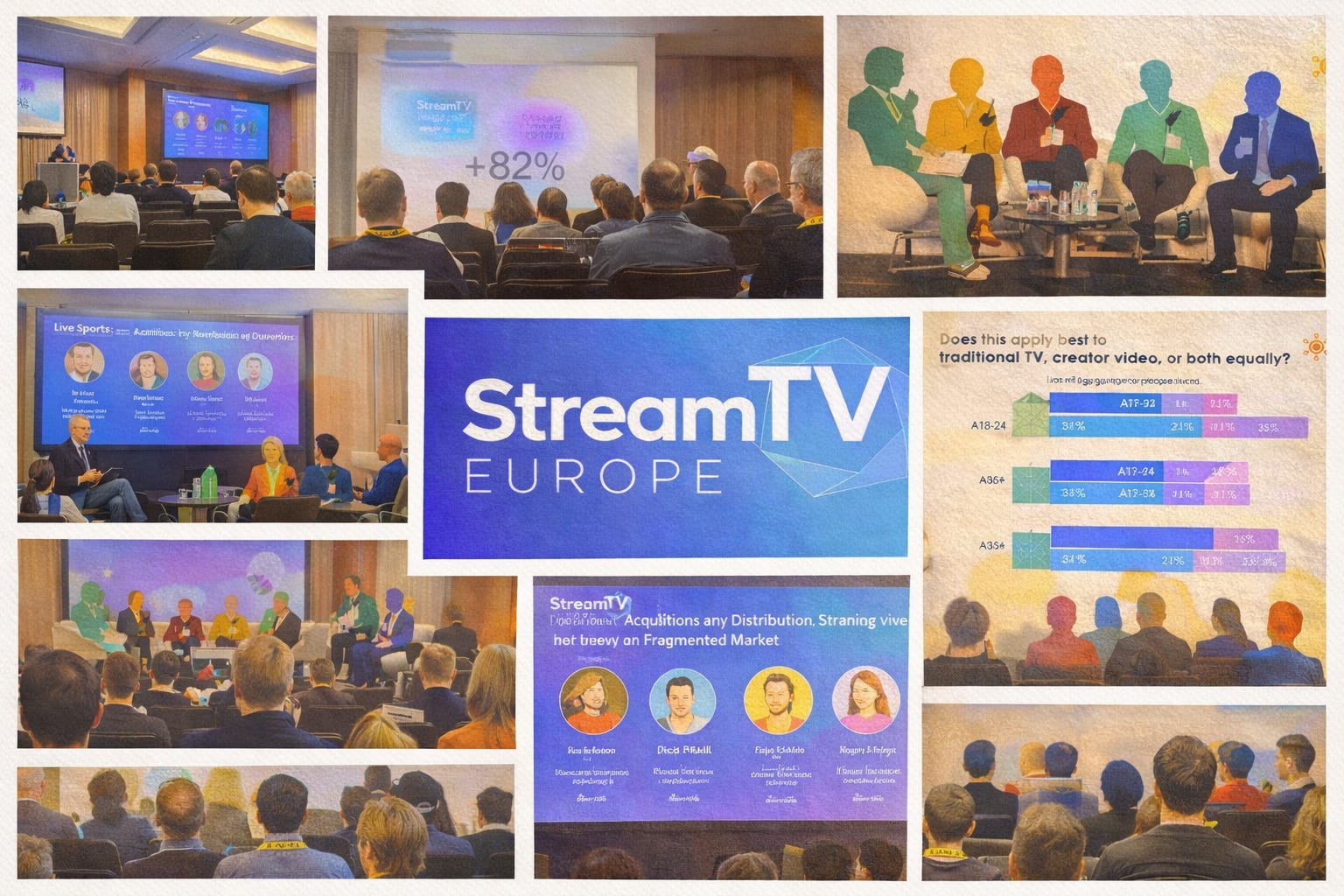
The Specific Is Universal: 3 Days at StreamTV Europe and 10 Insights on the Legacy-Creator Convergence You Can’t Afford to Miss
I was on the fence about speaking at StreamTV Europe. The Denver conference is well regarded, and the speakers and moderators are top notch. But Europe is a different animal. The creator economy doesn’t map cleanly onto a continent where a show that dominates in Spain means nothing in Germany, where public broadcasting still holds structural power that has no real American equivalent, and where regulatory frameworks treat content the way other governments treat roads and utilities — as infrastructure too important to leave entirely to the market. Was a thirty-minute panel worth a long transatlantic flight?
But something told me I needed to go.
Turns out the fragmentation and regulation I was worried about wasn’t the story. It was the backdrop. We say about country-specific content that breaks through globally that “the specific is universal.” That was true here too. The actual story was the same one playing out in every media market in the world, just more honestly discussed than I expected: we all know the model has changed. Nobody has fully figured out how to make money from the new one.
Here are the ten things I heard that I can’t stop thinking about. (And if you ever make it to Lisbon, grab a meal at O Magano — thanks for coming with me Tim Shey!)
1. “Fandom does not build itself. It builds around the community that feels ownership.” — Marion Ranchet, Founder, Streaming Made Easy | Session: Who Owns the First Click in the Living Room
This was one of the opening sessions of the conference and it set the frame for a lot that followed. Ranchet was making a specific point about ITV’s Love Island — which succeeds on social not because ITV repurposes clips but because the community around the show feels like it owns the conversation, in between episodes, in between seasons. The fandom isn’t a marketing output. It’s the product. The show is just the thing that feeds it.
I felt this one personally. I’ve watched it happen on shows I’ve produced — superfans building on social, real community forming in real time, and our streaming partners simply not interested in building engagement in the off-season. The show ends, the platform moves on, the community disperses. That frustration was part of the impetus for writing this newsletter in the first place.
When you build for a community that feels ownership, you build something that compounds. When you broadcast at an audience, you rent their attention one episode at a time.
2. “Working with creators — it’s not just a content strategy. It’s an audience acquisition strategy.” — Marion Ranchet | Session: Who Owns the First Click in the Living Room
Same session, one beat later. ITV’s I’m a Celebrity cast “Angryginge” — a creator — and his entire existing audience followed him into the show and carried him to the final. Casting a creator isn’t a social media stunt. It’s a distribution decision. You’re not buying content. You’re buying an audience relationship that already exists and inviting it into your ecosystem.
Legacy media has been treating creator partnerships as marketing tactics. The smarter operators are treating them as audience infrastructure. We wrote recently about Sony Pictures bringing in gaming creator Jacksepticeye as a producer on Bloodborne — a PlayStation horror game with a massive existing fanbase. He speaks for his community. His community is the audience. That’s the distinction. And it matters enormously for how you structure the deal, what you ask the creator to do, and what you measure at the end.
3. “I can buy attention cheaply, but I cannot buy relevance. And not a single boardroom can decide what relevance is. It is the community.” — Tobias Schiwek, CEO, We Are ERA | Session: New Forms of Distribution — Alternative Content
The arms race between platforms has made attention abundant and cheap. What’s scarce is relevance — content that actually matters to a specific community. And relevance can’t be manufactured from the top down. It emerges from communities and gets validated by them.
Schiwek followed this with an analogy that hit home: when electricity replaced steam in factories, the first instinct was to replace the one big steam engine with one big electric engine in the center of the factory. Nothing changed. It took a generation for someone to ask: why not replace the one overpowered engine with many small engines, each with a single purpose, distributed throughout the factory? That’s what’s happening in legacy media right now. Companies are protecting centralized power until the water boils, and by the time they try to distribute it, they’ve lost their bargaining leverage — with YouTube, with Amazon, with talent. You need those small engines running everywhere, powering every show to its community.
4. “The right way to do YouTube is not to worry about YouTube. The right way is to worry about your viewer. YouTube is just a platform to deliver that.” — Pedro Pina, VP YouTube Europe | Session: TF1 and Gaspard G are Transforming Journalism on YouTube
More radical than it sounds. The mistake legacy operators make is asking “how do I make money on this platform?” as the first question. The right first question is: what does my viewer need and how do I deliver it? Revenue follows audience. Legacy media has always made the thing first and then gone looking for the audience. Pina is saying flip it — start with who you’re serving and build toward them. The platform is just the road.
He also pushed back on the generational mythology the industry keeps telling itself. YouTube’s fastest-growing demographic is 55+. Gen Z are the biggest consumers of podcasts and long-form YouTube — in the living room, on the big screen, for hours at a time. The data keeps contradicting what everyone assumes they know. Build your strategy on the mythology and you’ll keep designing for an audience that doesn’t exist the way you think it does.
5. “Each episode is basically a content machine, because we can create dozens and dozens of clips used on YouTube Shorts, of course, but also on TikTok, Instagram Reels, podcast platforms.” — Gaspard Guermonprez, creator / Le Dossier | Session: TF1 and Gaspard G are Transforming Journalism on YouTube
This is the DNA-at-center, surfaces-everywhere model in its most concrete operational form. Le Dossier is a TF1/Gaspard collaboration — a 40-50 minute gamified interview format where political candidates sit with their own archive: old footage, forgotten tweets, past TV appearances. TF1 provides 50 years of archive. Gaspard provides the audience and the voice. No windowing — simultaneous on both channels via YouTube’s co-ownership tool. One piece of journalism produces a 4-hour podcast, a 40-minute YouTube episode, dozens of Shorts, Reels, TikToks, and clips. The IP is the archive plus the format. The surfaces are everything from a long-form sit-down to a 15-second vertical.
This is not a content repurposing strategy. It’s a content architecture strategy. The difference is that repurposing starts with the primary format and cuts it down. The architecture Gaspard is describing starts with the DNA — the format, the tension, the archive — and builds specifically for each surface from the beginning.
6. “Don’t speak about the creator economy. Speak about the economy of creation. We are part of this economy of creation. It’s our DNA. We are producers. We are creators.” — Alexia Laroche Joubert, CEO France, Banijay | Session: The Banijay Blueprint
The best line of the conference. Evan Shapiro said he was going to steal it right there on stage. Laroche Joubert was closing a section on Banijay’s Creator Lab experiment — where they gave five dormant IP formats to mid-level YouTube creators with €50k each to reinvent them. It worked in some ways and failed in others. The €50k was the wrong structure because it funded one-offs, not series. But the insight was more valuable than the content: legacy producers aren’t outside the creator economy looking in. They are the original creator economy. They just forgot it.
The reframe matters. “Creator economy” has been colonized to mean YouTube and TikTok and social-native content. Laroche Joubert is arguing the real question isn’t whether Banijay can enter the creator economy. It’s whether the creator economy will eventually recognize that format IP, production infrastructure, and decades of audience understanding are assets, not liabilities. Everyone who creates is a creator. Content will reach singularity.
At the end of the day, everyone who creates is a creator and content will reach singularity.
7. “Over 60% of our content discovery happens off platform. Our users are engaging with their community on Discord, Reddit, YouTube, TikTok, and that’s coming to us with a content wish list.” — David Ball, VP Business Development EMEA, Crunchyroll | Session: Content Acquisitions and Distribution
Crunchyroll is the world’s largest anime platform outside Japan — 50,000 pieces of content — and the majority of how its users discover what to watch next happens entirely outside its walls. The platform is the destination. The community is the discovery engine.
The implication is clarifying: if 60% of your discovery is off-platform, your most important investment isn’t your recommendation algorithm. It’s your community infrastructure — the Discord servers, the Reddit presence, the creator relationships, the social content. Those surfaces are doing the work. The platform is just where people go after the community has already sold them.
8. “Mr. Beast has 77 language versions. He has 150 million subscribers in English, with over 350 million subscribers in other languages.” — Fredrik af Malmborg, CEO, Dubhub | Session: The New Content Playbook
MrBeast has built more than twice as large an audience outside his native language as within it. The non-English audience isn’t a nice-to-have. It’s the majority of the business.
The proof point Malmborg offered: take a Turkish drama series, dub it into French for $400 per episode, publish it on a dedicated French-language YouTube channel, and after a year you’re generating $2-3k in YouTube revenue per episode. That’s a $2k profit per episode, achieved by opening a surface the original IP never reached. The DNA is Turkish drama. The surface is French YouTube. The economics are simple and replicable. Most legacy IP owners aren’t doing this because they think of their catalog as a rights library to be licensed. That’s a very different mental model — with a very different revenue ceiling — than thinking of it as a multi-surface asset.
9. “If you have 100% of something that lives on social and you can only monetize it socially, that’s great, but there’s a ceiling. If you have 50% of something that could grow bigger and be scaled globally, then that’s arguably better, because you have no ceiling.” — Matt Ford, Co-Head Digital Studio, Sony Pictures TIP | Session: Creators vs. Hollywood
The cleanest articulation of the deal logic with studios I’ve heard. The creator instinct is to own everything. The studio instinct is to acquire everything. Both positions are self-defeating. What Ford is describing is a third model: shared ownership of something that can scale without a ceiling.
The session also produced the most useful research data of the conference, from Hub Entertainment Research: under-25s now see creator content and traditional media as interchangeable. No quality gap. No premium distinction. What they do have is a clear preference for community — content made for people like them, that their friends talk about. That association goes overwhelmingly to creator content, not traditional media. The DNA of legacy IP is still valuable. The cultural authority that used to accompany it is not.
10. “We’re not even doing the basics properly.” — Nick Ruczaj, Sharp | Session: Better Targeting, Less Tracking — Monetising the Big Screen in 2026
Save this one for last because it’s the honest bookend to everything else. While every other session was describing the future — find the audience, build for every surface, let community do the work — Ruczaj was pointing at the floor. The advertising infrastructure to actually make money from that future doesn’t exist yet. You can’t reliably cap how many times someone sees the same ad. You can’t measure audiences consistently across streaming and broadcast. Even the most sophisticated data partnerships cover a fraction of the market. The plumbing isn’t built.
Three days in Lisbon confirmed that everyone in European streaming has intellectually arrived at the new model. The practice — the infrastructure, the measurement, the economics — is still being built. And in that gap is where the companies that move too slowly will lose their bargaining power for good.
So here are my four big conclusions—
The revenue gap is real, and AI is the uncomfortable bridge. Everyone in Lisbon admitted the same thing, some on, some off the record: traditional money is leaving faster than new money is arriving. The distributed model works in theory. The economics don’t close yet. AI — for localization, formatting, catalog monetization — is probably how that gap gets closed. That’s a hard thing to say in a room full of people who could lose their job or cut their workforces considerably due to this. But it’s also true.
There is no playbook. That’s the point. The German soccer league, Bundesliga, built a six-tier distribution stack. TF1 partnered with a 28-year-old YouTuber to unlock a 50-year archive. Crunchyroll let Discord do its discovery work. None of these models are the same. None are fully proven. The companies waiting for someone else to declare victory before they move are going to arrive at the negotiating table with nothing left to offer.
This is moving faster than any of us thought. I didn’t go to Lisbon expecting urgency. I found a room full of people who have already accepted the new model and are now racing to build it before their leverage runs out. Tobias Schiwek’s warning stays with me: the steam engine companies didn’t lose slowly. They just waited too long.
Your IP must travel or it dies. Meet audiences where they are isn’t a cliché — it’s an operational mandate that almost nobody has fully executed. Your IP has a DNA. That DNA has to live on every surface in the language of that surface. A TV show is one expression of something bigger. The question isn’t how do we make a great show. It’s how does this world live on YouTube, on TikTok, in a Discord server, between seasons. Gather them. Get in dialogue. Hold them in. That’s how reach becomes residence. That’s how a show becomes a world.


