


Welcome to The Vertical Bloom, a weekly dive into the fast-growing world of microseries and vertical storytelling. Here, we unpack the platforms, creators, and deals shaping the format that’s quietly redefining what it means to make—and watch—scripted content in the mobile age.

This week, major brands turn verticals into a shopping engine, creator-led scripted IP makes strides, and the man who saw podcasts early thinks about the future of verticals.
But first–
I’m writing this from a brasserie in Paris, searching for a few more words…
And tomorrow we’ll be making our way towards Cannes Lions. The Festival of Creativity. I get the feeling from those that went last year that it’s going to be quite the event. The creator economy continues to evolve.
On Wednesday I’ll be sharing the stage with some recent collaborators and reflecting on where this vertical space has been, and where it’s headed.
But as I myself head toward Cannes I can’t help but continue contextualizing all of this in the broader evolution of entertainment, of the creator economy, of digital media, but also that of technology and culture. It’s all careening together towards something we’ve never seen. The words to describe this undiscovered future are the words I’m seeking here next to the côte de bœuf and the tiled ceilings.
What I’ll share on stage is ostensibly about vertical storytelling. The ideas behind it are much bigger. The future it points to even larger than that.
Maybe I should find all of this uncertainty unsettling. Instead, I find it energizing. Because while I cannot describe the hard contours of the shape our collective future in entertainment is yet to take, I have more certainty than ever that within it will be the beating heart of story, and the ever-present texture of the human experience.
And some dank memes too.
Tonight though, I’m going to keep searching for the last words I need for this presentation at Cannes Lions. If all goes well, I’ll share the talk itself here next week.
If you’re in Cannes, join me Wednesday at 3:30 on the Creator Stage, and if you’re not there, I’ll share it here not too long after.
I hope some people think I’m right, I hope some people think I’m wrong, I hope we all end up talking about it fiercely on the Croisette.
But for now, let’s get into it.

Fox Plans to Keep Tubi and The Roku Channel Separate
Fox has bet big on verticals via some key investments, and this signals it’s move into streaming. As more verticals preserve the horizontal frame we’re interested to see how Tubi becomes a player, and where Roku fits in.
Target and Bravo Turn Fandom Into a Shoppable Digital Series
Shop What Happens points to a future where vertical and mobile-first entertainment are not just marketing extensions, but commerce engines built around fandom, talent, and real-time purchase behavior.
Silk White Builds a Hollywood-Free Hit Machine
Silk White’s success outside the traditional studio system is another reminder that underserved audiences, low-cost production, and FAST platforms can create real businesses without waiting for Hollywood permission.
Graviteur Studios Bets on Creator-Led Scripted IP
The team behind this venture represent some longstanding minds within the digital space, and this bet around scripted IP is another signal towards the market’s confidence in digitally-native scripted formats.

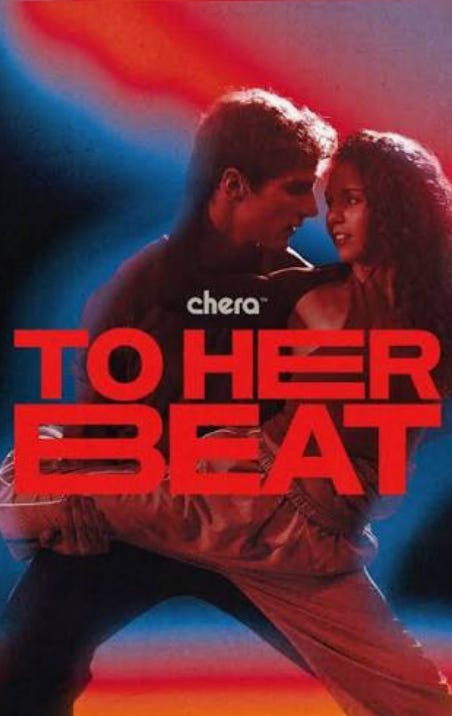
To Her Beat
Platform: Chera TV
Logline: Set against sweat-soaked studios, neon-lit warehouses, and early-2000s dance culture, To Her Beat is a coming-of-age love story about finding your voice, choosing your people, and dancing like your life depends on it.
Genre: Coming-of-age romance / dance drama
To Her Beat announces itself differently from the first frame. The color grade is particularly distinct compared to what you’re used to seeing in vertical: no overlit faces engineered to pop on an auto-playing feed. It’s moodier than that, more textured. Paired with a needledrop opening track, the show reads as something that has a strong point of view.
The writing leans naturalistic, and the cast handles it deftly. This medium is typically loud about the overtones but these deliveries were much richer in subtext.
There’s craft in the camera and post work too. A shot inside a fridge and jump cuts that lean into the digital grammar of the format paired with cinematic tracking shots that nod toward contemporary TV. The sound design feels equally deliberate. There are sequences carried entirely on SFX and dialogue.
In a format where music is often used as a constant emotional prop to hold retention, that’s a risk. But the most interesting gamble is the dance sequences. Conventional wisdom in vertical says stay tight, keep cutting, don’t linger: the format rewards speed and escalation. To Her Beat has moments of breath early to establish the motif of full dance sequences. I for one enjoyed them.
Chera TV built its identity around the idea that the vertical format deserves the same creative rigor as anything else. To Her Beat is a wonderful one-two step in that direction.

What the Vertical Media Summit Told Us
Editor’s note: Hernan Lopez recently published a piece in his Streaminomics newsletter summarizing insights from the Vertical Media Summit: a closed-door gathering of senior leaders across the industry. Scott was in attendance but we’re only sharing info that’s available in the free, public edition of this recap. Hernan notes that clients receive a version with deeper analysis and proprietary Owl & Co research one day in advance. If you work for an Owl & Co client, or would like to become one, reply to Hernan directly.
Vertical is real because people are arguing about it like it is real.
“Vertical storytelling is a phase”
“The quality isn’t there”
“Real audiences aren’t watching.”
There is a version of this conversation that keeps coming back. The tone is usually skeptical, sometimes dismissive and the arguments aren’t new. But the fact that it keeps needing to be made is, we’d argue, exactly the point.
Hernan Lopez has heard this before. He’s the founder of Wondery, which he built into the world’s largest independent podcast publisher before Amazon acquired it. He was one of the earliest voices making the case that podcasting was a serious storytelling medium, long before the industry agreed. He was right about that. He is now paying close attention to vertical.
His piece on the Vertical Media Summit frames the pushback not as a warning sign, but as a familiar one. A format that keeps threatening something keeps generating resistance. The persistence of that resistance is its own form of proof. Vertical has been generating that for a while now. Dismissal can sound an awful lot like disruption if you listen close enough.
It’s also worth noting who was in the room. Netflix. Amazon. HBO. Companies that rewrote the rules of their respective industries because they saw a shift coming and moved toward it early. They’ve done this before. That they are actively interrogating vertical now is not a coincidence. It is a pattern.
Their presence does not prove exactly where vertical is headed. But it does make one thing harder to dismiss: the format is no longer sitting outside the serious media conversation. So the more useful move is to stop arguing over whether vertical matters and start looking closely at where the category is actually taking shape.
We’ll connect more of those dots next week. A short history of television’s first years, how the industry positioned it against cinema, and why the arc from movie theater to living room to pocket feels less like coincidence and more like inevitability.
But here’s what to pay attention to in the meantime:
The first thing to watch is the nomenclature. The vocabulary of this medium is still being written. Microdramas get most of the attention because they’re the format most comparable to traditional TV. But they’re one rib of a much larger umbrella. Hernan points out what we’ve been feeling for a while: vertical is as broad a category as television itself and the grammar and definitions are still being found and defined.
Something we’ve been calling a format might turn out to be a genre. Something we called a genre might be a secret third thing. (We once referred to Playback internally as a vertical motion picture because that’s what it felt like to us.) There is already a push to retire “microdrama” in favor of “microseries,” or simply “vertical.” Not all of them are dramas.The language is still catching up to the work.
The second thing to watch is viewing context because it both literally and figuratively frames the content. He offers a useful system: four distinct contexts for where people are watching vertical.
Vertical native apps: Dedicated platforms built specifically for this format. Think ReelShort, DramaBox, CandyJar.
Media super apps: Large platforms where vertical lives alongside everything else. Think TikTok, Instagram, YouTube Shorts.
Streamers, free and premium: Traditional streaming platforms now licensing or producing vertical content. Think Peacock, Netflix.
News: Vertical-formatted journalism and nonfiction content. The most underreported category in the conversation.
Where people watch tells you just as much about the vibe of the content (and the viewers themselves!) as genre does. Each vehicle is building it’s own subset of audience expectations.
Then there’s AI filmmaking. The third thing to watch is that vertical is the clearest test case for it right now. There are essentially no fully AI-generated feature films or traditional series in wide commercial release. In vertical, the picture is completely different. AI-generated microseries already exist and already have audiences. (Though maybe not the same as the audiences that watch man-made microseries. Check out this edition of the bloom for our thoughts on that).
The reason is structural: when your budget is tight and your turnaround is fast, AI isn’t a luxury, it’s a production reality. The gap between what you can make with and without it is enormous at smaller budgets. It can change what a show is capable of being, not just how efficiently you make it. On a currently typical vertical series (small-budget with tight timelines), it can change the scope, speed, visual ambition, and even the genres that become producible.
The final thing to watch is timing. The big question of course is if and when to enter this space. Hernan names some instructive fads (3D movies, the metaverse, virtual reality) to illustrate how difficult it is to distinguish a trend from a technology looking for a use case. It’s hard to tell what the tipping point is. But, like with any good disrupter, those who are waiting to see it before they believe it will likely be too late.
Scott has said something to our team more than once since attending the summit, which was echoed to me when I read Mary Ann Halford’s closing remarks: the energy in that room was specific. Something more visceral than cautious optimism. A room full of people who have watched cycles come and go, genuinely excited about where this format is headed.
The energy around vertical right now does not prove the future. But it does show that serious people are no longer laughing it off. They are paying attention, testing the edges, and trying to understand the rules as they’re writing them.
That’s it for this week’s Vertical Bloom.
We’re excited to keep building this into a weekly home for the ideas, experiments, and creative voices shaping vertical storytelling in real time.
We’ll be back next Thursday with more headlines, more analysis, and another look at where this medium is headed.
See you then.
Editor: Scott Brown
Writer: Franziska Harms