


Welcome to The Vertical Bloom, a weekly dive into the fast-growing world of microseries and vertical storytelling. Here, we unpack the platforms, creators, and deals shaping the format that’s quietly redefining what it means to make—and watch—scripted content in the mobile age.

This week, an Ode to Open-gate, Larry Namer declaring that vertical is Hollywood’s future at VidCon, and Rachel Sennott returning to her digital roots with The Scene.
But First-
I’m partially in the business of reading tea leaves. At least that’s the closest metaphor for myself, and for my team over the past few years to describe the practice of interpreting the trends of an emerging market.
Two years ago, it was our observation about the then-unnamed world of short dramas (the ones we all now call microdramas) that put us in the position we’re in today.
The tricky thing about the future is that history doesn’t repeat itself. It just has a habit of rhyming.
I felt that rhyme today.
The Emmy nominations came out this morning. Sure, the short-form categories are broad. But when I look at who actually got nominated, what I really see is a proliferation of content and a recognition that is independent of vertical or horizontal format.
Three of the four noms in short-form are platformed on youtube. Kareem Rahma, the guy behind the nominee SubwayTakes, said it best in a recent interview: this feels like a watershed moment, the point where traditional Hollywood stops just lurking around digital and starts figuring out how to actually work with it.
I agree. And I think the continued democratization of content is a genuinely good thing.
But like any discipline where commerce and art collide, the most ambitious work is still going to need people with real resources willing to collaborate and push it further.
What I love most about this era, and what I see reflected in today’s nominations, is a simple idea: anyone with a perspective, a story they want to tell, and an audience they want to reach can be recognized at the highest level.
A gold statue is so much more than a physical object. It’s recognition. It’s people lifting other people up. It’s what it feels like when your work gets legitimized. It is art being validated at the highest level an industry has to offer.
But it’s also a signal. Usually from the people who hold the most tastemaking power in the room, telling everyone else to go further.
Today, the TV Academy sent that signal to everyone working in vertical and short-form. And I know exactly what we’re going to do with it: go further.
To be clear, when we’re telling a story, we’re not thinking about statues. We’re thinking about making the best story we possibly can.
But I’d be lying if I said today’s announcement didn’t give me a little more fuel to walk back into the unknown. The blank page. The next shoot day. The unfinished editing timeline that this work always seems to hand you.
So today, I want to recognize that the TV Academy is telling us something. Our peers are telling us something.
They’re telling us to keep going.
That’s exactly the message I needed to hear today.
Onward.

“Subway Takes” Along with other YouTube Shows Receive Emmy Nominations
The short-form series is the first creator-led show backed by YouTube to earn a nomination, alongside 3 other YouTube series, indicating a major push by the streaming app.
Traditional Hollywood Is Investing Big in Internet Stories. Here’s Why
The LA Times surveys why legacy players are treating vertical, internet-native storytelling as a real business line rather than an experiment.
Larry Namer at VidCon: The Future of Hollywood Is Vertical Video
E! founder Larry Namer told VidCon that Hollywood is still making content for the wrong screen, arguing the industry’s future belongs to whoever follows audience behavior over tradition. A notable endorsement of the vertical thesis.
Brands See Content Gold in Microdramas. Will They Muck Up the Moment?
Marketing Dive surveys the branded-microdrama land grab (Crocs, Dr Pepper, JCPenney, and Marc Jacobs among them) finding real engagement wins alongside warnings that treating the format like a rented 30-second ad could undercut the authenticity that makes it work.
Netflix Adds Variety’s “How Well Do They Know?” in New Publisher Video Deal
Netflix will stream short-form video from Variety, Vanity Fair, BuzzFeed, and dozens of other publishers starting in August. Another signal that streamers see snackable, vertical-friendly formats as essential to holding attention against TikTok and YouTube.
With Brand Microdramas, the Talent Layer Is the Real Opportunity
SonderCo’s Sean Akaks argues brands chasing microdrama virality are missing the bigger play: building real, ongoing talent relationships and franchises instead of one-off endorsement deals. A read that pairs nicely with this week’s Marc Jacobs feature below.

The Scene
Platform: Marc Jacobs’ owned social channels (TikTok, Instagram, YouTube, Website)
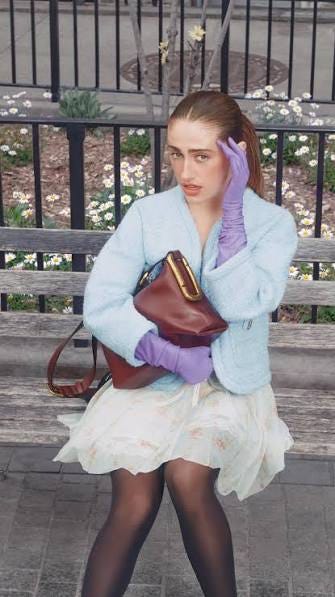
Logline: A fashion-world satire following Sennott’s frantic sprint across Manhattan trying to catch Anna Wintour’s eye and land a last-minute Met Gala invite. Marc Jacobs’ new Scene Bag is along for the ride.
Genre: Comedy / Branded
Rachel Sennott’s fingerprint is all over “The Scene,” and that’s exactly why it works.
The Scene Bag is the whole point of the campaign, and yet it’s never the plot. Instead we get fun shots of it like the POV’s from inside the bag itself: a technique that folds seamlessly into Sennott’s dizzying, constant-motion, docu-style handheld aesthetic. Nothing about the integration feels like placement.
The restless, indie, slightly chaotic “it-girl” quality of the filmmaking is precisely the vibe Marc Jacobs is selling with this bag, which makes the creator/brand pairing feel so right.
“The Scene” is available in both horizontal and vertical, and the vertical cut is arguably the better version. Getting only fragments of facial expressions and insert shots forces an extra layer of gritty intimacy and immediacy onto the footage and for a plot that’s essentially one long gallivant across Manhattan, that fragmentary, on-the-move quality is the appeal.
The namedrops and cameos (Francesca Scorsese, the SubwayTakes guy, Anna Wintour as a running gag) these aren’t in your face gen-pub pandering, they’re winks. You either clock them or you don’t, and that’s the design. A pure IYKYK exercise that flatters the audience sharp enough to catch it, and in doing so, quietly sorts viewers into “the kind of person who’d carry this bag.”
And then there’s the writing, which is where Sennott is truly in her element. The entire episode runs on dramatic irony. That gap between what the audience knows and what the character believes is the engine of the comedy, and it’s mined for everything it’s worth, right down to the stuffed puppet rat.
Sennott also understands microdrama stakes in comedy specifically. Getting caught calling the paparazzi on herself could read as a minor beat but here, it’s treated as a genuine crisis — and that’s correct, because comedy thrives on turning molehills into mountains. And those mountains are what makes a microdrama run. The audience laughs because they recognize themselves in the overreaction.
The pacing is another real technical achievement. In a few minutes, we watch her bolt out of the apartment, try to hunt down SubwayTakes guy, getting busted calling Backgrid on herself, mistake a dinner reservation confirmation call for Anna Wintour, spill wine on a stranger thanks to the rat, and get home just in time to discover the invite she already had. That’s six or seven distinct beats back to back. She nails the microdrama pacing. Setting it in New York wasn’t incidental either: that city’s built-in velocity is what makes cramming that much plot into three minutes believable and relatable.
My only real complaint is that there’s only one episode. Marc Jacobs found a way to showcase a $478 bag without a single cringe-inducing moment, inside a format built for a very specific audience, using a creator whose comedic instincts are purpose-built for exactly this pace. Given that Sennott made her name in digital before crossing over to legacy film and TV, none of this should be surprising, but as someone who falls squarely in this target demo, I (Fran) for one loved it.

ATTN VERTICAL FILMMAKERS: WHY SHOOTING OPEN GATE IS A GAME CHANGER FOR 9:16
If you’re about to direct a vertical microdrama, one of the first creative decisions you’ll make is deceptively technical.
What aspect ratio are you actually going to shoot?
On our first microdrama, The Diamond Rose, we shot native 9:16.
We mounted cameras to L-brackets. We committed completely to the final frame.
At the time, that felt right. Scott wanted to discipline himself as a Director, and challenge himself and the DP, to innovate inside the exact confines of the audience experience.
It’s called the Paradox of Constraints. It might be why Hemingway’s six-word story packs such an emotional punch: Boundaries unlock creativity.
On our next vertical, a musical series called PLAYBACK, we had the opportunity to shoot on Sony BURANOs with full-frame Cooke lenses.
This time, we mounted the cameras horizontally and we shot open gate.
Having the option to reformat the show horizontally down the line was a nice bonus. But that’s not why we did it. We did it because, already having had one microdrama under our belt, we knew the constraints and the challenges.
With these in mind, shooting horizontally made the vertical version better.
In post, it gave us the ability to reframe left and right. To fine-tune emotional close-ups. To push in and out and around with fewer boundaries, but with the intention that only comes from experience of restriction.
That kind of flexibility is key when you’re trying to make something that feels precise, cinematic, and emotionally alive inside a vertical frame.
Shooting in 6k, it also let us shoot wider and capture two actors at once, to split them into singles later. This saved us time and gave us room for more ambitious staging, which mattered a lot on a series with 17 musical numbers.
But one of the biggest unlocks was what it gave the actors.
By blocking scenes a certain way, and running a three-camera setup on the full-frame sensor, we were able to give performers more usable takes without slowing the machine down.
On many vertical sets, actors get one or two takes in coverage and then everyone moves on.
Not on this set. One actor told me afterward:
“I was always able to do my best work, even as we shot so many pages. I was never rushed.”
That stayed with me because when you’re shooting 15 pages a day, every edge matters. Every technical choice is also a creative choice. And every creative choice is a chance to protect the performances, elevate the story, and push the medium forward.
The point isn’t that every vertical should shoot open gate. In fact, if it’s your first one, I’d challenge you not to.
The point is that vertical storytelling deserves the same level of thought we bring to any other format. The frame may be smaller, but the choices within these limits can often have a more profound impact on the result, precisely because there is no “wiggle room”.
Every story in this space that succeeds in elevating the medium is a win for all of us.
Happy shooting.
That’s it for this week’s Vertical Bloom.
We’re excited to keep building this into a weekly home for the ideas, experiments, and creative voices shaping vertical storytelling in real time.
We’ll be back next Thursday with more headlines, more analysis, and another look at where this medium is headed.
See you then.
Editor: Scott Brown
Writer: Franziska Harms