The Vertical Bloom: 07/23/26
Your guide to the happenings of the vertical drama landscape.
Welcome to The Vertical Bloom, a weekly dive into the fast-growing world of microseries and vertical storytelling. Here, we unpack the platforms, creators, and deals shaping the format that’s quietly redefining what it means to make—and watch—scripted content in the mobile age.
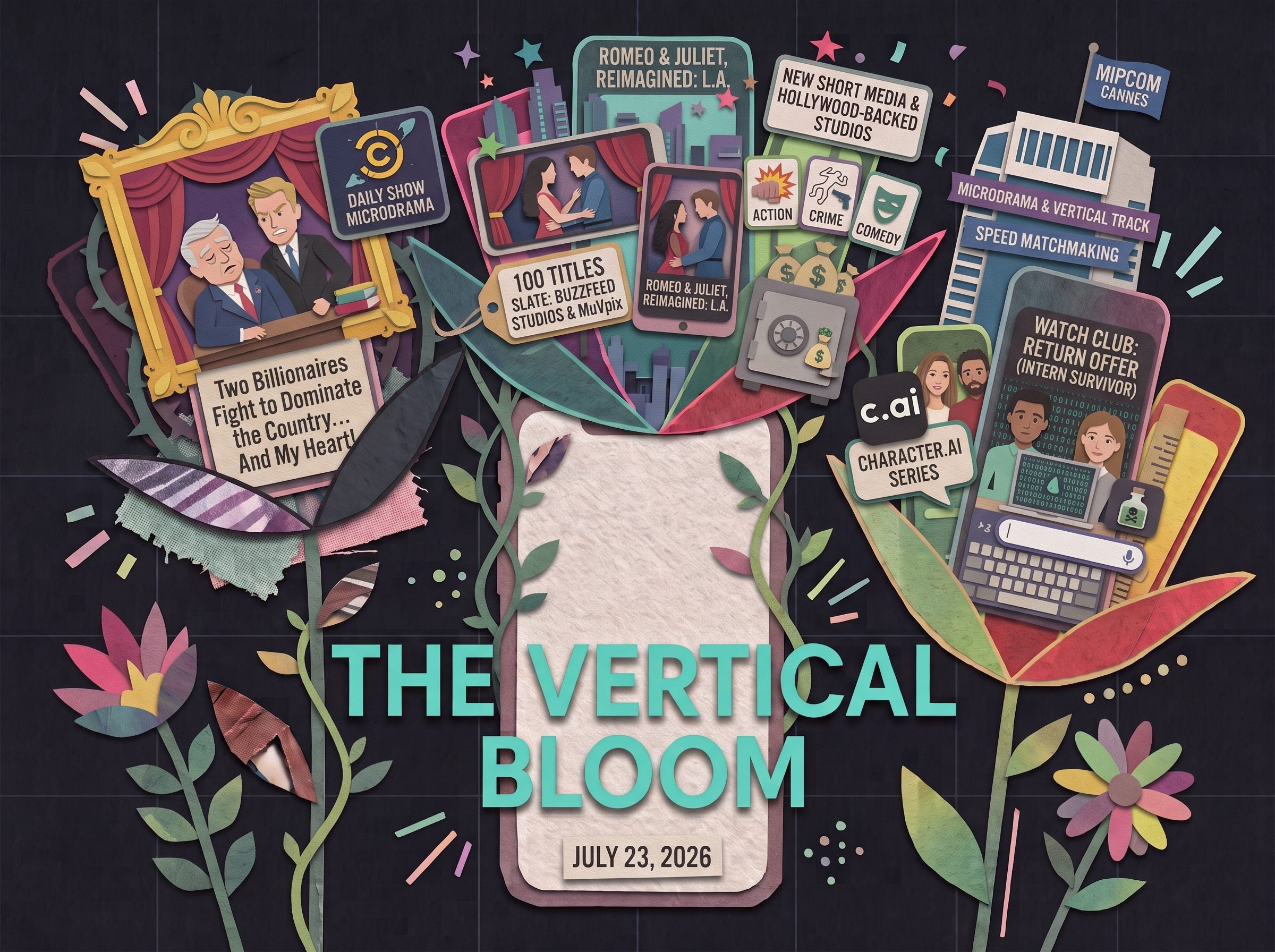
It’s been a wild week for vertical. The Daily Show is making a microdrama. Two Hollywood-backed studios launched on the same day. BuzzFeed committed to more than 100 titles. MIPCOM carved out dedicated real estate for the category. And an AI chatbot company decided episodes needed a chat window.
No deep dive this week. Just the headlines that matter, what they mean for the format, and a Weekly Watch I have a lot to say about.
But first-
There’s a lot of action out there right now, though I realize that for many people, it doesn’t feel that way.
For many of the actors and creative professionals in this space, production has slowed considerably since the boom of summer of ’25. People aren’t working every week or booking 30 shows a year. That kind of whiplash is real, and so is the impact on people’s livelihoods.
But from where I sit, and the meetings I take, I believe we’re experiencing a correction, not a collapse.
I believe a second wave is coming, driven by new players and some truly massive platforms that are poised to change the scale and reach of the vertical space.
I’ve been optimistic about verticals since I first discovered them. I can’t promise that the days of working 52 weeks a year are coming back (and, frankly, it’s worth asking whether they should.)
I read something by Truffaut about the creative mind needing to lay fallow. That it’s actually good for short periods of inactivity. Let’s all take a creative breath in.
Because I do believe over the next 6-8 months we’re about to see a major expansion in the genres, formats, and kinds of stories this space can support.
Most importantly, I believe we’ll continue to see the quality evolve—on the audience’s terms.
And we need our creative minds ready for these evolutions.
So yes, I remain optimistic.
Hang in there, friends. I genuinely believe the next chapter could be much bigger than the last.
Alright, let’s get into it.
Comedy Central Is Making a White House Microdrama, and It’s Aiming the Joke at the Format Itself
Source: TheWrap and Paramount Press Express
The Daily Show is producing its first-ever microdrama: Two Billionaires Fight to Dominate the Country… And My Heart! The vertical series spoofs both U.S. politics and the soapy, over-the-top DNA of microdrama itself, complete with a sleepy president, warring tech titans, and a love triangle.
This is a cultural validation milestone. When a 30-year-old satire institution decides the microdrama format is recognizable enough to parody, that’s a signal the tropes, enemies-to-lovers, absurd power struggles, breathless cliffhangers, have entered the mainstream vocabulary. It is the same way sitcoms began spoofing reality TV once everyone already knew the beats.
It’s also a hedge and a stress test. If audiences laugh with the format rather than at it, that’s free marketing for every straight-faced microdrama on the app store. If it reads as mockery, it could accelerate the “guilty pleasure” stigma some in the industry are trying to shed as they chase premium positioning.
Either way, we’re watching to see whether other legacy comedy and news brands follow, testing the validity of the format’s entrance into the zeitgeist.
BuzzFeed Studios Goes All In: 100 Microdrama Titles, Starting With a Gangland Romeo & Juliet
Source: BuzzFeed Studios
BuzzFeed Studios and muVpix, the flagship platform of BlackForge Distribution, have struck a deal to produce more than 100 microdrama titles over the next two years.
The partnership kicks off with Romeo & Juliet, Reimagined, which transplants Shakespeare’s star-crossed lovers into the criminal underworld of modern-day Los Angeles. The series was shot in both horizontal and vertical formats, and the larger partnership will span original IP, reimagined classics, and “shoppable” formats built natively for TikTok, Instagram Reels, YouTube Shorts, FAST/CTV, and muVpix’s own platform.
This is a scale play, not a toe-dip. A legacy digital media brand committing to more than 100 titles signals the format has moved past “experiment with one show and see” and into full-pipeline production, the same maturation curve linear television and streaming went through.
Two details are worth flagging for the industry. First, the dual horizontal-and-vertical shoot strategy suggests studios are increasingly hedging their format bets rather than committing purely to vertical, treating “vertical” as a distribution layer rather than the entire identity of a show.
Second, “reimagined classics” as a stated content pillar, adapting public-domain IP like Shakespeare, is a smart way to sidestep licensing costs while banking on built-in name recognition. It is a strategy other studios chasing scale will likely copy.
New Short Media Is a New Big Player
Source: Deadline
Veteran producers Alon Shtruzman, the former CEO of Keshet International, and Scott Einbinder have launched New Short Media, a vertical-storytelling studio operating alongside their existing 5X Media banner.
Backed by a “consortium of investors,” the studio is explicitly positioning itself around “brand-name content creators, actors and creative talent,” premium production values, and an early slate that pushes beyond conventional romance into action, thriller, comedy, crime, and reality.
Notably, the launch landed on the same day as another Hollywood-backed vertical studio debut: vertTV, a subscription platform and studio launched by veteran producers Jeffrey Schenck, Barry Barnholtz, and Peter Sullivan.
The genre-diversification angle is the real story here. Microdrama’s breakout success in the United States has largely been built on romance and soap-opera melodrama. This studio, and others like it, are explicitly betting that the format can carry action, crime, and comedy just as well once premium production and recognizable talent are layered in.
The clustering of launches also suggests we may be entering a land-grab moment. Investors and veteran producers could be moving in parallel because they all see the same window, and perhaps see it beginning to close.
MIPCOM Cannes Builds a Whole Track Around Microdrama and Vertical Content
Source: MIPCOM Cannes
MIPCOM Cannes, the major international television and content market running from October 12 through October 15, has unveiled a significantly expanded 2026 program built around vertical storytelling.
The program includes an invitation-only Global Microdrama & Vertical Leaders’ Summit, a live recording of The Media Odyssey podcast dedicated to “premium vertical television,” and a new Vertical Content Speed Matchmaking category on the market’s official platform. The category will join its existing Scripted and Unscripted matchmaking tracks.
Character.ai Wants You to Chat With Your Microdrama’s Characters
Source: Character.ai and The Verge
Character.ai has launched (c.ai) series, a collection of original short-form vertical series with a twist. After watching an episode, users over 18 can open a chat with its characters, ask questions, revisit moments, explore relationships, or roleplay new storylines within the show’s world.
This is one of the clearest attempts yet to bolt an interactive layer onto the microdrama format, and it is coming from a company that did not originate inside the existing vertical-video ecosystem.
Character.ai already has a fandom-heavy audience accustomed to creating characters, roleplaying, and building fictional worlds. That makes this as much a retention play as a content play. The episode attracts viewers, but the chat experience gives them a reason to remain inside the platform after the credits.
If it works, it opens a genuinely new lane. Platforms like ReelShort currently have no equivalent chatbot layer, and a “talk to your fave after the episode” feature could deepen the kind of parasocial engagement that serialized storytelling already encourages.
But it’s worth treating this one with some real caution. Character.ai has faced significant scrutiny over the way its chatbots have interacted with younger users. The company says the character-chat feature for these series is limited to over-18 users, but layering emotionally engaging serialized video onto AI companionship still creates meaningful questions around moderation, age verification, and safety.
Return Offer — Watch Club
Let me say it plainly: Watch Club might be one of the smartest plays in vertical right now, and Return Offer is the proof of concept.
The premise: A cohort of college interns competes for a full-time return offer at a high-stress AI startup, and it gets toxic and ruthless fast. If you’re a fan of SKAM, Industry, or Survivor, which, full disclosure, I absolutely am, this is your show.
The Platform Play
Let’s start with the macro read of the platform, which is that Watch Club is building specifically for a YA audience, and that’s a smart bet.
There used to be an entire ecosystem built around that demographic: dedicated cable channels, appointment viewing, and a whole cultural infrastructure. That infrastructure has largely evaporated. Because that audience has bifurcated across a million places on the internet, nothing has stepped in to capture them in a monoculture-type way.
Watch Club is making a direct run at it, and Return Offer is a well-executed big swing.
What I love is that this show refuses to talk down to its audience. It wears its SKAM inspiration well, not just in tone, but in the way it engages with situations that feel true to that age group, whether it is something they are currently navigating or something on the horizon that they are excited about or bracing for.
It handles this without ever getting gratuitous or “adult” for the sake of it and, even more critically, without being cringey. It respects the stakes through its characters’ eyes, which is exactly why it plays just as well for an older audience.
There are a few “The Summer I Turned Pretty moments,” my term for a moment that reminds you, yes, this is a YA show, but they are the exception, not the engine. The show mostly resists leaning on YA tropes in a way that would alienate a discerning younger viewer looking for something with real substance.
While I can’t recommend it to viewers under 21, I also know that 16- or 17-year-old me would have desperately wanted to watch it. That tension may be part of what makes it work. It feels made for a younger audience without feeling sanitized for them.
The SKAM DNA
The other big SKAM borrow, which I genuinely adore, is the structure.
Episodes are broken up by in-world social-media posts: an Instagram Story here, a LinkedIn post there, each one letting you dip further into the universe between chapters.
And this goes a layer deeper than you might assume. Per Watch Club’s own app description, these character posts go up in real time as the story unfolds, woven directly into the ongoing narrative rather than existing as preloaded bonus content.
That clever mechanic that made SKAM so innovative is perfect for the audience Watch Club is targeting: digitally native Zoomers. It has a Big Brother Live Feeds-style immediacy to it, and it activates real-time FOMO. Miss the update and you have missed a piece of the story as the fandom experienced it.
It’s a smart way to keep an already-engaged audience checking back outside the episode window, teasing future plot, and capitalizing on parasocial relationships. The retention, engagement, and community strategies are richly layered here.
The Craft
The character work is great. Nobody here is a walking stereotype.
You can see the recognizable archetypes the writers are building from, but each character gets fleshed out as an individual with real throughlines of motivations, weaknesses, strengths, goals, and fears.
The writing is naturalistic, which does mean it runs a little slower than your average microdrama. But it’s still considerably faster and more plot-dense than a typical television show.
The camera work is fun, too. It plays with keyframes and handheld chaos to give the show a distinctly digital feel. Sometimes that language heightens the comedy in an almost The Office-style way. In the tenser moments, the same instability starts to feel closer to The Bear. It is a smart visual bridge between internet-native storytelling and television craft.
The romance isn’t overwrought. It’s well-written and genuinely complex, playing with power dynamics and a paramour trope that has real flirtatious, toxic spice to it, running in parallel with a competing slow-burn romance.
The Vibes
(Yes, I’m Giving the Vibes Their Own Section)
I have to give a moment to the color grading, because this show is just nice to look at.
Paired with moments in the score that lean into that Nathan Micay-esque “tech startup” electronic sound, it adds up to a real vibe.
Bottom Line
I’m genuinely excited to see what else comes out of Watch Club.
If you are too, the company is currently hiring screenwriters and casting actors for upcoming projects.
That’s it for this week’s Vertical Bloom.
We’re excited to keep building this into a weekly home for the ideas, experiments, and creative voices shaping vertical storytelling in real time.
We’ll be back next Thursday with more headlines, more analysis, and another look at where this medium is headed.
See you then.
Editor: Scott Brown
Writer: Franziska Harms


