


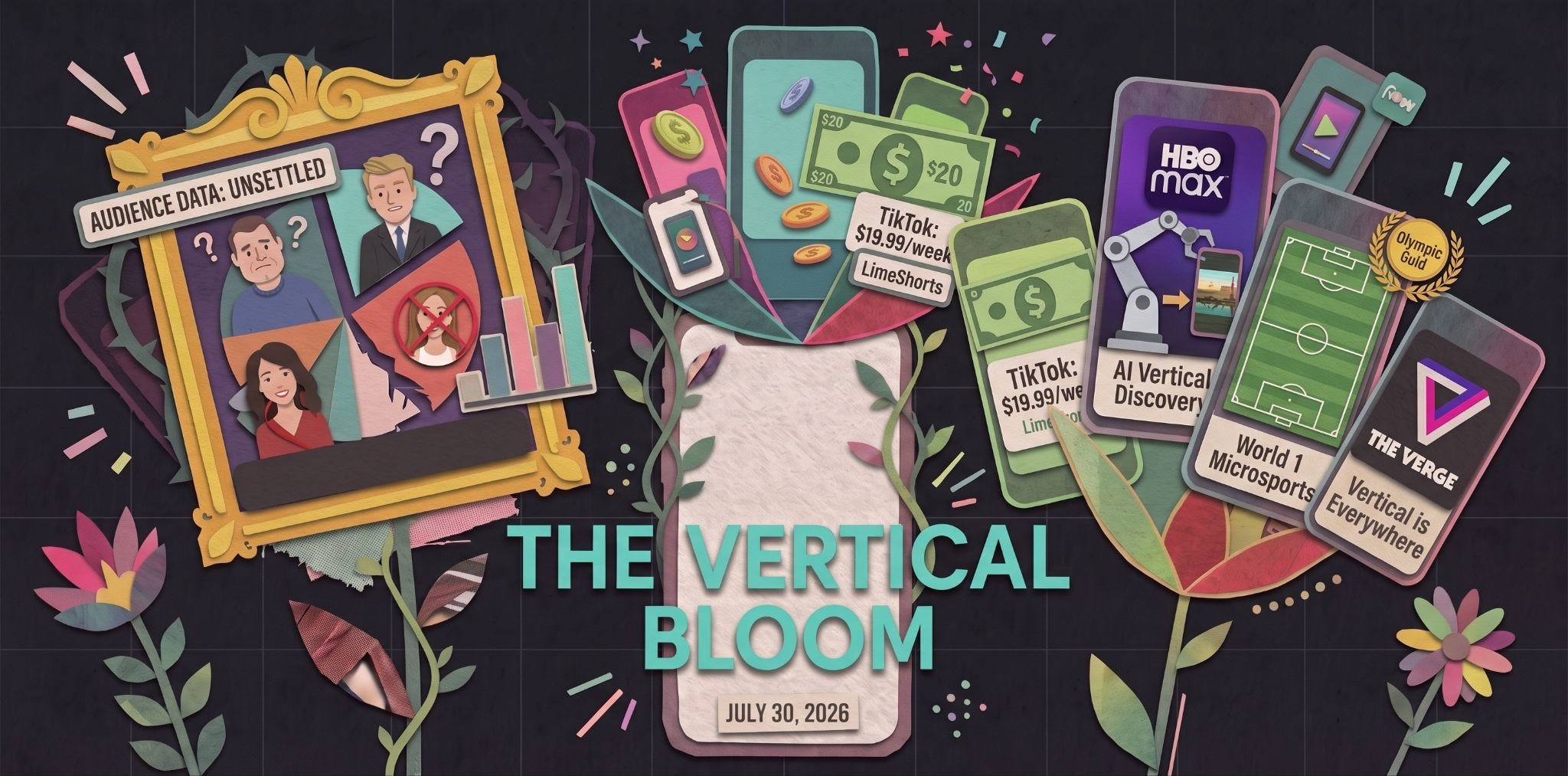
Welcome to The Vertical Bloom, a weekly dive into the fast-growing world of microseries and vertical storytelling. Here, we unpack the platforms, creators, and deals shaping the format that’s quietly redefining what it means to make—and watch—scripted content in the mobile age.

This week, TikTok tests the limits of microdrama pricing, HBO Max brings AI-assisted vertical discovery into its mobile app, and a new sports company asks what happens when the competition itself is built for the feed. Then, we dig into new audience data from HOLYWATER TECH and Owl & Co, and what it suggests about a category whose viewer profile is still changing in real time.
But first…
This was a wild week in vertical behind the scenes at Second Rodeo, but we still want to bring something valuable to your inbox. In the spirit of brevity being an important value, a Haiku:
The Audience Longs
For Moments They Won’t Forget
And a Secret Depth
And I still believe this is true.
Alright, let’s get into it!

TikTok Quietly Tests a $20-a-Week Microdrama App
TikTok has been running a paid microdrama app called LimeShorts in the U.S. since March. The app mirrors the freemium model of category leaders ReelShort and DramaBox: free opening episodes, followed by a paywall. Full access currently costs $19.99 a week or $200 a year, while digital coin packages range from $5 for 500 coins to $70 for 8,500. LimeShorts replaced ByteDance’s earlier fiction-reading app, Mytopia.
Its catalog currently comes entirely from third-party partners, and a TikTok spokesperson said pricing may still change as the company tests different options. The app sits alongside TikTok’s free PineDrama app and a dedicated microdrama feed being tested inside the main TikTok app.
This means TikTok is now running free, freemium, and premium experiments in the format simultaneously. The U.S. microdrama industry generated roughly $1.4 billion in 2025, according to consulting firm Owl & Co, and TikTok’s multi-tier approach reads as an attempt to find out which price point that audience will actually bear.
HBO Max Dips a Toe Into Vertical, Powered by AI
As part of two new mobile discovery features, HBO Max rolled out a vertical, scrollable feed called HBO Max Shorts this week.
The feed surfaces trailers, bonus material, and iconic or memorable scenes from the platform’s library to help users discover something to watch. It is currently being tested with select iOS users in the U.S.
Crucially, these are not original vertical dramas. The clips are designed to move viewers toward the full-length titles they came from, a discovery strategy Netflix is also using with its Clips feed.
The clips are generated with help from an in-house AI tool that uses scene-level metadata to comb through thousands of hours of programming and suggest potentially high-impact moments. Human editors then decide which scenes to use and how to verticalize them.
World 1 Wants to Build “Microsports” for the Feed
World 1, a sports-entertainment company backed by Mark Cuban and built with a founding group that includes ten Olympic medalists, has unveiled Microsports: entirely original athletic competitions where world titles can be won or lost in roughly 30 seconds, designed specifically for vertical video.
CEO Brett Morris argues that the modern sports industry was built around television, even as audiences increasingly moved toward their phones. Rather than adapting legacy competitions into shorter clips, World 1 is attempting to build a new category of sports engineered for the feed from the beginning.
The company is starting with two competitions, Fastest and Strongest, with plans to develop more.
The Verge: Vertical Video Is Eating Every Platform
In a column tying together many of the week’s threads, The Verge argues that TikTok’s vertical format is spreading across YouTube, Instagram, streaming services, and nearly every other major media platform as their products converge around mobile-first viewing.
It is the connective thesis behind everything else in this roundup. HBO Max is reformatting its library into scroll-friendly clips. A sports startup is engineering entire competitions for the feed. TikTok is testing multiple ways to package and monetize serialized vertical storytelling.
The underlying format war may already have been decided. What remains is the fight over who owns the audience once they are there.

The Category Is Still Being Built: What HOLYWATER’s Data Actually Tells Us
A Vertical Bloom deep dive into The State of Microdrama 2026, shared with us by HOLYWATER TECH.
HOLYWATER TECH, the company behind live-action app My Drama and AI-generated app My Muse, passed us a copy of The State of Microdrama 2026, a joint report with Owl & Co.
The report combines four data sources: internal product data from My Drama and My Muse, a self-selected in-app survey of 2,737 self-identified U.S. microdrama fans reached through My Drama, and a separate self-selected My Muse survey with 34,406 responses. The reporting windows vary by dataset. My Muse product data generally covers December 2025 through May 2026, while some of the My Drama demographic data extends back to Q2 2024.
It was prepared for the Vertical Media Summit 2026 before HOLYWATER decided to release it publicly, with Owl & Co founder Hernan Lopez writing the foreword.
Several outlets have already run through the top-line findings, but we wanted to focus on the numbers we have kept coming back to, and what they might mean beyond the report itself.
1. The Audience Isn’t Settled Yet. Not Really.
The data: Roughly 65% of the My Drama users surveyed have been watching microdrama for less than a year. Break that down further: 31% started less than three months ago, another 35% started three to twelve months ago, and only 12% have been watching for more than two years.
By the report’s own framing, the category is “still being formed.”
That might be a throwaway statistic if new viewers behaved like new viewers usually do: tentatively, at low intensity, and with a high likelihood of drifting away. The current users represented here do not. Eighty-two percent of the under-three-month cohort already opens My Drama daily, the same rate as viewers who have been around for two years.
It is the same pattern showing up elsewhere in the report. Men went from 1.1% to 30.3% of My Drama’s monthly active users with known gender in seven quarters, a 28-fold increase. The share represented by viewers aged 22 to 27 among known-age monthly active users more than tripled in five quarters.
Among the current users captured in this report, later arrivals are not behaving like tourists.
Our take: This is the single most important finding in the report because it reframes what “the microdrama audience” even means.
There is no stable, legible microdrama viewer to design around yet. There is a viewer profile from 2024, women aged 35 to 54 watching at night, that the report itself describes as a caricature. Underneath it is a fast-moving population that increasingly does not look like that.
Any platform, studio, or brand treating today’s engagement data as a fixed target may be optimizing for a group that could represent a much smaller portion of the audience a year from now.
The more useful implication is about where the immediate growth opportunity sits. The report does not prove that retention is solved. It surveys current My Drama users rather than tracking everyone who has ever tried the category and churned, and a voluntary in-app survey is naturally more likely to capture engaged viewers.
It does, however, suggest that frequent use can form quickly among people who make it into the app. Eighty-two percent of users who began watching microdrama within the previous three months already open My Drama daily.
That should push the industry to think just as seriously about sampling as optimization: getting unfamiliar audiences, including men, older Gen Z viewers, and non-romance audiences, to try the format in the first place.
The platforms that win the next eighteen months may be the ones that expand who samples microdrama, not only the ones that optimize for the people already watching.
2. The Audience Peaks on Sunday Night
The data: The highest-activity window on My Drama is Sunday between 8 and 10 p.m. local time. The lowest activity occurs on weekday mornings between 3 and 9 a.m.
Our take: This is our inference, not the report’s.
It is hard not to notice that My Drama’s highest-activity window overlaps with the Sunday-evening slot legacy television spent decades cultivating for appointment viewing.
The technology and episode lengths have changed, but the psychology may not have. Sunday evening remains a natural period for escapism before the workweek begins, whether that means settling in for a prestige drama or binge-scrolling an entire vertical series in bed.
It is a useful reminder that this audience may not be inventing entirely new viewing behavior. It could be bringing very old habits into a new format.
3. Adapted IP Is the Strongest Lever in the Report, With One Real Asterisk
The data: Forty-one percent of respondents ranked “stories adapted from books, films, or shows you already know” first among four things that would get them to watch more.
That placed adapted IP ahead of underserved genres, famous actors, and knowing that friends are watching.
The report calls it “the single most powerful lever for the audience overall.”
The asterisk is that, within the survey’s male subgroup, adapted IP mattered at roughly half the average rate. It is one major lever where a rapidly growing part of the audience diverges sharply from the existing base.
Our take: This validates a trend we have already been covering.
WWE’s ReelShort collaboration and the vertical reformat of Alfred Hitchcock’s The Lodger are not simply opportunistic one-offs. They are recent examples of companies testing whether recognition can reduce the friction of choosing what to watch inside an unfamiliar format.
The report supports adapted IP as a lever for getting existing My Drama users to watch more. microdrama.
Expect the IP-licensing conversation in vertical to accelerate. Familiar worlds, characters, books, films, and entertainment brands give audiences a trusted entry point into additional stories.
But the male-audience finding is an important qualification. Adapted IP may be the strongest overall lever without being the universal answer.
The category is growing, but it is not settled. The audience is becoming habitual before it becomes predictable. The opportunity is not simply to serve the microdrama viewer better.
It is to help discover who that viewer could be.
That’s it for this week’s Vertical Bloom.
We’re excited to keep building this into a weekly home for the ideas, experiments, and creative voices shaping vertical storytelling in real time.
We’ll be back next Thursday with more headlines, more analysis, and another look at where this medium is headed.
See you then.
Editor: Scott Brown
Writer: Franziska Harms