


Last week, a friend was speaking at SoCom, a new national event series about how people discover and buy products through social media. It brings together brands, creators, platforms, agencies and technology companies focused on creator-led sales and livestream shopping. My friend is a social media strategist and entrepreneur with an uncanny ability to see around corners. She knows I’m fascinated by what she does—and that I draw inspiration from it for my own businesses.
At lunch, we sat with two engineers who built a platform that scores creators’ value for brands, and a 22-year-old founder whose platform helps social media management companies analyze their creators and match them with brands. And then there was me, a legacy producer of television and film, trying to understand how all these worlds are colliding.
My friend said our lunch (perhaps a bit too generously) reminded her of the coffeehouses that helped launch the Enlightenment: people from different worlds exchanging ideas that would never emerge inside a single industry. She had explained, more clearly than I could, why I find it so valuable to get outside our core businesses and look around with curiosity.
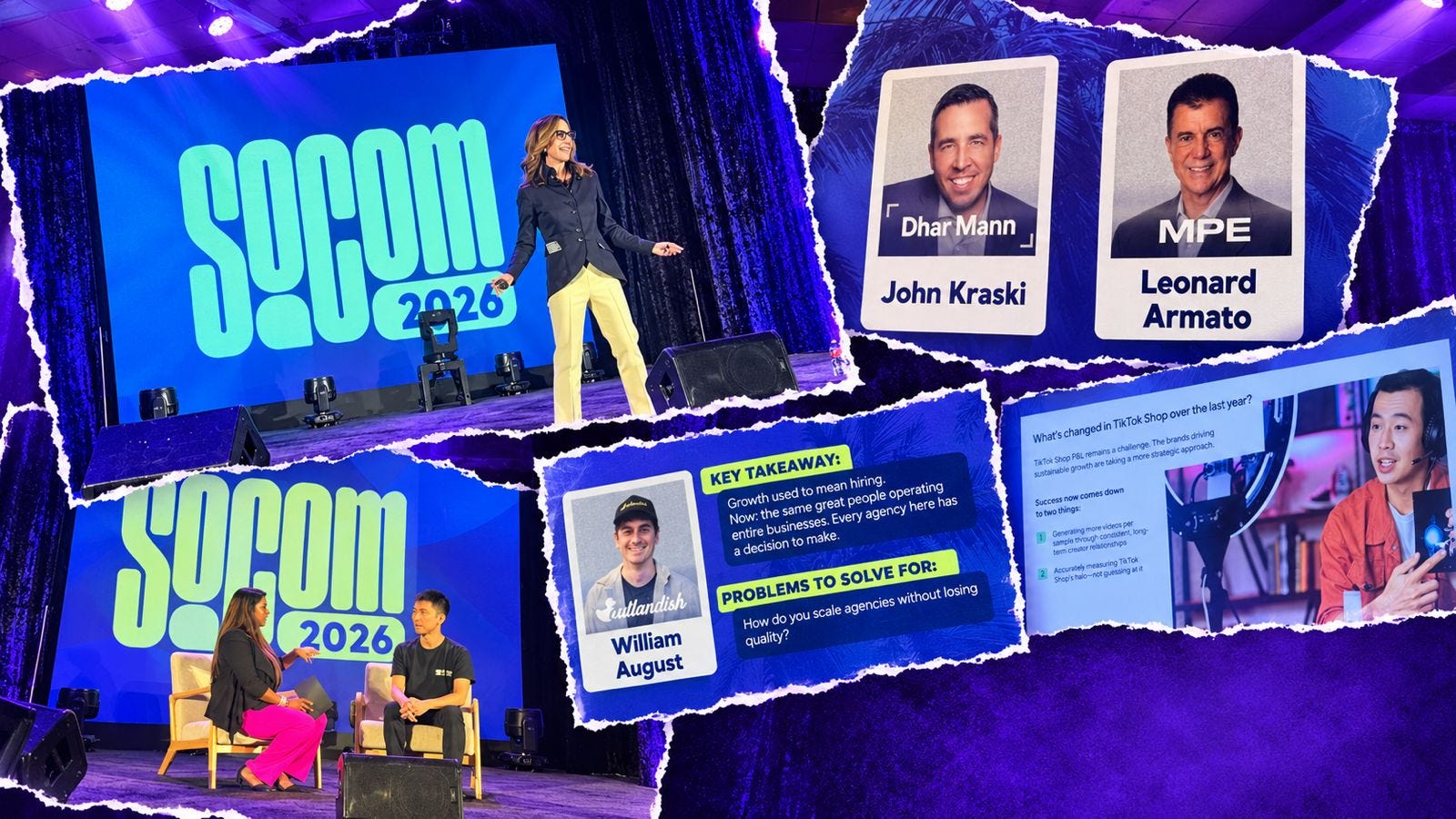
On day one, I heard from SoCom organizer David Vanderveen; Vincent Launay of TikTok Shop; Leonard Armato of Management Plus Enterprises in conversation with John Kraski of Dhar Mann Studios; Jamie Gutfreund of Creator Vision; Deren Baker of Flywheel Ventures; K-beauty marketer Norman Chu with Rashmi Paul of SoCom News; and Will August of Outlandish. Their sessions covered celebrity brands, livestream commerce, creator measurement, affiliate sales and the increasingly blurry line between content and shopping.
Why does any of this matter to my business? Social commerce is rooted in storytelling and faces many of the same marketing problems as film and television. It offers a window into how people’s habits are changing and, for producers who know how to tell and market stories, a possible new source of revenue. That’s something we are pursuing at my company, candidly.
I could attend only the first day. Here are three things I learned.
Three things I learned about celebrity at SoCom…
As my brain tried to filter all this information, one theme emerged across a few different panels—the value of celebrity…
Brands are being told to stop chasing stars and start running a show. TikTok’s Vincent Launay told brands that success is no longer about one viral moment or one famous creator. It’s about “operational excellence.” One poignant example --- At K2O, the hydration brand Kylie Jenner founded, more than half the sales come out of a studio an operator built in his basement, where staff paid $50 an hour go live on TikTok. The celebrity’s name is on the brand, but the hosts are doing the selling.
Will August, whose agency runs TikTok Shop for brands, was blunter about trust. David Beckham, he said, “can’t convert because he doesn’t give social proof.” A famous face brings attention. The trust that closes a sale comes from the people showing the product and answering questions.
A famous face can’t fix a product that doesn’t deserve a second buy. David Vanderveen built the Excess energy drink, sold it to Amway in 2015, and later helped launch IM8, a supplement brand co-founded with David Beckham. IM8 reached about $200 million in revenue in roughly 18 months. Then he told a room full of founders not to copy it: “Be careful about celebrity brands. That’s coming from a very successful celebrity brand.”
Here is what Beckham actually did for IM8. He gave the brand “stratospheric awareness” and attracted major ambassadors and creators, but “it didn’t convert that many sales.” The celebrity is a megaphone, not an engine. It buys attention and recruits talent.
So why do so many celebrity brands fail quickly? Vanderveen’s answer was pretty blunt: the celebrity’s team isn’t involved day to day, and “the product doesn’t deserve a second buy.” Fame can win the first purchase. The second belongs to the product and the people running it.
Celebrity prices itself on attention, not on sales. Jamie Gutfreund made this point with a made-up example she borrowed from the founders of Trudy, a company that scores how much a creator is likely to sell for a brand. Marge makes one post and drives 100 sales. Lois makes many posts and drives the same 100 sales, but costs far more. A brand that counts only sales sees two equal results. Gutfreund called that “just dumb” but “preventable.”
The example is about creators, but it points to a bigger problem with celebrity. A famous person’s fee is set by an unscientific analysis of how many people know them—followers, box-office success and the like—not by how much they will sell. And brands often can’t check because they don’t track what each result cost them. Gutfreund said most companies don’t keep their own creator data. It sits in reports their agencies hand over.
So a big name gets paid like an engine when, as Vanderveen showed, it often works like a megaphone. Fame is worth paying for when you want attention or want to recruit other talent. It’s a poor bet when you’re buying sales. 3Pas is partnering with more and more creators, so this is now the first question I ask: what did each result cost? In plain terms, what did we pay, and what did we get?
The pattern: Fame buys attention. Everything after that is operations, product and measurement.
Where my head goes—The lesson on the commerce side feels fairly clear. As we’ve explored businesses with celebrities, I’ve watched some representatives become so focused on the percentage their famous client receives that they lose sight of what actually makes a company work: a product people want to buy again, strong distribution and disciplined operations. They overvalue the trust the celebrity has built with an audience and undervalue almost everything required to turn that trust into a durable business. The wreckage of celebrity brands is increasingly hard to ignore.
I’m less certain how neatly this maps onto entertainment. A star in a movie isn’t simply endorsing a product; the star is part of the product. But I do wonder whether legacy media companies make a similar mistake when they treat recognition as proof of demand. A famous name can attract attention, help secure financing and get a project through the door. None of that guarantees that people will watch—or tell someone else to watch. This story is as old as time—(Digger the latest example. Right star wrong movie, too expensive, etc)
However that question feels especially relevant as streamers struggle to market individual titles and make their spending produce durable value. Are companies paying stars for the audience they are assumed to bring without knowing whether that audience actually follows? Are they using casting to compensate for weaker development or marketing? And are they measuring the value of a star with the same vague proxies—familiarity, followers, past box office—that brands use when pricing celebrity endorsements? Maybe this is all pretty obvious. But I do think there is something new in this lesson around celebrity brands that we need to think about… I just don’t know what it is yet.
The quote that surprised me
“A lot of people talk about social commerce. We talk more about discovery commerce right now.”
That was Launay again. TikTok sees itself as erasing the old split between media that creates awareness and e-commerce sites that convert it. People arrive to be entertained, and the platform carries them “from awareness to conversion and even to advocating.” The scale behind it: more than 200 million active U.S. users averaging over 100 minutes a day, with time on the app up every year for five years. Those are TikTok’s own numbers.
What surprised me was the assumption underneath. Discovery commerce needs a viewer who is scrolling and open to being found. Lia Haberman, who tracks social media trends, wrote last November, “We’re in our slow social era.” People aren’t logging off, she said, but they are showing up more deliberately. Launay himself conceded that “intentional discovery,” where people search for products instead of stumbling on them, is “becoming even bigger.” If audiences become more deliberate, discovery by accident gets harder. And if brands get hooked on marketing to consumers online while consumers curb their social media habits, everyone has to pivot again.
Where my head goes—As consumer behavior keeps splintering, how do you chase the trends? They seem to be moving in different directions at once. Even within generational cohorts, the data is starting to contradict itself. It’s also an admission that, as a producer who lived by “if you build it, they will come,” paying attention to this data in a profound way is relatively new to me. I need to get smarter about it.
The moment I felt vindicated
As I’ve put more emphasis on creator businesses, I’ve found it hard to measure their value. How big is a creator’s community? What is a post worth? What is a channel worth to a brand? Every answer seems to come from a different tool measuring something different.
It turns out Jamie Gutfreund has been working on this exact problem, especially for brands. She put up a slide mapping the software companies brands use for creator marketing: audience intelligence, analytics, payments and more. One category has grown from about 15 companies to so many she’s “stopped counting.” There are enough tools to make your head spin like The Exorcist.
Then she said, “Who the hell knows what a view is anymore?”
If the person advising brands on this can say that out loud, I’m not behind. The industry is.
And where does my head go generally? We should all look for inspiration outside our own industries. MIPCOM and Sundance are necessary. But if those are the only rooms we enter, we’re just talking to ourselves. The muse needs many sources from which to draw…
Certainly all changing fast.