


(You can still read it for free.)
If you didn’t notice, we recently—and without much fanfare—put up a paywall on Open Gardens.
Here’s what you should know:
Our weekly articles are still free. You can also read the previous three months of the archive for free.
Paid subscribers will get the complete archive and additional premium material as we start creating more. I’ve begun recording interviews on Riverside, and we’ll be publishing highlight clips on social. The interviews are the basis of many of my long-form articles, but the conversations themselves are often pretty interesting. Those go behind the paywall.
A paid subscription costs $8 a month or $80 a year.
I didn’t launch Open Gardens as a revenue stream. But doing this well costs money.
We want to record more interviews, produce more video, cover more events across the country—and eventually around the world—and continue expanding the group of people contributing to the publication.
Right now, I run Open Gardens at a deficit because this is, in the parlance of our time, top of funnel. The payoff is what I learn and what I can share with others and the community we are building.
Any money from subscriptions will go directly back into doing more of the work.
Because of where we’ve placed the paywall, Open Gardens is still essentially free. But if you get a lot out of the publication and can afford to support it, please become a paid subscriber.
And if you can’t afford it but want access to the archive and other paid material, just DM us. We’ll give you a subscription for free.
Really. Hit us up.
I launched Open Gardens a year and a half ago for three reasons.
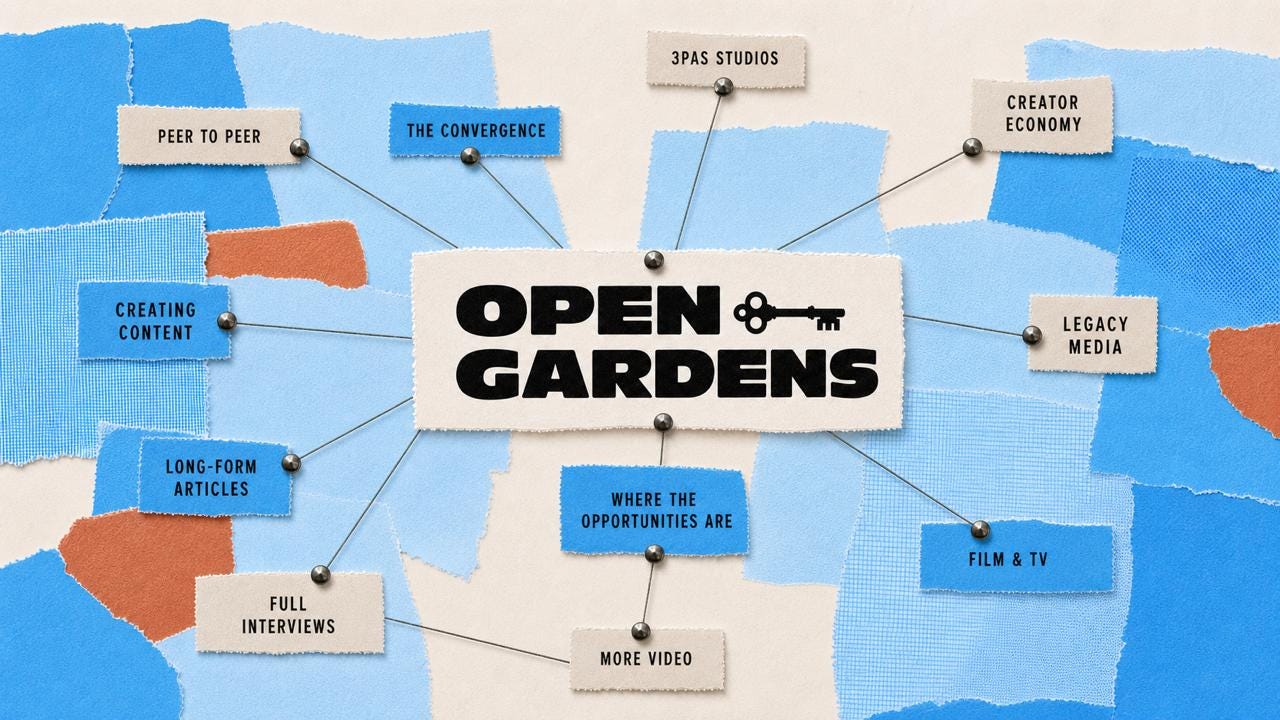
First, I saw the convergence of the creator economy and legacy media coming, and I wanted to hold myself accountable for understanding it—for my own benefit and for the benefit of my company, 3Pas Studios.
Second, I wasn’t seeing enough reporting on these changes from the perspective of the people actually doing the work. Journalists provide enormous value, and I read just about everyone covering this space. But a peer-to-peer conversation is different.
Third, I realized that if I wanted to understand the creator economy, I needed to become a creator. Open Gardens became my induction into that world. Since we’ve launched multiple creator businesses with more on the way.
All three of those things paid off.
Here’s what I didn’t see coming.
I didn’t expect Open Gardens to become widely read by people across both legacy media and the creator economy.
I didn’t expect the convergence to happen so quickly—or for it to become one of the most talked-about subjects across both industries.
And I didn’t expect the publication to connect me with such an enormous network of smart, curious people on every side of this conversation.
I also didn’t fully appreciate that publishing a deep-dive article every week—while managing a team of three other writers and running a very active film and television company—would be a lotta work.
Duh.
Every week, as I face another deadline, I question whether I can keep doing this.
And every week I pull my shit together and get it done, usually while my family gets the brunt of my polishing an article over the weekend. Mitch Camarda , Scott Brown ,and Fernando Morett face similar struggles with time.
And yet…
And yet it’s so worth it.
Open Gardens has become so integral to the evolution of my company that I can’t afford not to continue.
It has been the single best way for me to understand what is changing, where the opportunities are, and what all of this means for people who make a living creating content.
And, from what many readers tell me, it has become similarly useful to them.
Which brings us back to the paywall.
Truthfully, we turned on paid subscriptions because Ted Hope suggested it. Ted is—and has always been—the Patron Saint of Indie Filmmakers and a mentor to an army of people in this industry. When Ted offers advice, it’s generally wise to listen. He was the first to pay for a subscription (thanks Ted).
It also turns out that Substack was built to make money, and it favors Substackers willing to do the same.
The Venerated Algorithm giveth, and the Venerated Algorithm taketh away.
But the real reason to subscribe is simpler.
If Open Gardens helps you understand where this business is going, and you can afford to support the work, please subscribe.
Your subscription won’t determine whether somebody else gets to read Open Gardens.
It will help determine how much more of this work we can do.
Thanks to all who have supported our stack,
Substacker-in-Chief, Open Gardens