


An Open Gardens reader recently asked me the question I hear everywhere in legacy media: producers have spent their careers getting paid to make things — fees up front, backend if you’re lucky. The creator economy asks the opposite of you: fund it yourself, build it in public, and wait years for real revenue. How does a career producer survive that transition?
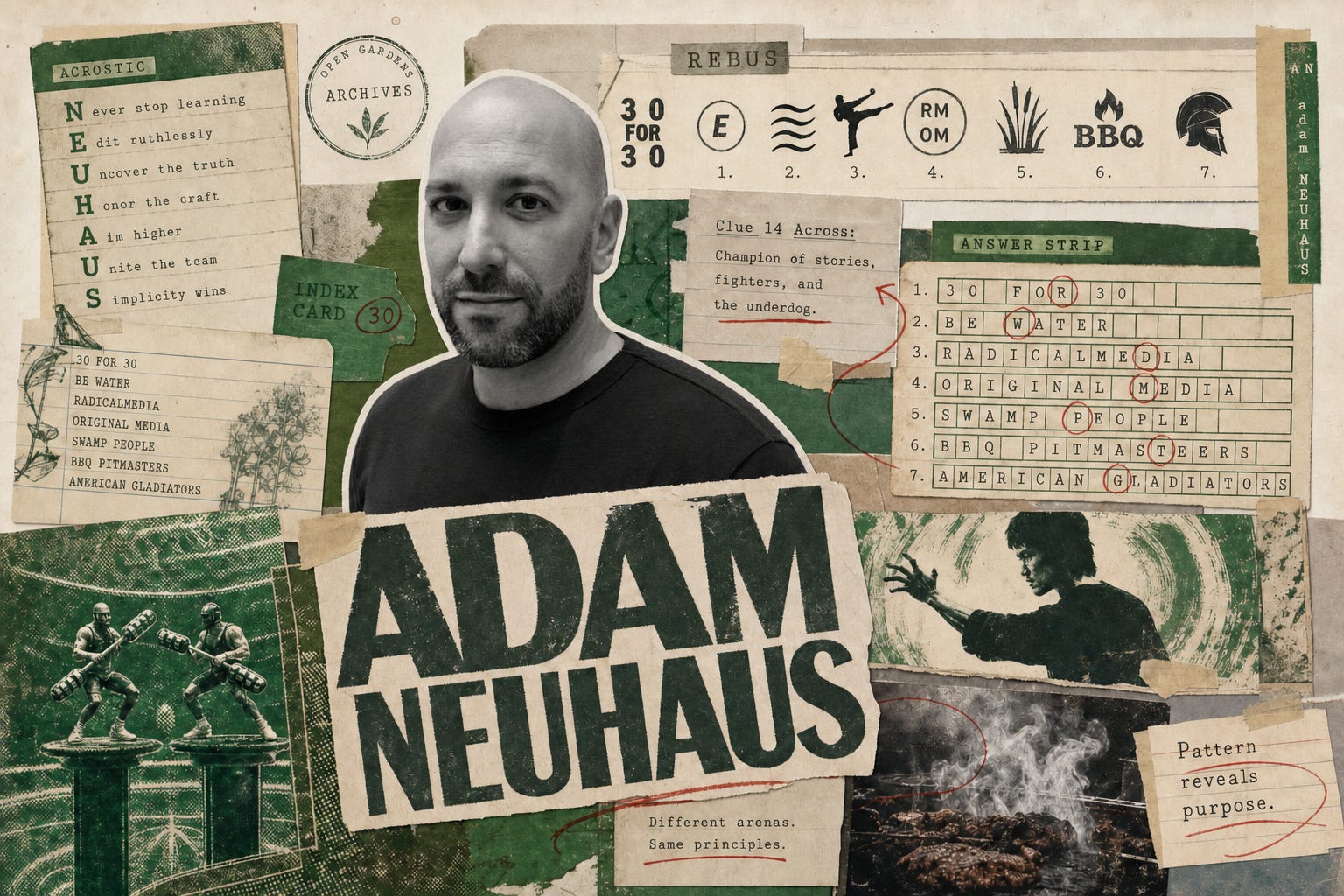
This week, I’m writing about Adam Neuhaus, a high-level nonfiction producer and former executive who isn’t just asking that question. He’s actively building a playbook to answer it.
Adam started in the William Morris mailroom in New York, then moved through Original Media and RadicalMedia, working on shows including Dual Survival, Swamp People, and BBQ Pitmasters. He later spent more than seven years at ESPN Films and 30 for 30, where he helped launch the 30 for 30 podcast series and worked on films including Be Water, The American Gladiators Documentary, and Dream On. A premium executive making premium content during peak TV.
He’s also an Open Gardens reader, which is how we connected. After I wrote about Teton Ridge and what I call OpenVerses—loose affiliations of people around a shared interest that can be corralled into vertical businesses—he reached out on LinkedIn: Hey, I’m actually building what you call an OpenVerse. Would love to chat.
So we did. Then we talked some more. The more we talked, the clearer it became that what Adam was building spoke directly to that reader’s question—and to how I’m thinking about my own company and the bridge between legacy media and creators.
I love this guy: how he thinks, how proactive and strategic he is, and what a mensch he is. That menschy-ness may be part of why he succeeds.
If you want inspiration, take a big hit of Adam Neuhaus. He’ll get you buzzed with excitement about the future of media.
First, Don’t Quit Your Day Job (Seriously — It’s the Strategy)
Before I get into the very distinct creator-legacy convergence businesses Adam is building — and I want to discuss each in detail — I want to lay out one of the foundational principles for producers leaning into the creator economy.
The thing you are great at, the way Adam is great at producing nonfiction series and films, you don’t stop doing it. First of all, you need the revenue coming in. And yes, it’s not what it was during the streaming wars, but if you’re good at what you do, you can still make money. And that’s going to keep the lights on while you build the next business.
Adam still develops and pitches the traditional way, because that’s who he is. But listen to how deliberately he manages it:
“I am developing projects one-off because I’m a development person and I can’t stop doing that… I have series that I’m out pitching, I have formats that I’m out pitching, I have documentaries that I’m packaging up, but I’m being very precise on the amount of those that I take on… it’s not going to be consistent money.”
Because buyers are buying less, that precision is vital: it opens up time to build other things. The commissions that once sustained a whole class of producers have thinned dramatically—the festival acquisition market has cratered (Sundance 2023 famously produced zero U.S. Documentary Competition sales), Participant shut its doors after twenty years, and the streamers have pulled way back on third-party buying. Adam saw it in real time:
“It just became very apparent very quickly that you could not make a living just producing one-off documentaries in this landscape… so I needed to find some other projects that I owned a piece of… beyond a line item in a production budget that takes a couple of years to happen for a single project.”
At 3Pas, we’re trying a version of the same thing: using the traditional business we know to fund a digital division that acts as the company’s spine, then making sure each legacy project is wired into communities. (I keep promising to write more about it, and I will. It’s a work in progress, and I’m waiting for the right moment.) When I described the approach to Adam, he jumped in:
“I’m trying to build that digital spine in my own organization… for all the traditional producers out there, I don’t want to make it sound like I figured this out. It has been a bumpy path to try to find enough revenue in certain ways to reinvest in creating those kind of digital spines for the projects.”
I appreciated that honesty. Neither of us has fully cracked it. That’s kind of the point — this is a piece about building in public, and building in public means you gotta show the scaffolding…
Hello OpenVerse, Hello Puzzlers
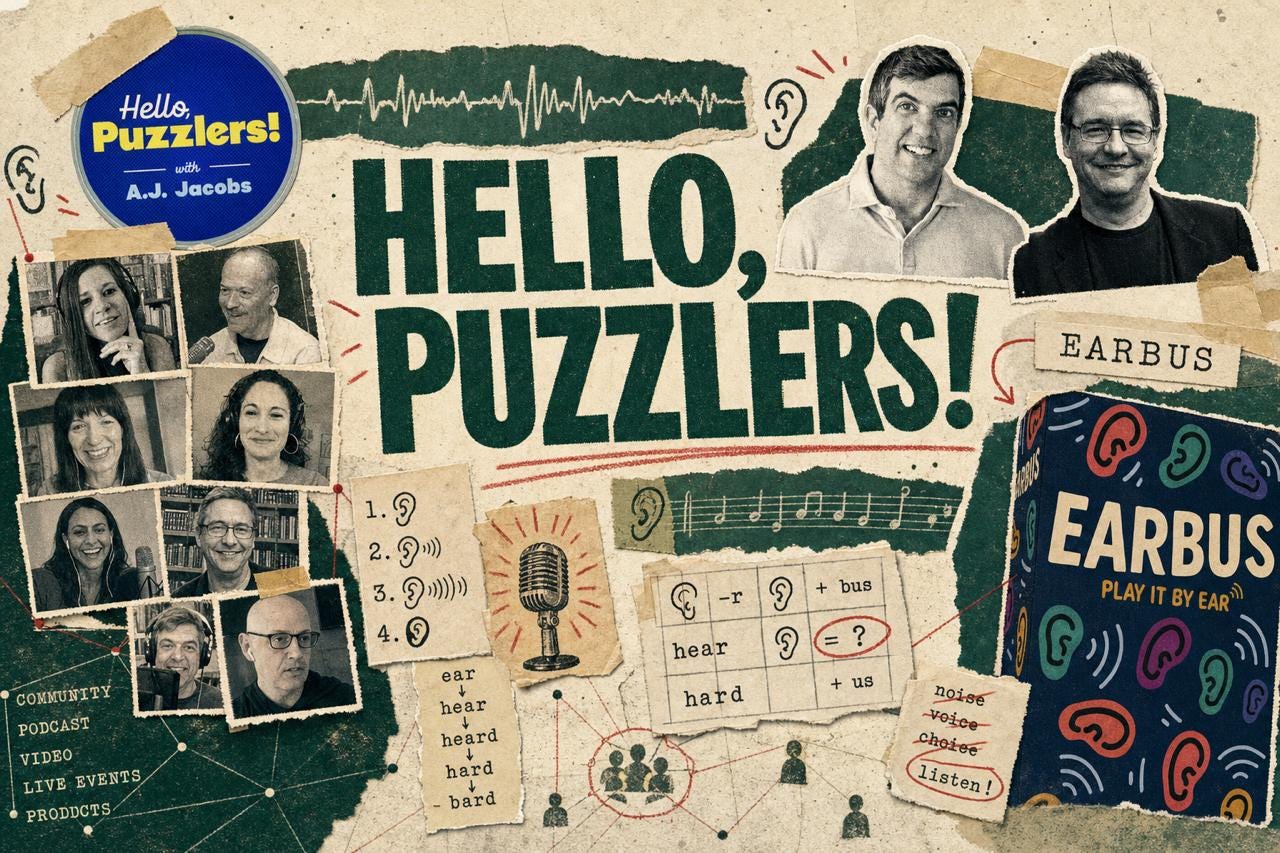
OpenVerses are what connected Adam and me. When he read my pieces, he recognized that I had put a name to something he was already seeing—and beginning to build. His recognition helped propel him in a new direction. Puzzles were his OpenVerse, and the vertical he and his partners are building is called Hello, Puzzlers.
When Adam left ESPN, most of his slate was exactly what you’d expect from a premium non-fiction guy — series, docs, big IP. But one project put him immediately into creator-led territory. He partnered with author A.J. Jacobs, whose book The Puzzler he loved, and quickly sold a puzzle podcast to iHeart. And then came the realization:
“I had an aha moment very quickly when we sold this podcast… this is a larger play to build a community. And this is a niche that I’m actually very interested in. It’s a niche that is non-racial, non-gendered, non-political… it’s kind of the opposite of doing a million true crime series… Nobody’s against puzzles. It’s brand safe.”
Puzzles are precisely the kind of category that legacy content models struggle to serve. They’re too niche for a studio or streamer to build a business around—which is what makes them a ripe OpenVerse. The New York Times owns puzzle games as products, but nobody owns puzzle culture. From day one, Adam and his partners treated that opportunity as a company, not a show:
“With the host of that show and a couple other partners, from the very beginning, we said, we’re gonna grow this. We’re gonna think about this as a 15-year project.”
They also had to do it the way every creator does—through what serial creator-entrepreneur and creator manager Zack Honarvar calls “bootstrap VC”, i.e., funding your own seed round. “Building a brand without any money, if you talk to any creator, it is a challenging situation,” Adam told me. The iHeart deal covered a couple of full seasons, and the journey since has been a crash course in creator economics. They launched as a daily show:
“We did 250 episodes year one. And we did 250 episodes year two. And it was very challenging to do that. And we started in very short form and then realized the kind of short-form podcast was very hard to monetize. So we had to move to more of a three-times-a-week scenario.”
After two years they decided to take the show independent — and credit to iHeart, who “very graciously gave us back our feed.” Then came the platform build-out, right as the industry decided every podcast needed to be a video podcast:
“Not every podcast was video at that point. And then everyone was saying you got to do video as well. So now we have this very small team with not enough resources… And so we decided we should… We left iHeart, started a Patreon, started the video in a religious way, putting those out on YouTube. And it’s hard. It’s hard to stand out.”
Three years in, here’s where the flywheel stands:
More than 670 episodes of podcasting at the time of this interview, a Patreon, a YouTube channel with nearly 100 episodes, a TikTok channel, live events — and their first physical card game arriving in September.
Full disclosure: as I’m an idiot and not a real journalist, I hadn’t watched or listened to the podcast before I spoke to Adam. But I did watch a few episodes on YouTube afterward. First I’ll say A.J. Jacobs is a perfect host — fun, authentic, smart, family friendly, and he knows he’s not curing cancer with his content, which is exactly the right tone for a platform that wants puzzlers. I watched Michael Ian Black, a heady comedian who clearly loves this stuff because he nailed so many of the questions. Fun to watch, except that it made me feel intellectually inferior to everyone on the show. While the podcast is doing respectable numbers, the YouTube channel is still in its early phase. But the content is great, and focused clearly on the niche.
Amongst their portfolio for the vertical, they tested live. “We saw live puzzling as a very interesting two-word phrase that we didn’t see a lot in the marketplace,” Adam said. “We filled rooms and we learned a lot along the way. I wouldn’t say it jumped up, but we saw that it traveled.” That word — traveled — is clutch to building any niche. In my own exploration of how to value communities, I wrote an article called the Six Dimensions Test about the six ways to analyze a community’s worth, and live events is one of them. So I love that Adam and his partners were kicking the tires early, testing the community’s portability and seeing IRL who these people actually are.
And then there’s booking talent for the show, which tells you everything about how niches work:
“It has been some of the easiest booking that I’ve had in my whole career. Just the idea that people could come play games and not have to be asked a million questions… our podcast… has punched above its weight in terms of the amount of celebrities who’ve come on… Joseph Gordon-Levitt, Dax Shepard, Kara Swisher, Taylor Rooks, Roy Wood Jr., Katie Nolan… Ken Jennings from Jeopardy fame… And people come back. Because they had a really good experience.”
Passionate groups of people self-activate inside a niche world they love. The celebrities have fun, they come back, and the flywheel gets a push.
Commerce as a Community Test
One obvious measure of a community’s commercial potential is whether people will buy a product. In September, Adam and his team will test that with their first physical one: Earbus, a card game featuring 900 audio rebuses.
Earbus is a portmanteau of “ear” and “rebus.” An audio rebus is a word or phrase spoken in a particular way that forms a clue—“trouble, trouble,” for example, becomes “double trouble.” The idea grew directly out of a problem they had to solve for the podcast: How do you make a visual puzzle work in a medium where nobody can see it?
“I’ll say a word in a particular way and it will be a full phrase… [like Trouble-trouble]… We have 900 of those cards and clues. And we created a kind of Cards Against Humanity type thing. We partnered with an independent game studio who we’re splitting the revenue of the game with—not the IP.”
The podcast’s audio format forced them to think about puzzling in an audio format. Now they’re turning that format into a physical card game. They’ll split the revenue with the game studio that is helping bring it to market, but Adam and his partners will retain ownership of the IP—a distinction someone with twenty years of rights negotiations knows matters.
Then Adam said something that captures the whole mindset of using content to build a top-of-funnel while staying loose about where it might lead:
“Maybe our podcast ends up just being the vehicle for us to make games. Maybe—and that wasn’t the goal.”
Yep, that’s the top-of-funnel mentality that all of us legacy knuckleheads need to get straight. Content creates the community, but the business is probably downstream—and you never know what it’ll be.
Maybe the Hello Puzzlers buy up an escape room company. Or make puzzle games for phones. Or maybe it’s a subscription business where you get a different physical game each month. Who knows? No one, actually—which is why you have to bootstrap these businesses long enough to prove the model. Then you can bring in financing if you need to.
Regardless of whether this particular niche ever gets the traction they hope for, he’s getting his 10,000 hours in audience-building. “It gave me the most cred,” he told me, “because I was able to say, I’m building this audience. And it is hard to build an audience… I have more respect for people who really gather people and build it and then monetize it.” That skill set compounds. It travels to the next niche, and the one after that, whether or not puzzles becomes the big one.
The Next M&A Gold Rush Is Community
Why does any of this matter beyond the joy of making things? Because of where Adam is convinced the market is going:
“As all this contraction happens in traditional media, at some point they’re gonna go shopping — and they’re gonna go shopping for communities. And whether that’s traditional media or other money, they’re gonna be looking for communities.”
He’s so right. This is going to be the next frontier of M&A. It’s been happening quietly for a while, but community is becoming one of the strongest moats for building media companies that sell at a multiple. It lines up exactly with what Chris Erwin of RockWater told me when I wrote about how creator businesses actually get valued: the conversation has shifted from growth at all costs to durable businesses — profitability, IP ownership, revenue diversification, defensible moats.
In Chris’s framing, media is no longer the end product; it’s the acquisition channel, and community sits at the center. A company like Hello Puzzlers, with owned IP, diversified revenue, and a real community around it, is being built to be exactly what those buyers will be shopping for.
The Hot List — the Genius of the System
Now for the second business, which started with failure. After leaving ESPN, Adam worked in a first-look deal with a bigger producer who wanted sports expertise, and built a slate he believed in completely. And then:
“By the end of ‘24… of those 15 or 20 projects, I hadn’t set up any of them… And I just looked at myself and I said, these projects are excellent. The market is wrong… And if I’m one producer who has a slate like this, there must be a lot of other people with full slates not selling stuff.”
So he took the idea to his LinkedIn community, writing that he had taken out 15 projects he believed in and sold none of them—and that other producers must be sitting on similarly strong unsold slates. He proposed using the Black List as a model for nonfiction.
He wasn’t announcing a company. He was airing his own slate’s failure in public and asking whether anyone else wanted to do something about it. The post went “mini viral” on LinkedIn.
People kept asking, “Are you gonna do it? Are you gonna be the one to put this together?” Because his own projects were having a hard time selling, he said yes and “immediately gathered a group of 20 volunteers on a Zoom call”:
“Let’s do this once for the industry… as a gift to the industry… put out a call and just highlight great projects… we don’t own a piece of them, we’re not gatekeeping them, we’re just saying these are excellent.”
He expected early-career filmmakers. “Instead, we got everybody. Emmy winners, Oscar winners, and in 30 days we had gotten 640 submissions.” They ran a film-festival-style review process, selected 23 projects, and published a public deck — with the contact information of every filmmaker, plus all their sizzle reels and pitch decks in one place. “In my twenty-plus years in the industry, I’ve never seen this type of resource out there,” Adam said. Filmmakers could be contacted directly. No toll booth. No gatekeeping.
And the spotlight worked. “We had films premiere at Telluride, premiere at South by, premiere at Sheffield. The one podcast we selected won a Peabody Award.” Some of those projects were already on their way — Adam is quick to say The Hot List was sometimes just another voice on the bandwagon — but the momentum was real, and so was the ethos behind it: don’t ghost anybody, get back to people, be easy to reach.
Which brings me to the thing I find most important about how Adam thinks. He wasn’t building a business. He was building a community, and the business emerged from it. Hello, Puzzlers is a B to C community. Hot list is a B to B community. The smartest move in my opinion is what he did with the 600-plus projects that didn’t make the list:
“We sent an email to all the projects that didn’t make the list… and we said, do you want a strategy and feedback session? When was the last time you applied for something, didn’t get it, and then were offered something?… 125 projects signed up. And over three months, we did 125 meetings.”
They called it the Fresh Eyes Initiative, and let’s be clear about the value here — these filmmakers were getting an hour with someone as smart and experienced as Adam Neuhaus, for free, at exactly the moment they’d normally be getting a form rejection. And all those conversations put his team in the middle of every trend line moving through the nonfiction space.
The goodwill turned into a business almost by accident — though of course serendipity and relationships are so often how brand deals actually happen. A former ESPN colleague, Ryan Spoon, is at Yahoo. During a catch-up call, Adam mentioned what he was seeing, including that documentary shorts felt like a wildly undervalued category. Yahoo hadn’t been doing much original content, and had no internal infrastructure to run an open call. So Ryan proposed one: Hot List runs the submissions and the curation, Yahoo licenses and distributes 20 shorts.
“We turned into a company on the back of that deal… we got 920 completed shorts submitted in an eight-week window… We ran a film-festival-style review process. We paid our reviewers… And we negotiated a deal on behalf of the filmmakers with Yahoo to pay a license fee.”
The films roll out at the end of August on Yahoo’s YouTube across sports, business, arts, and science and nature — plus a live activation at the American Dream Mall in New Jersey.
And notice what happened structurally: a brand-new distributor entered the documentary space because someone built the connective tissue that let them. Adam has been telling the documentary world that the Hot List’s goal isn’t just more money into the space, but new pathways — new partners, new distributors, new people who haven’t been doing this.
And once again, they turned rejection into community. Filmmakers whose shorts weren’t selected received a redirection email with six free webinars, created with organizations that support filmmakers—Seed&Spark, Kinema, Show&Tell, and Picture Motion:
“We tried to turn around the moment of dread when you get your rejection email… we created what we call a redirection email… People said, this is the best rejection email I’ve ever gotten… We’ve decided that we want to be part of the soil of the nonfiction [space]… By sending our audience to other places, we are helping create a healthier ecosystem.”
So smart.
This is how you build a lasting community: give people something without expecting anything in return. What comes back is loyalty and a desire to strengthen the Hot List and who knows what down the line... And, for most people—especially those working in a cutthroat business—it simply feels good to help.
Submissions for the 2026 Hot List — works in progress — are open now. They’re anticipating several thousand submissions this time.
From here the business is branching in ways that all flow from the same funnel.
They’re going to brands in categories where submissions run deep, offering to curate slates of finished, independently made shorts — “we can bring you 10, 20, 30 amazing documentary shorts… in your topic, in your theme… You can roll these out in 30 days. And by the way, we’ll charge you a lot less.”
The brand knows exactly what it’s buying before it writes the check, which solves branded content’s oldest problem. And they’re raising a small fund to make bets on documentaries whose subjects could become real communities — funnels to flywheels — with shared resources on marketing and community building.
As Adam put it, the goal is to help “filmmakers build community before their projects are done,” because most “don’t start marketing until their film is done, which is the most expensive marketing dollars you could spend.”
Build your own email list early, and “you could bring those lists with you the rest of your career.” Filmmaker sustainability, built the creator way.
The Tarzan Effect
Take a step back and the two businesses share a similar diagnosis. Adam has a name for the disease they’re both treating:
“[It changed] going from a one-off scenario, or what I call a little bit of a Tarzan effect, where you’re grabbing one vine and then looking for the next vine. And because you don’t own any of these things, you’re just trying to make do with a production line… that didn’t really make sense to me from a long-term perspective.”
Every legacy producer has swung on those vines. What Adam realized is that with one-off projects, you work incredibly hard—and then it all abruptly ends. Why can’t all that effort sustain an ongoing business? It takes the same amount of work to get started.
For me the wake up call was Acapulco on Apple and De Viaje con los Derbez on Amazon— two shows I produced, both extremely well supported by their platforms, no complaints there, but missing the connective tissue between seasons to keep the superfans engaged. And on both there were superfans who were begging for more content and continuity. That really started to bother me and was part of what pushed me to think about community building not just content creation.
Legacy just isn’t built for that idea.
Meanwhile, I was watching creators work in almost the opposite way: they started with the community and used content as one of many ways to keep it active. Legacy content could build communities too—we just weren’t always aware of what we had created, much less organized to sustain it. That gap really started to bother me and pushed me to think about community building, not just content creation.
Adam saw the same thing through the lens of nonfiction: vine to vine, project to project, instead of building around one community and letting its value compound over time. Building that community is much harder at the start, but far more valuable in the long run.
And the Hot List shows what’s on the other side of the swing — “now I sit at the top of a funnel of hopefully several thousand ideas,” projects that can be looked at not just as documentaries but as worlds, businesses, creator-led scenarios.
How Adam’s Legacy Brain Prepares for a Creator-Convergence Future
One of the things I love about Adam is how strategic he is. He’s thinking about the Puzzlers business as a 15-year business. Sure, it might end up being an exit in three or five years — but the founder mindset of building for the long term keeps you focused on value rather than quick exits, which, if you’re lucky, is exactly how you end up exiting well, quickly or otherwise.
He’s organized his whole working life around four categories, chosen so that expertise and interest compound instead of evaporating between projects:
“I don’t want to work in true crime… I want to work in categories long term and try to have that expertise and interest compound over time. So for me now it’s sports, because I’ve done a lot of sports content… Puzzles, long term… Documentaries as another category. And then my wife runs a Substack in the wine space. So wine — another thing that I’m investing in long term… Can I have the boundaries of those categories and enjoy the time in those categories and try to make a living doing it?”
He’s also hunting for worlds the way he used to hunt for reality-show access, but with a different endgame — “worlds that are maybe passed by, where we can build different pieces of businesses that make sense for that business.” A gardening documentary that leads to a seed business or a shovels business, like Epic Gardening. “There are lots of those,” he says, “not even in the creator economy yet — of experts.”
Niches Don’t Necessarily Need to Be Undiscovered
A word about the wine lane.
Adam talks a lot about finding underexploited niches. Wine is not one of them. It’s a packed category, with experts and creators everywhere. And yet his wife, Isabel Neuhaus, shows why that doesn’t necessarily matter.
Isabel writes a Substack called Wine Ideas, which includes essays and videos. I read a few posts and watched a few of the videos. I can’t claim any deep knowledge of wine, but she clearly knows her stuff—and, just as importantly, she has a specific voice. She’s charismatic. And as much as she knows, she doesn’t sound like a know-it-all.
That’s how even crowded niches work. Wine drinkers aren’t looking for the one person who owns wine. They’re looking for someone they trust, whose voice and sensibility resonate with them and whose expertise is expressed in a way they understand.
A niche can be owned by many people. You don’t need to own wine; you need to build a meaningful community within it. From there, you can expand into live events, curated trips, subscriptions, or a wine club—and monetize the hell out of it. Isabel doesn’t need 20 million followers. A couple hundred thousand engaged ones could create a great business. It will be interesting to see how she and Adam lean into it.
The Future of Storytelling: Stop Treating the Feature as the Finish Line
Toward the end of our conversation, we got into the part of this transition that filmmakers resist most: the idea that the film is no longer the whole product. The stats have been telling us this for a while—Gen Z discovers 60 percent of the TV and film it watches through social media, and that share keeps climbing. Which means you can’t think only about the movie anymore. There are all these surfaces where people consume, and the idea you’re making has to live across them—one of those surfaces happens to be a feature film. Adam has taken heat for saying this out loud:
“I gave an interview to IndieWire where I caught a bit of flack from filmmakers because I said, you’re having a film, you should be really thinking about how do you make 60 pieces of content to go with your film… It’s a little bit tongue-in-cheek, but… how many podcasts are consumed via the clips that are on Instagram?… If you can be thoughtful about it… it can work in a really beautiful way to bring you more audience. But it is no doubt extra work and harder and a new muscle.”
Here’s what I’d add, as someone who has made a lot of independent films: the greatest frustration was always the helplessness after the film was done — a distributor cutting the content, pushing it out however they wanted, a publicist, and that was the extent of your control. If you look at the marketing as a creative extension of the work, it lets you create more and gives you far more control over how your thing enters the world. People who didn’t grow up in the pre-social system don’t understand how many problems came with it.
Adam also punctures the prestige illusion in a way I loved:
“People have a hard time quitting the prestige vibe. There’s still a lot of value in getting something on a very powerful streamer. But… it might air on a Friday and you’ll get an email on Monday saying, congrats, this many people watched it. And you don’t know who watched it or where they are. You don’t get any of that data.”
Against that, here’s where he sees the real energy:
“Where I really think the excitement is coming is in the tools for microtransactions, for the ability to charge your audiences directly… removing this kind of binary where you’re either Mr. Beast or nobody… How do you make some money in between stuff? How do you make some money off the filmography that you have?… That might be the difference between holding you over versus having to get another job… The effort you put into the marketing and the community building can more directly correlate to your bank account and not just driving higher viewership.”
And then the line that could be the thesis of this whole piece:
“The community provides… We’ve been telling filmmakers too: instead of just looking for money when you’re going out to do stuff, find partnership, find brands, find other communities, find other filmmakers… You make a film about whales, and then the next film comes along and they rent your list and they pay you a little bit for a list you created… There’s a brand in that lane who needs a commercial. And now, because you’ve been in that space doing that, you get the commercial opportunity.”
I asked him to check my bias on one more thing — my belief that in a world flooding with AI-generated content, real stories about real people become more valuable, not less. His answer is a model for how to hold that position without sounding like a Luddite:
“I’m not against AI storytelling. It’s just… more is being made — vertical dramas, AI storytelling… What it means is that there’s just more competition for attention. And so your things gotta be stronger. You gotta show up… Human-led stories are something that people crave. It’s in our primal wiring.”
There’s no fear in that comment. The people who win aren’t afraid of the future—or at least they don’t let fear drive their decisions.
And the contraction that started this whole story? He sees the opening inside it:
“Because all these big streamers and traditional media have cut back so much, they have also given a lot of territory to people to create solutions that they don’t have… The trade-off of them paying for your content, but then them owning all the rights and all the marketing — it doesn’t feel quite fair. And I think there’s new things that are gonna emerge.”
Karmic Kickbacks
One last thing, to bring this full circle. Adam first reached out to me with no agenda. We had a conversation. Then more conversations. Along the way, a very high-level documentary producer he knew was working on an intereating piece of IP that happened to be right in my lane—and he sent them my way. We decided to collaborate. We’re moving along—early days—but I love the idea, and I love that it was simply a product of this connection. No deal memo, no agenda, no ask.
Adam thinks about this stuff deliberately: “I think a lot about how do we create circular economies… where we’re passing stuff among people.”
It sounds hokey, but it isn’t. The goodwill you put out into this ecosystem comes back, in weird ways, on its own schedule.
It built Hello Puzzlers’ guest list. It built the Hot List. It turned a rejection email into the best one anyone ever got. And it’s the answer, or at least the beginning of one, to the reader question that opened this piece: the model that bridges the gap is the one Adam is building in public — keep the craft, keep the revenue, pick your categories, own a piece of what you make, and treat the community as a partner. The community provides.
Adam is the first to say he hasn’t figured it out. But he has the thing that makes me believe he will: the right mindset. That’s why I write about people like him—and why the rest of us can learn from what he’s building.
I did.