


I can’t tell you how many agents, managers, execs, and producers have called me in the last few months asking some version of the same question:
Who should I sign?
Who wants to make a movie?
Who has a real audience?
Not surprising.
The horror-youtube triumvirate (you know who) all landed in roughly the same six-month window, and suddenly the whole industry had a collective epiphany about creators, community, and the power of launching content when people already care.
On one hand, that epiphany was overdue. The signals have been there for years. Creators have been building real communities, moving audiences, selling products, filling venues, launching formats, and proving over and over again that follower count is not the same thing as fandom.
The industry just wasn’t paying attention.
On the other hand, the six-month cluster was a fluke. Three creator-led breakouts arriving that close together makes it feel like there are hundreds more sitting out there, fully formed, waiting to be unleashed.
Not so fast… Worth chasing? Absolutely.
But finding the next one is still a needle-in-a-haystack business. It’s not that different from trying to pluck the next great filmmaker out of Sundance, SXSW, or Cannes. Different playing field. Same odds. There is still only a Ronaldo or Messi every once in a very long while.
I’ve spent the last few years as a producer working with creators to develop shows, movies, and other media properties. And yes, part of the equation is spotting whether a creator can actually step into a bigger arena.
Watch any interview with Kane Parsons and you see it immediately. He’s so smart, clear, and articulate that he reminds you of the precociousness of Orson Welles or Steven Soderbergh making their first films in their mid-20s.
The best producers and execs already know how to spot that.
That’s a skill.
But there’s another question that gets less attention and may matter just as much:
How do you actually value their community?
How do you know if it’s portable?
How do you know if the followers will show up for something new, or if they’re just along for the algorithmic ride?
That’s what I wanted to explore.
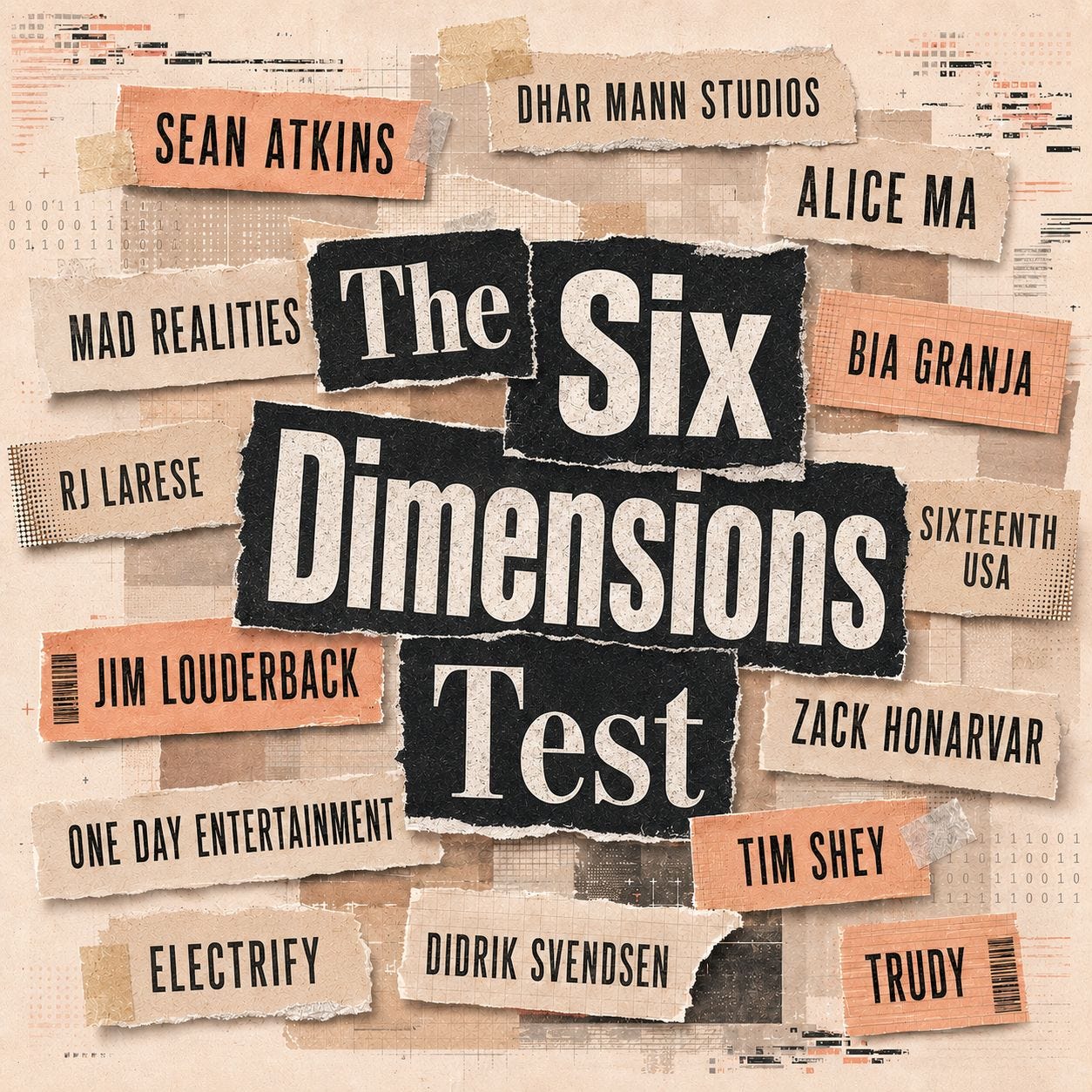
Through this Substack, I’ve built a network of people in the creator economy who are way smarter than me. So I asked a few of them directly. Here’s the team of Avengers I assembled to explore this topic:
Sean Atkins, CEO of Dhar Mann Studios.
Alice Ma, co-founder of Mad Realities.
Bia Granja, the godmother of the Brazilian creator economy.
RJ Larese, President of talent management company Sixteenth USA.
Jim Louderback, OG of the creator economy.
Zack Honarvar, manager of some of the biggest creators, including Yes Theory and Airrack, and a serial entrepreneur.
Tim Shey, chair of creator-backed media company Electrify.
Didrik Svendsen, co-founder of Trudy. He’s perhaps the least known of the bunch, but no less interesting. Trudy is a platform built on data from more than 230,000 brand-creator campaigns, probably the most rigorous analytical approach to creator evaluation I’ve come across.
And this is what they said.
The Instrument That Doesn’t Exist
How do you tell which creator communities travel? The industry has the rhetoric down.
“Depth beats width.”
“Real fandom, not vanity metrics.”
“Community over audience.”
All true. Also mostly useless when wielded like blunt instruments.
Because when the deal memo gets written, the number everyone still reaches for is followers.
This isn’t a new problem. People have been trying to reduce influence to a score forever. One of the early attempts was Klout, which tried to assign people a single influence score from 0 to 100 across hundreds of millions of social profiles. Brands handed out perks to high scorers. Employers even asked for Klout scores in job interviews.
Then the social landscape fragmented. Klout shut down. And the fantasy of one clean number went with it.
The problem wasn’t that scoring influence was a stupid idea. It was that the dimensions that matter most don’t compress that neatly.
Sean Atkins put it bluntly: “I’ve been playing this game for a long time and have not yet seen a tool or analytic model that can get this right.”
No one I talked to disagreed.
After all the conversations, the answer didn’t boil down to a score.
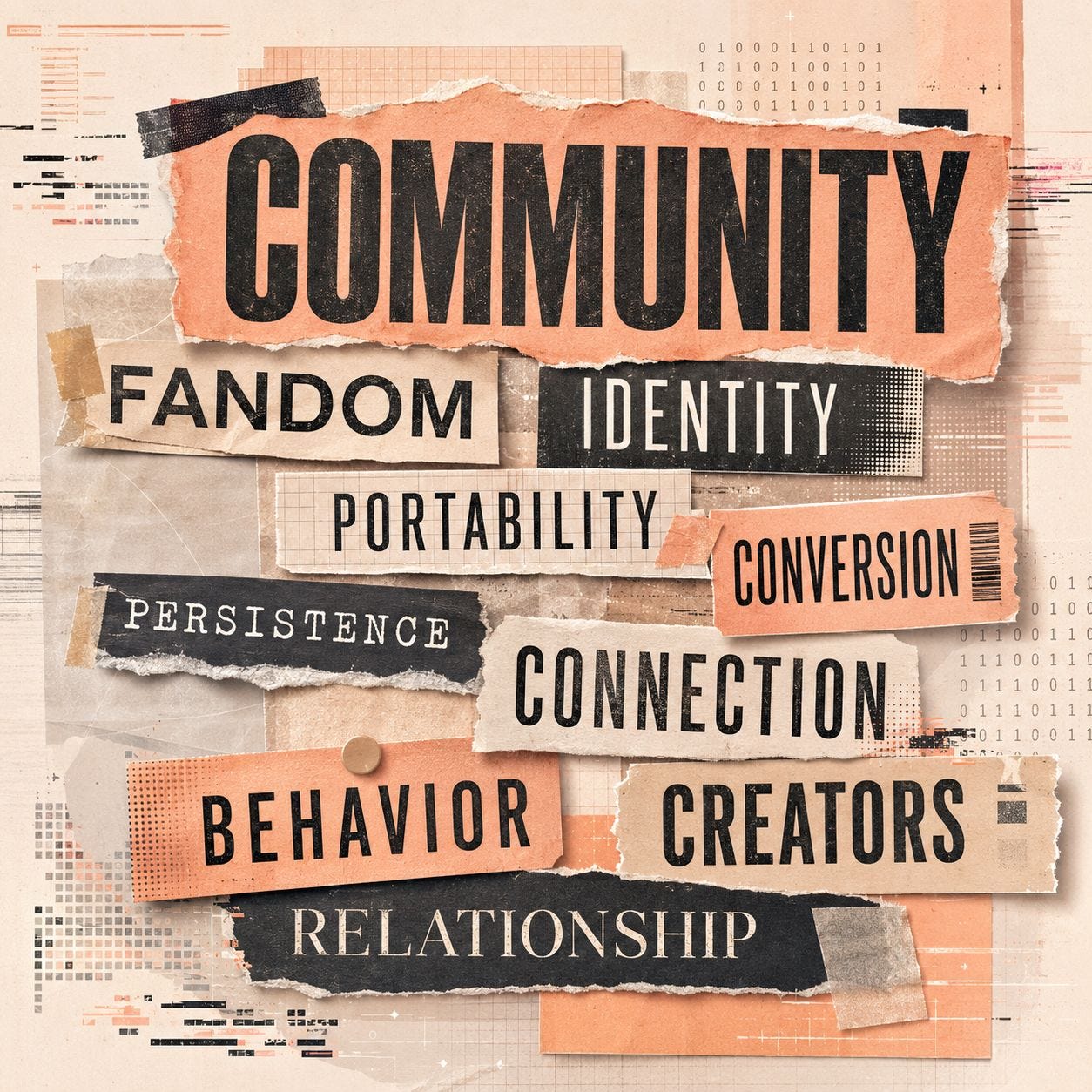
It boiled down to six dimensions.
None of them are definitive on their own. None of them require a dashboard. And three strong dimensions plus three weak ones does not equal 50%.
It means you’re looking at a specific kind of community with a specific commercial profile.
The point isn’t to grade the community.
The point is to understand what kind of animal you’re dealing with.
Welcome to the The Six Dimensions Test
1. Identity — Does membership say something about who you are?
I keep coming back to something Atkins said, because it’s so simple it almost sounds too obvious.
“At its peak CSI was on every TV in every country on every day. It was the most popular TV franchise in the world. See anyone with a CSI hat? For most of its life, The Simpsons has been below the top 50 TV shows. But you see that merch everywhere.”
CSI had more viewers. The Simpsons has identity. That distinction — between a show people watched and a show people belong to — is the whole thing.
The fans who have named themselves — Swifties, ARMY, Beliebers, Deadheads — have already answered this dimension. The fans of a show whose name you forget by Tuesday haven’t.
Alice Ma has the structural explanation: “The most successful communities cater to an opinionated subculture first, then spin out from that core fandom into greater scale.” Identity forms before scale. You can’t retrofit it onto something that’s already gone wide.
The tell: do they have a name for themselves?
2. Lateral Connection — Do members know each other exists?
An audience connects in one direction — toward the creator. A community connects in every direction. That horizontal layer is what separates the two.
Alice Ma goes right to the language: “The internet is so federated, each subculture is like its own little language. Encoded in that language are things about worldview, emotion, what are the top items most stressful and most joyful.”
The language develops before anyone formally builds a community around it — and it keeps going after the creator goes quiet.
Bia Granja calls it “inner culture”: “Recurring memes, slang, rituals, references, slogans, or ‘I know the name of your dog’ behavior. This usually points to fandom infrastructure.”
RJ Larese goes straight to the comments: “Are people defending the Creator in the comments like it’s their full-time job? Are they quoting them, talking to each other, showing up over and over again?”
Didrik Svendsen has found the simplest proxy I’ve come across: “The greatest creators use a lot more ‘we’ than they use ‘I.’ Count the we’s versus the I’s, do the percentage. If that percentage is high or low, that tells you more about that creator’s ability to move their audience than any other metric or bullshit thing people will throw your way.”
The tell: is there activity that doesn’t require the creator to start it?
3. Creation — Do they make things?
The highest form of engagement isn’t watching. It’s making.
Fanfic. Edits. Fan cams. A visual vocabulary that didn’t exist before the community invented it. When fans start producing artifacts — things that weren’t there before the community made them — the property has crossed from being consumed to being inhabited.
Bia Granja putting it simply: “Communities that remix are usually much deeper than communities that only consume.”
Alice Ma’s team at Mad Realities built their own internal system, Mad Metrics, specifically because no commercial tool was catching this signal. A homemade analytics stack is itself a data point about where the industry gaps are.
Fun fact I just learned researching this article -- Fifty Shades started as Twilight fanfiction. The Love Hypothesis started as Star Wars fanfiction and hit the New York Times bestseller list.
The tell: is there a visual language or vocabulary fans built that the creator didn’t give them?
4. Portability — Does the audience travel?
I think this is the easiest signal to measure and the most obvious. But how much portability does it take to make a community valuable? I keep thinking about this with a community we’ve been building around a digital show.
Alice Ma’s honest base rate: “Most creator communities won’t travel. I want to say 99%.”
The 1% that do have something in common. Atkins, on how he finds them before making the big bet: “You don’t ‘know’ until you do some testing like do a merch drop or have a small meetup. Other indicators are newsletters, uptake of your business in new areas as you expand.” Small bets before big bets.
RJ Larese uses a proxy no platform has automated: “I’ll even ask creators how often they get approached in public and where people know them from. That’s valuable signal because it helps you understand how invested the audience actually is.”
Zack Honarvar: “Markiplier’s $50M box office performance with basically no traditional marketing showcases that his channel isn’t just empty numbers but real community and following.”
And the mechanic underneath that, from Didrik Svendsen, who calls it the IKEA effect: “If you feel like you’ve part built it and co-built it, you end up loving the table more because you’ve put blood and sweat into it.” Markiplier didn’t release a movie to his community. He built one with them. They didn’t show up to watch it. They showed up to see it finished.
(Author’s digression – in my 20s when I lived on Ikea furniture I actually detested their stuff after I wrangled it into a wobbly mess. But the analogy works…)
The tell: when they last moved formats, who came with them?
5. Conversion — What’s the gap between free attention and paid behavior?
Two creators with identical follower counts can have wildly different commercial profiles. Size is the wrong variable. The question is how much economic activity the community will actually take on.
Jim Louderback trusts one signal more than most dashboards: “If someone says ‘Sign up for Squarespace, use my code for 25% off for the first year, my code is MRKitten’ — then you get a sense of how many sales were driven by the cool katt.”
Code-based affiliate signups trace actual behavior. They’re one of the few public signals that close the gap between attention and purchase.
Zack Honarvar, from the brand side: “When we’re pitching one of our creators to a brand, we’re selling the power of endorsement and the emotional connection that comes with it. It’s about recognition and trust, the same thing that used to justify paying an NBA player or artist millions to be in a commercial. The CPM doesn’t capture that depth of relationship or the quality of attention our creators command.”
Bia Granja on why some communities convert and others don’t: “Creators whose audiences travel well are providing some kind of service to the community.”
Disposable entertainment needs massive scale to convert. An identity-based community converts at smaller numbers because the relationship is functional, not passive.
The tell: revenue per active follower, not follower count.
6. Persistence — What survives creator silence?
The last one, and probably the most predictive of everything else. If the creator goes dark for six months — by choice, by burnout, by injury, by whatever — what does the community do?
Jim Louderback on how he actually checks: “Go to a creator appearing at an event. Do they drive meet-and-greets. Watch when the fan and the creator meet. Is it just a perfunctory thing or is there a real connection with each and every fan. There’s a difference.”
RJ Larese on what it looks like from the outside: “Are fans excited, emotional, waiting around just to say hi? Or are people casually walking by because they vaguely recognize them? There’s a huge difference.”
Sports communities are the benchmark. Browns fans don’t leave when the team is bad. Liverpool supporters don’t disappear between seasons. The relationship isn’t to the content — it’s to each other and to the thing the content represents. Most creator-driven communities aren’t there yet. The ones that are have a completely different financial profile.
The tell: six months dark — what’s left?
How to Actually Use This
Three contexts where this matters.
Before signing. Run the test on any creator you’re considering before the deal is done. Three strong dimensions might be enough — depending on which three.
Identity and lateral connection together are more predictive than identity and conversion.
The combinations matter.
And take Atkins’ advice: before the big bet, run a small test. A merch drop. A meetup. Something that generates real signal before you commit.
On what you already own. Before you spend a dollar trying to build community around a new property, run the test on your existing slate.
A senior digital exec at a legacy TV and Film studio told me recently that when he started his job he was told to build community around their flagship action franchise — a series of movies with spinoffs and a TV streaming extension. Huge IP. But you could see in the behavior – people didn’t show up for the spin offs or the TV show. There were no Halloween costumes. People just wanted to see the main franchise movie with its iconic star.
Meanwhile, on the same lot, there was another property where the fans had given themselves a name, written (and still write ten years later) tons of fan ficiton, built their own conventions, and were waiting for any reason to come back. And its essence had mutated into microdramas where it had launched a kind of subgenre inspired by those movies because no one was attending to them.
The property had laid dormant for 10 years. And the studio had no clue.
They ran the wrong test. They were measuring recent box office success on a franchise not looking at the behavior of its consumers outside of its principle revenue stream.
The dimensions come online in a rough order:
--identity first
--lateral connection second
--creation third
--portability and conversion as you scale
--persistence last and only with patience.
Most teams skip to conversion and wonder why nothing sticks.
Reach or Residence
Zack Honarvar thinks the market is already dividing: “The premium creator market will end up bifurcating from the programmatic one. They’re fundamentally different businesses serving different buyers.”
The Six Dimensions Test is for the premium side — where the asset isn’t reach but relationship, and the question isn’t impressions but whether the audience actually believes in what the creator is doing.
Tim Shey adds something I loved: “I would think less about evaluating each creator’s community as an isolated thing, and more about the wider community that each of them comes from, and appeals to.”
Michelle Phan’s fans didn’t just show up for her — they recruited. They spread the word to beauty communities that this was someone worth paying attention to. A community that recruits is worth more than a community that gathers.
When I push everyone I talked to on whether any tool can actually capture all of this, I get the same answer.
Atkins has been making these calls for decades and hasn’t found the algorithm.
Alice Ma built her own system and still says she leads with creativity, not data.
Jim Louderback’s most reliable signal is still showing up in person and watching what happens when a fan meets their creator face to face.
Bia Granja feels a lot of this still comes down to pattern recognition from the gut.
The dimensions that matter most — the ones that predict whether a community will show up when it counts — don’t live on any dashboard. They live in the room, in the comment sections, in whether a creator says “we” or “I.”
The Six Dimensions Test isn’t a score. It’s what the people who’ve been doing this longest reach for when the dashboards don’t tell them what they need to know.
Try it out. I just applied it to a digital property we have. The results were telling. More on this soon…
At Made in Chelsea we had our own lingo. You could spot a real fan by whether he used the show's language and I remember during the NFT boom, all the Bored Apes holders were wearing merch and connecting on Discord and IRL on a regular basis. I think what holds a community together are great community managers. The creator can't do that all by himself.
The amount of time spent building a community doesn’t guarantee any of these dimensions but allows for all the trying and failures and experiments