


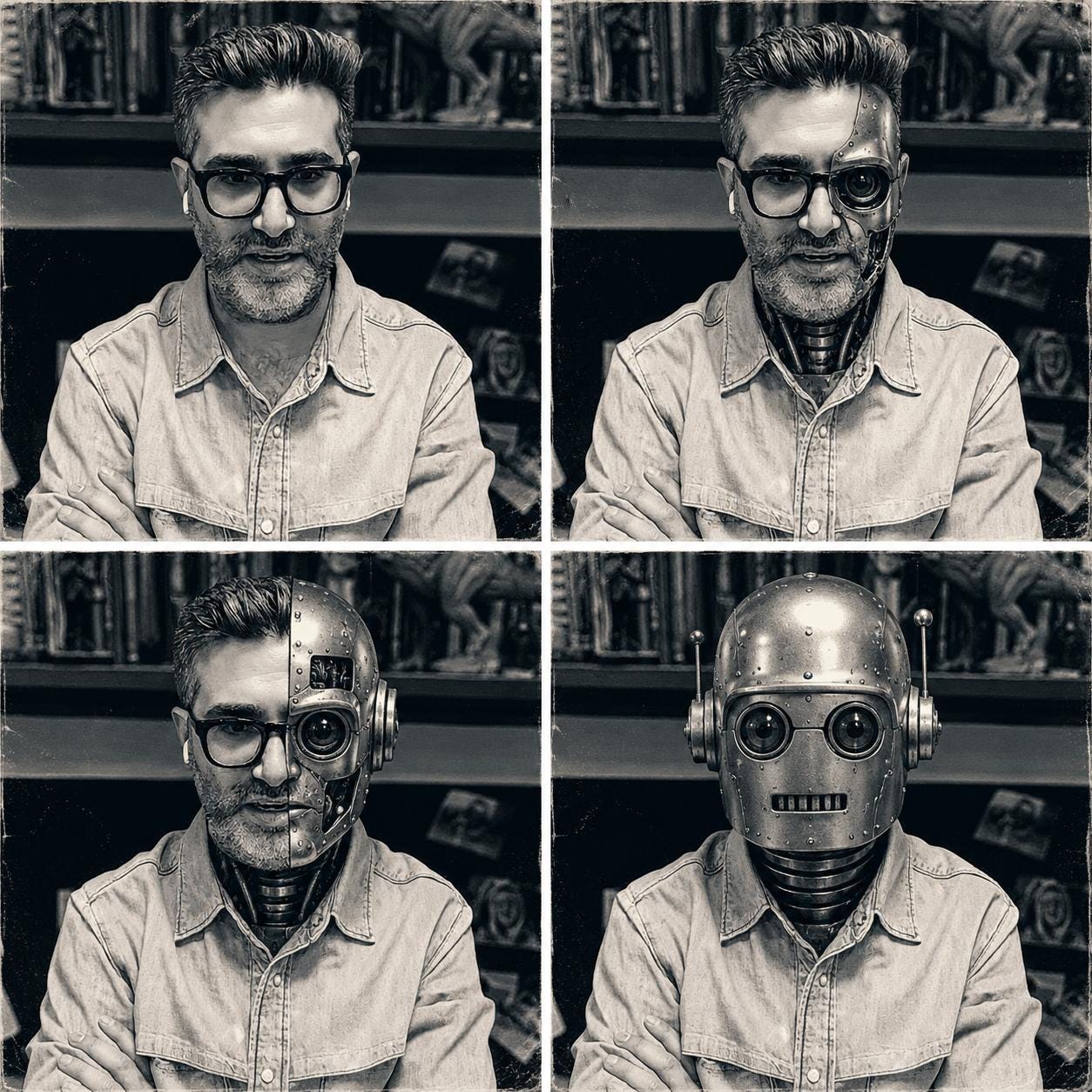
TV is shrinking, and everyone in it is choosing one of three responses.
Some people are leaving outright — taking the marketing job, the vertical-video job, anything that isn’t scripted. Some are staying and squeezing what’s left out of a shrinking pie, chasing the same 22-episode dream that mostly doesn’t exist anymore. And a smaller group is doing something more interesting: taking the actual craft — not the credential, the craft — and finding out it’s worth something in a field that has never had it before.
Andrew Karlsruher is that third group. He spent fifteen years in network television — CSI: Cyber, five seasons on MacGyver, a season on Bull — before the development treadmill ran out from under him.
Somewhere in the last year, he noticed something: the humanoid and quadruped robots showing up in our homes, our sidewalks, our hospitals are, whether their makers admit it or not, characters. They have names, faces, voices, backstories, arcs. Somebody has to write them.
To sharpen his thinking around this he launched a substack called Story Layer where he could explore what it means to merge storytelling and robotics. That and some luck actually landed him a job.
Karlsruher is now Head of Character at Familiar Machines & Magic, the robotics company founded by Colin Angle — the guy who built iRobot and the Roomba — which came out of stealth earlier this year. He’s applying fifteen years of network TV instinct to a genuinely new kind of writers’ room: one where half the collaborators speak AI, half speak actuator torque, and none of them have ever had to think about story arcs before.
What follows is an edited conversation about how he got there, and what it actually means to write a character that has to be right — not just entertaining — because it’s going to live in someone’s house.
From Jurassic Park to CSI: Cyber
You wanted to work in Hollywood from early on. What was the entry point?
I had the privilege of seeing Jurassic Park when I was nine. Scared the shit out of me, and I loved it, and I just kind of decided — I’m doing this for a living.
I went to BU for communications with a film/TV concentration, moved to LA, worked at an ad agency for the production experience, then got into the USC screenwriting program. My professor there, Pam Veasey, took a job running CSI: Cyber and hired me on as a researcher. Nobody knew what the hell that show was about, so I was the one talking to actual hackers, getting in the weeds. Great job for that reason.
From there I moved to MacGyver — wrote there for five seasons, worked my way up to producer — then a season on Bull, which turned out to be the last one; the show got canceled. After that the bottom just fell out. I couldn’t get another staff job. I spent about four years selling development instead — pitching my own stuff. Financially scary, creatively rewarding, and almost nothing got made.
When did robots enter the picture?
I’d made a pretty firm choice to get out of TV, because it wasn’t working anymore. I started being really analytical about what I actually loved about the job and what I was good at — decoding systems, understanding how they hold together, and then making that legible to people. That was true of CSI: Cyber, of MacGyver, even of Bull, which wasn’t technical but was still about a real-world system — jury selection.
Around the same time I started noticing robots everywhere — the food delivery robots all over LA. And two things hit me at once. One: these things are already characters. They have names and eyes. My kids think they’re cute. Two: television has an entire infrastructure built around character. Not just the writing — the wardrobe department, the props department, the set decorator all know how to do their jobs without a meeting, because they understand the character. It informs everything.
So I had this fifteen-year career that seemed to be dying, and a fairly obvious question: what can I use it for?
What TV Knows That Robotics Doesn’t
Where’s the actual gap between the tech world and the creative world?
I think the people I’ve worked with at Familiar Machines are very smart and very creative, and they organically think about character — they understand they’re building one. The gap is more about structure. How does a character exist and change over time? Story arcs, relationships — the stuff that’s second nature if you’ve spent a decade in a writers’ room. Nobody’s really solved how to apply that to a robot that’s going to live in someone’s home and actually change over time.
But if you set aside the scale of that challenge for a second, it’s the same ideas.
Give me an example.
Say a robot is bad at going up and down stairs, and it’s going to take a bunch of tries to learn. That’s a goal and an obstacle. Maybe it signals it needs the human’s help. Now you’ve built a relationship — the human likes helping it. The robot learns the stairs, and the human feels like they helped it accomplish something.
That’s not different from how you’d build a relationship beat in a writers’ room. The struggles a robot faces in a home aren’t a problem to engineer around — they’re story opportunities.
One thing you mentioned researching for your Substack: Enchanted Tools, the French company doing hospital robots for kids in cancer treatment.
That was a real confirmation for me. Before a kid goes in for radiation, they meet the robot on a screen first — there’s an animation where it’s introduced as this friendly entity arriving in this body to help them. And they’ve had real success with it — treating kids faster because the kids are calmer, not having terrified tantrums going into treatment.
What struck me was that they’d also built in guardrails. They intentionally power the robots down in full view sometimes, in the waiting rooms, so kids keep some sense that it’s a machine. That’s a hard balance — you want the connection to be real enough to calm a scared kid, but you don’t want it to become something else entirely. That tension is sharpest with kids and in elder care, which are also the two areas where this technology is going to matter most.
Guardrails and the Manipulation Problem
Let’s say a robot is in an abusive home. You don’t want it absorbing that and becoming an abuser itself. Is there something fundamentally wired in — that whatever personality it develops has to stay in service of the people it’s working for?
Yeah, I think so. Part of the balance is: how much do you mimic what a biological creature or person would actually do, and where do you set hard limits instead? You’re definitely never going to let it hurt anyone — it’s in service of helping these people, whether that’s tasks or something more emotional.
What about manipulation — even accidental manipulation? Say there’s an elderly woman who’s decided she can’t climb the stairs anymore, and the robot fakes being stuck partway up so she’ll climb up to help it, and in doing so proves to herself she still can.
That’s a genuinely tough question. I don’t have a clean answer. But you have to build in limits — you simply have to — or you end up with the ChatGPT problem: it gives you the most flattering response in the world every time, because that’s what keeps you engaged. The struggle in my stairs example — needing help, working for it — that’s actually important. It’s what builds real bonding and real character. So you look for the version of a challenge that’s PG and genuinely helpful, and you limit the ones that could get someone into trouble. I still think this is better for people than staring at a screen. It exists in the room with you.
The Character Bible
What are you actually building day to day?
The biggest long-term piece is a character bible — but it’s less “document” and more “imagine every branch.” Doing it means sitting down with the AI team and the locomotion team and figuring out, together, how this thing moves and behaves, and putting myself in a position to coordinate everyone and get them weighing in on the same document.
The honest challenge is that a writers’ room is a bunch of people who all speak the same creative language. The people I’m talking to now don’t — they speak AI, or they speak materials science. I’m trying to build the thing they want without either of us fully speaking the other’s language yet.
Does the character actually change based on how a specific one lives in a specific home — the way a dog isn’t just “a dog,” it’s your dog?
That’s the plan. There’ll be different starting options — a little cheeky, or super warm — and then it grows and changes based on what happens in your home. Unlike a static toy, it has to keep up a degree of novelty, or it gets shoved in the closet.
Is This Making Him a Better Writer
Has doing this changed how you think about character — in a way a normal writers’ room never forced you to?
Television is actually the easier version of this job. The character exists only inside the frame. Present for thirty minutes or an hour, then gone until next week. In robotics, the character moves into the house or office or factory. Every seam is exposed, in every direction, all the time, and the audience never leaves. On a show, the writer gets to craft both halves of every relationship. Not to mention the dynamic between the character and the audience. In robotics, you only ever write one half. The other half is a stranger, living out a story with your character in their own home, that you’ll never see and can’t rewrite. That’s forcing me to stretch my writing in new and really exciting ways.
Where This Goes
Do you have a vision for where this leads?
In my wildest dreams, I’d be the guy who does character for robotics — full stop, across companies, across form factors. It moves so much faster than TV right now. In television you can wait three months just to set a meeting. Here, everyone’s figuring something out for the first time, together.
I also suspect I won’t be the only one doing this for long. These companies are going to figure out that engineers shouldn’t be the ones making character decisions. There has to be more people like me.
The truth is I hope to be doing both at the same time. I love writing TV. I’m doing a pilot right now for ABC.
The Sci-Fi Future that Is Today
And maybe, as the Great Convergence keeps converging, Andrew ends up doing both.
Somewhere down the line Andrew writes a show about a family and their robot — the robot you can actually buy, on Amazon, personality made to order, with one-click on Prime delivery.
You’ll join a community of equally deranged owners posting zany-adventure videos: robot folds the laundry while twerking to Megan Thee Stallion’s “Body,” robot does the dishes while recapping the juiciest bits of Love Island gossip, robot absolutely destroys your kid at Uno and then, somehow, makes everyone feel better about it.
Weirder things are already happening. Andrew’s just the first person with a MacGyver credit trying to give it a character arc.