Obsessions, Iron Lungs, and the Portable Community
The real question behind the creator-to-theatrical wave: whose community actually travels?
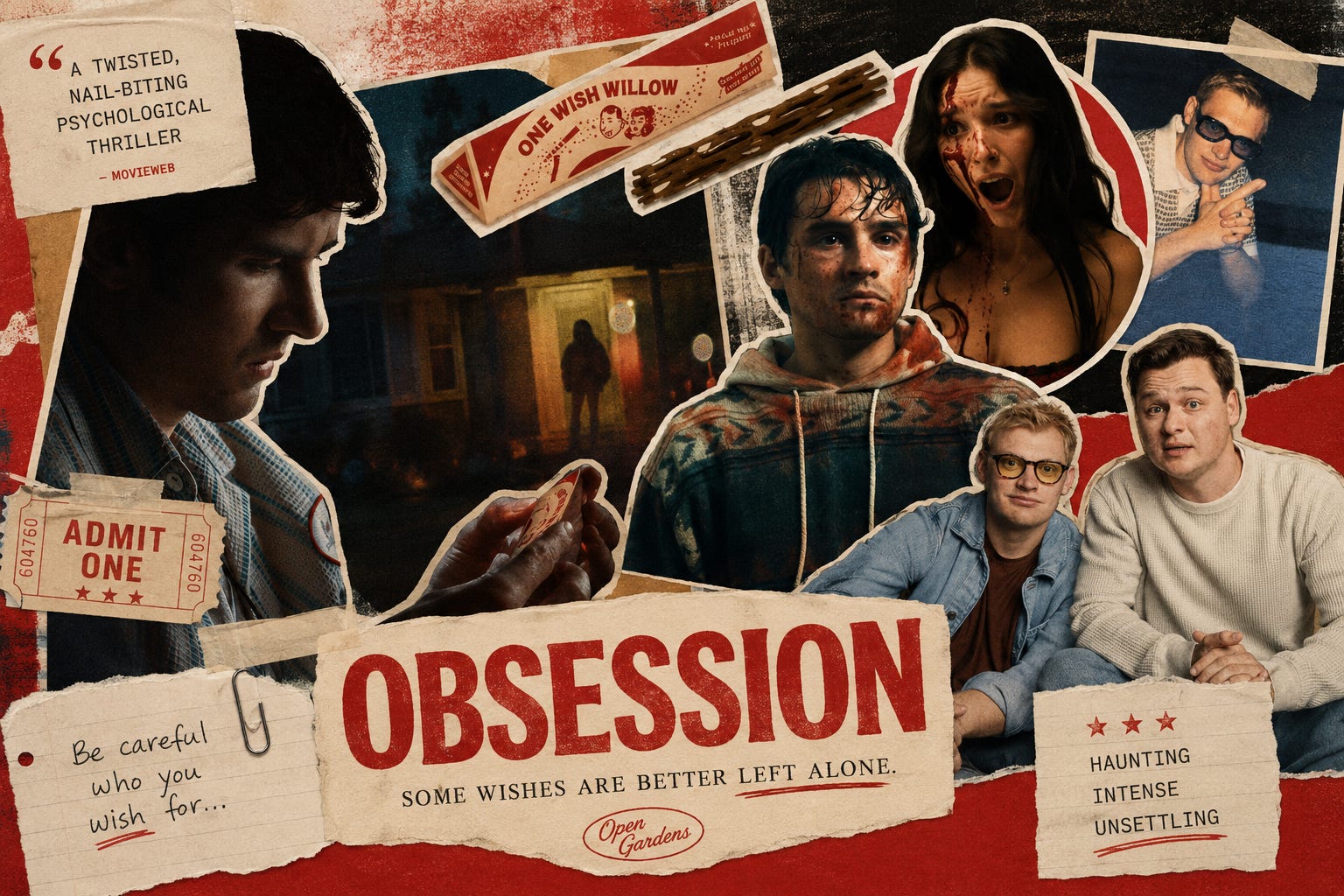
Every producer, studio and distribution exec, every indie filmmaker staring at Monday morning numbers will be obsessing over the 30% INCREASE Obsession posted in its second weekend.
Horror movies hardly ever go that direction (like NEVER). The genre’s natural expression is to front-load opening weekend and drop 50% in frame two — a 30% DECREASE would be a home run.
And while everyone is going to spend the week piecing together what Focus, Blumhouse, Curry Barker and his producing partner James Harris did to get there, the more interesting story is how this success differs from another recent creator-to-theatrical win — Markiplier’s Iron Lung. Two wins, two opposite paths.
But let’s first hit the broad strokes on how Obsession came together — how a $650,000 movie ended up on 2,615 screens in the first place. The backstory, Blinkist-style:
Curry Barker moved to LA at 18, started making YouTube videos, uploaded an $800 found-footage movie for free, it went viral, and connected him to producer James Harris, who told him to write a script. He did. They made the movie for $650K. It went to TIFF and got bought in a bidding war for $15 million. You can read the full story on The Wrap or a million other places.
Retention Is the New Grammar
To say that the language of retention in social media is going to impact the language of movies and TV will make many film school professors clutch their pearls. How dare you insinuate that the cheap pursuit of views will pollute the fragile art of cinema!
Yeah well, remember when editing went digital? How did that change the language of storytelling?
Exactly.
Because audiences don’t live in a vacuum.
And the more they live online the more they demand change from traditional storytelling. Adapt or die. For younger creators it’s not even adaption. It’s just the language they speak.
Barker has a line about his own training is telling: “It’s the same kind of muscles,” he told The Wrap. “To make a scare and make a laugh are very similar.” He’s talking about why sketch comedians keep ending up directing horror — Peele, Cregger, now him.
But the muscle isn’t comedy-to-horror. It’s audience-retention literacy. Knowing, in real time, how engaged the viewer is. Barker put it more bluntly:
“There’s a certain editing that you kind of do when you’re doing those [sketches]... you get these instincts of like, ‘okay, we’ve lost [them],’ which is really helpful in film…”
I suggested in an Open Gardens post last year that film schools should require students to open a YouTube channel. (Many a pearl was clutched.)
Retention isn’t just a marketing function. It’s a storytelling function for younger audiences raised on social. Barker edited Obsession himself, and its 92 minutes are the proof.
You can see it right in the trailer — Obsession is a horror version of Fatal Attraction calibrated to Gen Z. The fear isn’t being stalked by a stranger. It’s being loved too intensely by someone you already let in. That’s a specific generational anxiety, and Barker is fluent in it.
Reminds me of one of the OG (as in three years ago) creator-to-filmmaker success stories: RackaRacka, the Australian YouTube duo behind chaotic creepy-comedy shorts, pivoted to horror with Talk to Me in 2023 and watched it become a major theatrical hit for A24.
And now Barker is pulling the same move from the same kind of channel. He also seems to be a fan: one of his early viral hits was a Talk to Me parody.
Followers Don’t Buy Tickets
But the muscle doesn’t fill 2,615 theaters.
Barker’s YouTube channel, that’s a bad idea, has 1.1M subscribers — a real audience, but not a theatrical one. And not a sticky portable community that’s in deep dialogue with its creators.
But you don’t have to be fluent in creator culture to know it would be hard to convert 1.1 million followers into real numbers on a wide release whether that community is portable or not.
So at the end of last year, barely six months before the movie hit theaters, Focus brought in Blumhouse for their brand power and their marketing knowhow.
Focus’ Vice Chair Jason Cassidy explained the rationale to Fast Company:
“Blum has that reach into the broader horror audience, which absolutely enabled us to extend our tentacles with this one.”
Blumhouse’s logo on a poster is shorthand the horror audience already speaks — this is a real horror movie, worth your Friday night.
Barker couldn’t generate that signal from a sketch channel and one 62-minute horror movie that went viral on YouTube. Focus couldn’t generate it from a marketing budget.
Blumhouse could, because they’d spent twenty years building that depth.
Sell Without Selling
But this isn’t an instead move. It’s an also.
At the same time Focus brought in Blumhouse for reach, they recognized that Barker had instincts they couldn’t buy at any of the legacy agencies. He knew how to sell the movie the way his generation actually buys movies — by not selling it.
Cassidy again, to Fast Company:
“He’s so native to his digital world and he knows his voice and his community, and we absolutely wanted to tap into that. This is a group that has been online their whole life and likes to participate in stuff, and that’s vital to the experience of this.”
What they built together looks nothing like a horror campaign.
There’s a 30-second retro commercial for the One Wish Willow toy that plays like an actual ad from another era — no movie title, no release date, no Focus Features logo. Just a jingle and a product.
It hit 4.4 million views in a month.
They put One Wish Willow vending machines in Los Angeles selling the actual toy.
The physical pop-up store sold out in under 24 hours.
Fans recorded themselves cracking the toy open and posting their wishes on TikTok.
Seventy thousand people signed up to receive voice notes from the character Nikki on their personal phones.
And the activation that captured the whole strategy in a single moment: Inde Navarrette, the actress who plays Nikki, interacting live with mall shoppers from an advertising screen — locking eyes, whispering, going from sweet to obsessive — triggering jump scares that shoppers immediately filmed and posted to Instagram.
The campaign became the content.
Cassidy on the philosophy: “It’s immersed in giving them something to own, but also putting them right in the story in a way that feels just very authentic to that experience.”
In other words as I wrote about just a few weeks ago: to sell a product, don’t mention the product.
None of it sells you a ticket. It builds the emotional connection that drives you to the movie to get the full experience.
When Community is the Audience: The Markiplier Effect
This is where the contrast with Markiplier comes in — because the easy read of this past month is that creator-to-theatrical is one trend, one model, one playbook.
It isn’t.
Markiplier has 38 million YouTube subscribers.
His audience asked him to make a movie out of Iron Lung, a horror game they’d watched him play. He got the rights. He built the film in public. He kept his community inside the process the whole way through.
And when Iron Lung opened, it did it with effectively no traditional marketing campaign — and pulled numbers in the same neighborhood as Obsession, on a much smaller ad budget.
Two creator-to-theatrical wins within six months, both real, both worth studying.
But they’re not the same case.
Markiplier’s community was the audience. He didn’t need Blumhouse’s brand because his own brand already meant “real horror, worth your Friday night” to 38 million people. He didn’t need a traditional movie marketing campaign because the development of the movie was the campaign — every update was content, every content beat was a marketing beat. The community he’d spent a decade building was both the development pipeline and the box office.
Barker’s case is the opposite.
His community is the language, not the audience. The 1.1M people who watch That’s a Bad Idea taught him how to speak to a generation, but they were never going to fill 2,615 theaters on opening weekend. And he hadn’t been building the movie online with them.
So Focus and Blumhouse built the rest of the architecture around his fluency — Blumhouse for the reach, Focus and Barker for the surfaces. Two halves of an equation Markiplier didn’t have to solve because his half was already big enough.
Markiplier was self-sufficient.
In the Open Gardens thesis that the creator economy needs legacy to fully converge, he’s the outlier — he relied on legacy for almost nothing. The theatrical infrastructure to put the movie on screens, some below-the-line crew perhaps (unsubstantiated), and that’s about it.
Everything else, including the audience itself, he already owned.
Focus and Barker went the other direction.
They recognized that the creator side had something the legacy side couldn’t manufacture — the fluency to connect with Gen Z and millennials on the surfaces those audiences already live on. And the legacy side had things the creator side couldn’t manufacture either — brand authority, institutional knowledge around marketing horror…
So they married the two.
That’s the convergence the Open Gardens thesis has been pointing at since the beginning. Markiplier didn’t need it. Barker did. Both are real outcomes.
As I just said in a presentation not long ago—
The new model is that there is no model.
Everything product you sell, every campaign you launch must be bespoke.
And as the industry gets more and more obsessed with the creator-as-filmmaker story, the smart operators will be the ones who understand that every time out of the gate is going to take a different structure to get the best results possible.
Markiplier and Barker had very different communities.
The delta between them was easy to measure — one was portable, the other wasn’t even big enough to ask the question. But where I’ve seen a lot of failure lately is the harder case: follower counts that look big on paper but don’t actually convert. The best operators will know the difference.
Which is the only question that matters when you’re trying to turn community into commerce. Forget how big. Does it travel?


