The 30-second spot and the trailer are dying, and not just because attention spans got shorter. They feel corporate.
Even for a middle-aged dude like myself, I’ve developed a strange aversion to trailers. They talk at you, not with you. They often feel… slow. (Yikes!). That’s the gap between what corporate does and what a creator connection does — and the implications run deeper than marketing.
I’m a producer. I still love making movies. But every producer I know has another part of their brain that’s always running — the part that’s thinking about how to get someone to actually watch the thing. And that part of my brain is what I’ve been trying to update to the new operating system…
I used to think about it like this: you make the movie, you cut a trailer, the trailer pulls people to the movie. Linear. The movie is the destination. Everything points back at it.
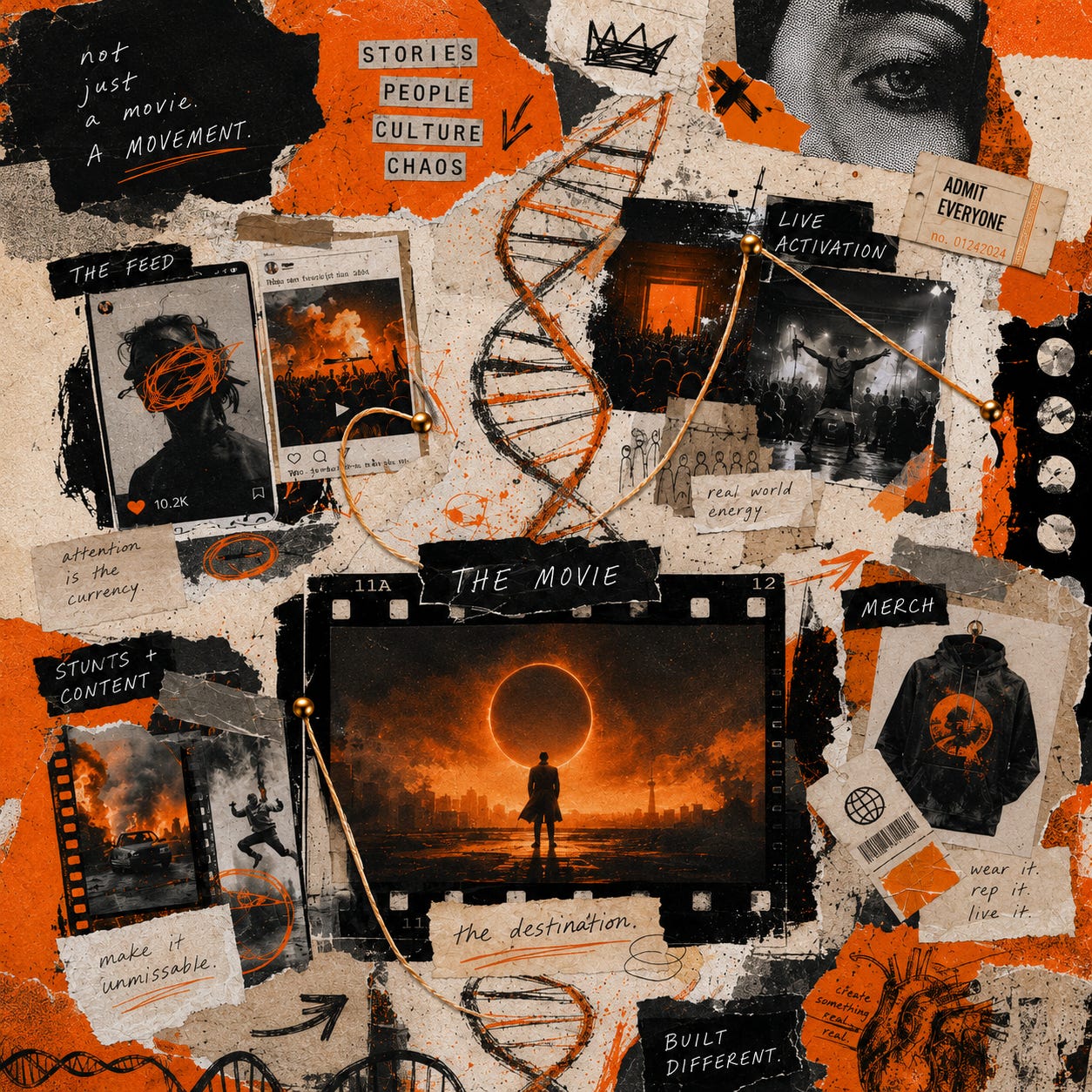
Now I think about it the other way around. You find the core DNA of the thing you’re making, and that DNA travels out across different surfaces, creating connection in each one.
The movie is still the destination. That doesn’t have to change. What’s changed is that you can’t get there in a straight line anymore. You get there by building everything around it first — the ecosystem the DNA lives in.
The movie is one surface. Instagram is another. So is a live activation, a merch drop, a stunt. All of it connected by the same DNA. You’re not just making a movie anymore. You’re making the ecosystem the movie has to live inside.
WHERE THIS STARTED
A few weeks ago I was talking with Christoph Becker, Chief Creative Officer at Whalar Group, and he was talking about the challenges of creating symbioses between creators and brands.
“Im constantly telling brands that to sell a product, you can’t mention the product.”
We’ve all been hearing some version of this. But hearing it from Christoph — someone who’s spent decades in the ad world at the highest levels — especially in the context of the bigger conversation we were having about creativity, it resonated in a different way. And I had been thinking about this very issue in making movies and tv shows. They are a product. And you gotta sell it and the thirty second spot and trailer aren’t the answer…
Christoph wasn’t talking about clever copywriting, he was talking about how a brand needs a brief that can be interpreted across different surfaces, with different creators, organically.
The brief is what I was referring to above as DNA — in a perfect world the brand hands it to creators and lets them make it their own through their relationship with their community.
The brief was historically used to prescribe the message. It created strict, immutable guardrails.
Now, what it needs to do is prescribe the DNA — still guardrails of sorts — and then let go. The brand sets the DNA loose and lets creators decide which surfaces it lands on.
Because the surface belongs to the creator, and the creator belongs to their community. A brand that wants in has to be loose enough to be translated — into a TikTok, into an in-joke, into a piece of content that creates an emotional exchange the brand itself could never have authored.
But the dialogue isn’t one-way. The creator shapes the DNA for the community, and the community shapes it back. They remix it, they spread it, they build inside jokes around it, they turn it into something the brand never could’ve predicted.
The reach is the creator’s. The trust belongs to the community. The brand is just a guest.
Christoph added one more thing which might seem obvious to sophisticated marketers but gets lost on producers like me: somewhere in all of this, there should be a unifying visual element. A color. A shape. A motif. Something that lets the DNA stay recognizable across every surface it travels through, immediately connecting it to the whole ecosystem.
I’ve been turning this over for weeks now, and every time I try to articulate why it matters, I keep landing in the same place. I know — believe me, I know — that the entire internet has already written about A24’s Marty Supreme campaign. There is nothing left to say about the blimp. And yet… it just feels like the very best example to make the point…
…So bear with me.
THE DNA OF MARTY SUPREME
You probably know the broad strokes, but just a quick refresher…
The whole campaign was built around a single color — Hardcore Orange. It wasn’t invented for the campaign, it came from the movie. Marty Mauser tries to launch a business selling orange ping pong balls — his scheme for putting his stamp on the sport.
A24 took that exact orange out of the film and put it on everything else. An orange blimp drifted across the country from Nashville to LA. Streetwear brand Nahmias made a windbreaker in that same Hardcore Orange and seeded it to half of Instagram’s most-followed athletes (connecting ping pong to professional athletes does a whole bunch of work I’ll mention later). The character’s scheme to make orange the signature of his career became the studio’s scheme to make orange the signature of the movie.
The orange is the visual DNA. What it’s carrying — the emotional DNA underneath — is obsession. The way Chalamet describes the orange is obsessive. That’s the emotional DNA of the movie. And you start to see how Chalamet the actor is obsessed in the same way Marty the ping pong player is obsessed — and the two are melded together in the color orange.
Sounds like intellectual masturbation? Only when you say it out loud. The feeling watching Chalamet do this is the same feeling you get watching Marty: a man possessed.
META METHOD MARKETING: OBSESSED OBSESSION
Inside the film, Safdie doesn’t let you forget the obsession for a second. Marty is in perpetual motion — hustling, scheming, performing — all in an attempt to become the greatest ping pong player who ever lived in a sport almost nobody takes seriously. Orange and obsession are now one thing.
We’ve already seen how the actor and the character share the obsession. The interesting part is what Chalamet did with it once he brought it out into the real world.
He pitched the unhinged ideas in the leaked Zoom meeting — orange landmarks, orange blimps raining ping pong balls, four named shades of orange (hardcore, corroded, falling apart, rusted) that his “visual artist” supposedly spent six months developing. He dropped surprise coordinates on Instagram and made fans chase him across cities. He climbed to the top of the Las Vegas Sphere — the first person ever to do it — to declare Marty Supreme “an American film that comes out on Christmas day.”
The Zoom video isn’t a marketing stunt. It’s the same obsessive performance, just on a different surface. The film and the campaign aren’t separate things. They’re the same artifact, carrying the same DNA.
And here’s the point. The campaign isn’t promoting the movie. It’s its own content. People discovered it first because they live on Instagram — and what they found wasn’t an ad. It was a piece of content that made an emotional connection on its own terms, that pulls the viewer toward more of it. The movie is the ultimate expression of the DNA. The campaign is one path into it.
Now back to the parenthetical about jackets…
MERCH MADNESS
The Nahmias jacket got seeded to a long list of celebrities — but the names worth focusing on are the athletes. Tom Brady. Michael Phelps. Steph Curry. Three of the most obsessive competitors alive, in three sports that we all take very seriously.
When you put the Hardcore Orange jacket on Tom Brady, it’s not advertising, you’re staging the emotional thesis of the film in real life. I’m speculating here but I’d imagine Brady doesn’t have a lot of respect for ping pong. The orange jacket on his body says (ironically): even he takes this seriously now.
That’s what makes it funny, but it’s also what creates the feeling, the emotion… The delta between ping pong and Tom Brady is enormous — and that delta is exactly what makes Marty’s obsession funny and heartbreaking at the same time. He cares this much about a sport that the world treats as a basement game. When Brady wears the orange, the delta collapses for a moment. The character’s delusion becomes real. The world is taking ping pong seriously because Tom Brady is.
None of these guys mention the movie, and none of them have to. The casting itself is the message — the orange just carries it. The audience doesn’t think about any of this consciously, they just feel something. That something is goodwill, and goodwill gets cashed in at the box office.
And the jacket is just one surface.
MERCH EVERYWHERE ALL AT ONCE
Hardcore Orange ended up on Wheaties boxes, on the pyramids at Giza, on the top of the Las Vegas Sphere, on a blimp dropping ping pong balls over Camp Flog Gnaw, on a soundtrack release, on listening events in New York and Tokyo, on an actual underground ping pong tournament A24 hosted with Airbnb.
The DNA found surface after surface to live on. Some of them just generated feeling. All of them were the ecosystem.
But the jacket feels like the biggest tell — about how well this whole thing was working. The Nahmias windbreaker retailed at $250. It’s currently reselling on Grailed for $1,000, $2,000, $4,000. People are paying sixteen times retail for a piece of cloth — not because it’s a movie ticket but because it carries the DNA. The orange and the obsession, manifested in a jacket.
The emotion was the product. The value just showed up wherever it landed.
And this leads me back to how legacy executives, producers, even directors might need to rethink things…
THE AUTEUR IS NOT EXEMPT
Wasn’t this all orchestrated by a marketing department? 1000%. And one of the best marketing teams in the business. Josh Safdie just made the movie he wanted to make. He didn’t walk into A24 pitching orange-and-obsession as the campaign thesis. He didn’t pitch Chalamet going ape shit on a Zoom call with the stoically-faced A24 marketing team.
But we can’t keep talking about “meeting audiences where they are” without considering how storytelling itself is changing.
You could argue Alejandro Iñárritu doesn’t need to think this way. He’s an auteur. And I’ll be there opening weekend to watch Digger with Tom Cruise. But Iñárritu wants to win. The Digger rollout shows a filmmaker who’s thinking carefully — an unrecognizable-Cruise reveal, a teaser hidden inside a Cruise montage, a longer trailer. Smart, mysterious, old-school. It might even work. But if Iñárritu thought he needed to spread Digger across every surface — to tell the story in this new way — would he do it?
If I want to keep making movies and TV shows, I need audiences to show up. And if that means changing how I think about them, build for them, and market to them, I’m going to do that work now. Not when it’s too late.
A few months ago I was at StreamTV Europe in Portugal, speaking on a panel and sitting in on as many others as I could. One presenter shared a statistic we all intuit but rarely see written down so cleanly: 80% of people aged 18 to 24 discover new shows and movies on social media.
That number used to feel like a marketing problem. It isn’t. It’s a storytelling problem. If that’s where the next generation of audiences lives, that’s where the next generation of storytellers will tell their stories. Not deliver them. Tell them.
To sell a product, you can’t mention the product.
It’s not about 30-second spots. It’s about creating emotional connections that build goodwill — connections that eventually lead someone to want to watch the movie or the show.
Many in the next generation, and they may not even be so easily categorized as filmmakers, aren’t looking at the big screen as their canvas. They’re looking at the whole ecosystem of surfaces.
Their stories live in a Tom Brady photo wearing an orange jacket. In a blimp over the 405. In a Zoom video that wasn’t supposed to leak. In a windbreaker reselling for four grand. The screen is one place the story lives. It’s not the only one anymore.


