


Hollywood is in the middle of an overcorrection.
As the industry chases the creator economy—and wonders whether it has been doing everything wrong—a new generation of producers is arriving for whom the internet is neither a threat nor a strategy. It is simply another tool in the box.
Lucas Ford is one of them.
Yeah, he’s the guy who discovered The Backrooms and Kane Parsons. (For the feature, they dropped “The”—channeling Timberlake-cum-Sean Parker.)
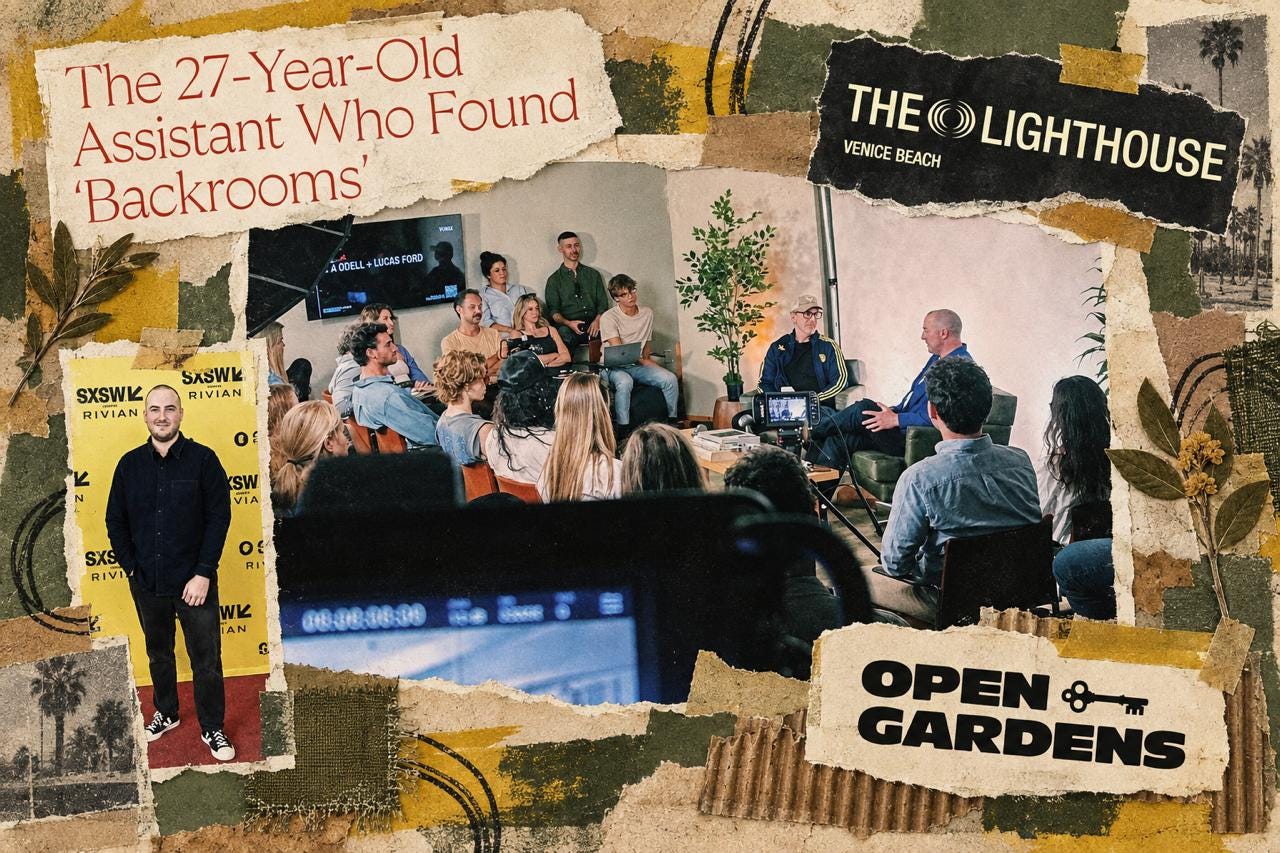
In August, my friends at Lighthouse suggested we host a series of Open Gardens conversations about this great convergence, building on the success of the Horror Triumvirate.
We began with Akshay Mehta, head of Lighthouse Studios, and a fascinating discussion about his work with Lyrical Lemonade. Then we brought Open Gardens to Lighthouse for a conversation with Lucas.
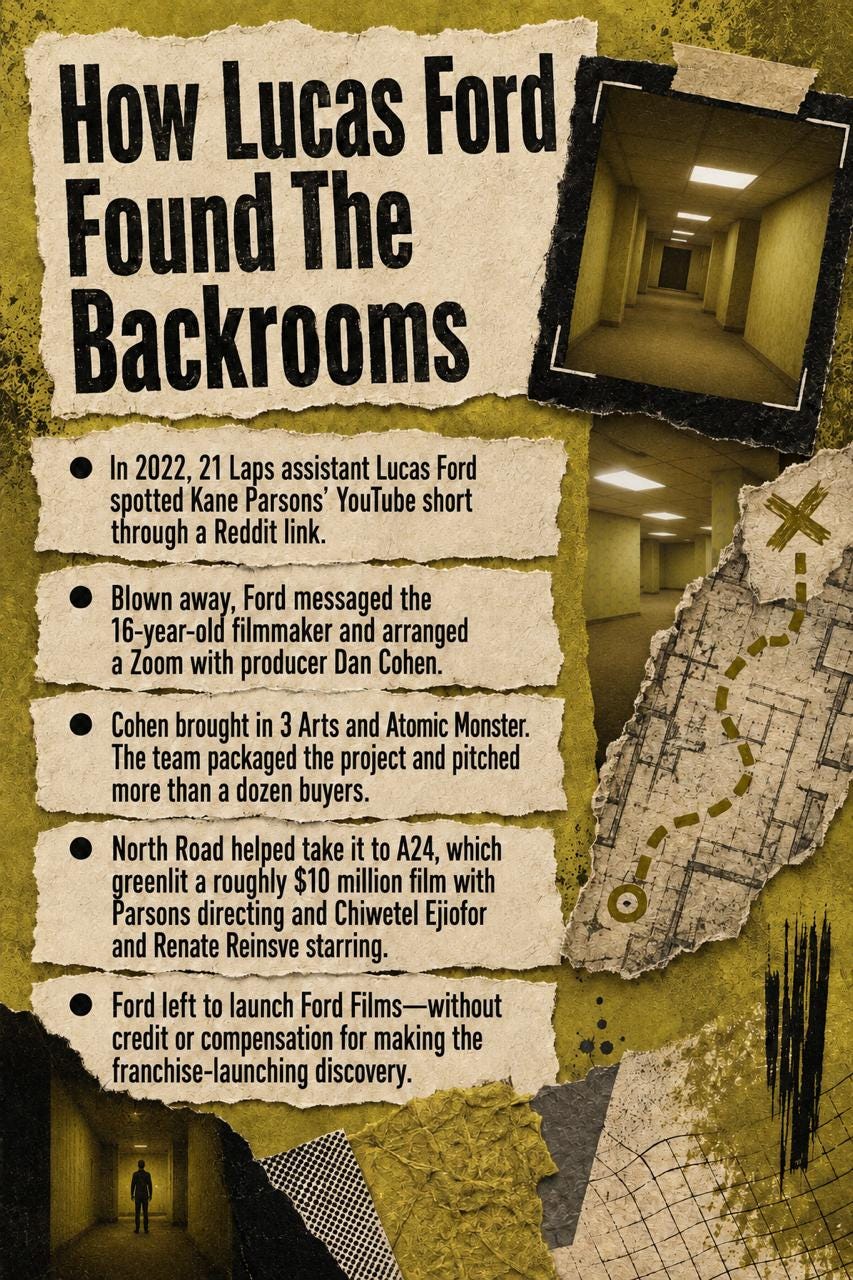
I knew the headline version of his story. While working at 21 Laps, Lucas found Kane Parsons’s short, brought Kane and the project to his bosses, and helped set in motion the development deal that followed.
Leading up to the movies’ release, press and interviews referred to him only as “the assistant” who had found it—until Matt Belloni finally put his name to the story in Puck.
Before my pre-interview with Lucas, Belloni’s account was all I had read. It was gratifying to see Lucas receive credit, but I was more interested in what came next.
I had him pegged as a terminally online kid who had stumbled onto something huge—probably someone who preferred YouTube to movies and would eventually leave Hollywood to work with creators or start some new-media business.
In short order, our conversation made it obvious that I had him wrong.
Lucas is thoughtful, curious, ambitious, and deeply driven—although in that polite, low-key Canadian way that can make ambition easy to miss.
He grew up making things online and learned early to pay attention to an audience. The internet became a natural place to find emerging talent, ideas, and cultural currents. Then he worked at TIFF, encountered world-class filmmakers, and became a cinephile.
That is what makes Lucas interesting. He isn’t “the internet guy.” He is a producer looking everywhere—online, in cinemas, at festivals, and in conversations—for filmmakers and stories that move him.
He left 21 Laps before The Backrooms was made or his role in it was widely recognized, then began building projects of his own.
At 32, one of his first films as a producer, Portal to Hell, had just been released. He now has a dozen movies between development and post-production, six of them financed. There’s Adulting, about a recent grad student who falls in love with his mom’s friend; Henry’s Ebb, an emotionally grounded film with genre elements about a boy and his imaginary friend; a stop-motion movie made by two young artists in their Silver Lake home; and a prehistoric love story.
None of this happened because he was “the guy who found The Backrooms.” It happened because Lucas is not a fluke.
Sitting with him reminded me why producing can be so much fun.
His approach recalls producers like Christine Vachon and Ted Hope, but it is powered by a distinctly contemporary fluency: Lucas understands the convergence of filmmaking, online culture, and audience. He is humble, but seasoned producers should listen closely. There is much to learn from how he is evolving the role.
He will be a leading voice of this generation. You heard it here first.
Taste Before Metrics
The easiest lesson for Hollywood to take from The Backrooms story is that Lucas found a popular YouTube video before everyone else. But Lucas does not begin with popularity. He begins with his own response to the work.
“Filmmaking first and foremost. When I look at something, I look at theme. The world of The Backrooms has themes of isolation and nostalgia, and there’s something almost tactile about it. I got excited. I wanted to know more about the world—what was there, what was beyond it, and what existed beyond that nine- or ten-minute video.”
The same principle has shaped every great producer since Irving Thalberg became the Boy Wonder at MGM in 1924. And that’s how Lucas looks at creators more broadly.
“Just because someone has millions of followers doesn’t mean they need a feature film. I’m looking underneath that. What is this creator trying to say?… I try to stay open about what constitutes IP or how a filmmaker might express themselves. It could be a mural artist, someone who wrote a book, or someone with an interesting reel on Instagram. There may be something in the theme or point of view that I want to build around.”
A large audience will get his attention. It will not make the decision for him.
“If someone says, ‘There’s a YouTube horror creator with 20 million followers,’ you take it seriously. But at the end of the day, it still has to be good.”
Sometimes the work that excites him has almost no audience at all.
“I’ve found something with 80 views and thought, ‘This is great.’ That can be equally exciting because no one knows about it.”
Lucas understands the signals coming from the internet, but he does not confuse those signals with taste. We all need to heed that warning.
Looking Everywhere
“When you’re a young person in the studio system, you have to find ways to stand out. I was at a very commercial company making big blockbuster movies. Because I had made a lot of shorts and grown up on the internet, I thought my way to get ahead could be becoming fluent in new voices.”
No one at 21 Laps formally appointed him the company’s internet scout. He simply went where no one was looking—and where he naturally explores anyway.
“I started covering festivals and getting online links. During lunch, I would find interesting filmmakers and invite them to the Fox lot. I was tracking filmmakers before there was necessarily a project.”
The habit was more important than any particular platform.
“I try to be format-agnostic. It could be a short film, a festival, or a conversation on a Reddit forum. I’m constantly looking in traditional and nontraditional places.”
One project began with a piece of album artwork.
“I liked the photography on an album cover, met the photographer, and then discovered that he had a YouTube series. From there, it became a question of reverse-engineering his visual style into a traditional film pitch deck…There aren’t really rules. My instinct is to follow my curiosity and find the distinct point of view underneath the surface.”
Elsewhere in the conversation, he talked about finding filmmakers through Instagram, Fantastic Fest, video-game cutscenes, and work coming out of New Zealand, Scotland, Serbia, and the UK.
“If you’re regionally specific, you’re missing a lot of great stuff. Filmmakers from outside the studio system can be more willing to try different things because they don’t know all of its rules.”
We all know that a cinematic voice doesn’t need to come from Sundance. But it could. His internet fluency just means he casts a bigger net.
Community as Creative Intelligence
When Lucas stumbled onto The Backrooms, Kane Parsons’s video had around 50,000 views. Within a month, it had 11 million. Lucas noticed that growth, but he was equally interested in what the audience was saying.
“You could see a genuinely engaged audience leaving specific comments: ‘I would watch two hours of this,’ or ‘This should be a movie.’ The velocity of the engagement was exciting… I remember wondering, if even a handful of these people showed up at a theater, what could that mean?”
The audience gave him another way to understand the work. It showed him which details people cared about, where their curiosity was leading them, and how deeply they wanted to participate in the world Kane had created.
“What I observed from Kane’s work on The Backrooms was how meticulous he was about understanding what viewers and the Discord community wanted. If one thing was done incorrectly, they would call it out… That level of engagement shows that it’s a product problem, not an audience problem. If you make something great, people will show up.”
Lucas is optimistic about younger audiences precisely because they are demanding.
“I feel like younger audiences are some of the smartest audiences out there. They can tell when you’re giving them the conventional path.”
Yeah, don’t we always do this? Question the younger audiences because we don’t understand them? They are all ADHD. Terminally online. Can’t watch a whole movie. The fear is generated from lack of proximity. Its not just reading data, its living in it. That’s why we need young producers making movies for their generations.
The participatory nature of an online community also creates a different kind of relationship with a story.
“There are so many other creators doing their own spin… That interactive part is exciting because everyone can feel like they’re doing their own choose-your-adventure. They become more emotionally invested. That can create conversation and culture.”
But Lucas stops short of letting audience data become a formula.
“It’s an awareness of what people are excited about, not necessarily a calculation. I look at audience and engagement the same way I might look at other signs of promise. It’s another tool for reducing risk. It isn’t the only tool.”
He understands an online community as a source of creative intelligence. It can tell him why people care. It cannot tell him what he should care about.
Trust your gut. In a world that demands curation, the producer-as-curator has never been more vital.
But it’s not new — Thalberg, David O. Selznick, Samuel Goldwyn, Val Lewton, Robert Evans, Bert Schneider and Bob Rafelson, Saul Zaentz, Kathleen Kennedy and Frank Marshall, Don Simpson and Jerry Bruckheimer, Scott Rudin, Vachon, Hope, Dede Gardner and Jeremy Kleiner, Jason Blum.
All curators of their generations.
Protecting the Strange Edges
I’ve written about the success of the Horror Triumvirate. How it was as inevitable as it was a fluke to timing.
I asked Lucas about it. Like me he expects Hollywood’s current enthusiasm for creator-driven movies to produce failures.
“There’s going to be a correction. We’ll see things that don’t work, people will decide it was a bubble, and then another one will work and we’ll be back in it… I look at it differently from trying to find something you can rinse and repeat. I’m asking whether there is a vision or a voice. Is there something with substance? Does it hit a theme that excites me? That matters more than the follower count.”
Wise words from a young producer. Finding a creator is only the beginning. The harder job is bringing that creator into a larger system without losing what made the work distinctive.
“When you take something from the online space into the studio system, there can be a tendency to remove the strange edges that made it great so it will fit the system… You need to amplify what is good about the creator. That gives you a more authentic result.”
Lucas applies the same test when developing an online work into a feature.
“I try to distill what makes it great. If we give it the Hollywood treatment, will the original audience show up, or will they feel betrayed?”
He sees the internet as another place to find filmmakers, not as a shortcut around the work of producing them.
“It’s one more pipeline, in the same way Sundance is a pipeline. People now take the internet seriously as a training ground because anyone can make a good short and put it on YouTube… That doesn’t mean you shouldn’t go to film school or do the work.”
If you really break down the success of ‘Iron Lung,’ ‘Obsession’ and ‘Backrooms’ only the first was a pure creator-driven movie. The other two depended on the Hollywood system, ‘Backrooms’ more than the others. Developed, packaged, financed and distributed by the Hollywood machine.
It’s an AND conversation: the old way and the new way, working together.
Building Around the Artist
A creator who can make something remarkable alone may not be ready to direct a large crew, develop a screenplay, or explain an idea in a studio meeting. Lucas sees helping them cross that gap as part of producing.
“You find something great, and then you meet the filmmaker. Can they articulate an idea to a team? Can I imagine spending three years with this person?… If someone has made horror shorts in a bedroom with one friend and is suddenly being asked to oversee a $10 million budget, my job is to help with that transition.”
The process cannot be identical for every filmmaker.
“Some of these creators have never opened Final Draft. I’ve said, ‘Record your ideas as a voice memo, and then we’ll talk through them. You become part facilitator. You’re helping them find and refine their process.”
Lucas described an animation project he is producing with two filmmakers who were accustomed to animating everything themselves.
“They had only worked with each other. We built a process around them. Every Monday they send [me and my producing partner on this movie, Joey LePage] what they’re animating, we give notes, and I connect them with resources and financing.”
The goal is not to turn every creator into a conventional studio director.
“Some people may never be the natural leader of a hundred-person crew. I try to meet them where they are and build around them.”
This may be the clearest expression of what makes Lucas valuable as a producer. He can translate between a creator’s highly individual process and the larger machinery required to finance and make the work. He does not assume the creator must change first.
Designing More Than One Path
Lucas is still primarily producing movies. But he does not assume that a feature released through a traditional distributor is the only possible destination for a project.
“When you’re working with creators who have a large audience, they have leverage. They may be making as much money online as they would making a traditional movie. Then they enter the traditional system and are told how they have to do everything, how it will be released, and that it will be overseen by 70 people who have always done it the same way. They can ask, ‘Why would I do that?’”
We talked about the excitement of a storyteller using more than one medium—not simply a ninety-minute movie—to express themselves. What’s exciting is considering how that talent can live across so many different formats.
For Lucas, a feature can be one expression of a creator’s work rather than the final rung on a ladder.
“We have to be flexible about how we do things. On one project, I’m envisioning the feature-film version, but I’m equally excited about the possibility that this person could create an experience for the Sphere or Cosm… The traditional development apparatus is one way to develop an idea.”
That flexibility is built directly into his stop-motion animation project. The team is producing it as 45 two-minute episodes that can also be assembled into a feature.
“We can package it as a feature and sell it in the traditional sense. But if we don’t like the offers, we have 45 episodes we can release to build an audience and monetize differently. Maybe we bring the filmmakers into a larger studio. Maybe we build a video game around it.”
He’s building in a hedge for himself, the filmmakers, and the financiers—not merely as a matter of pragmatism, but to create leverage and preserve the best path forward.
“We start with the traditional feature. Here is the target, and here are the distributors that have bought at this level. If we don’t like that outcome, there is a second tier where we build and monetize an audience ourselves. Then there are other ways to sell or divide the work because we’re producing it at a lower budget.”
Yet his ultimate investment is in the filmmakers, not a distribution hack.
“The reason to do the partnership is that we believe in the filmmakers. It isn’t necessarily that this specific movie will become a runaway hit… We’re building and proving the relationship so we can make future movies together.”
Reaching the Audience Is Part of Producing
Lucas does not draw a hard line between making a film and finding its audience.
“The producer’s job is to protect the filmmaker’s vision, make the movie, and figure out how to get it to the audience.”
That means considering how the film will live beyond its running time.
“You can’t make the movie, put up traditional outdoor and digital ads, and assume people are going to show up… You might get people excited about a horror film by releasing what looks like surveillance footage. People see it and think, ‘What the fuck is this?’ It feels real, they lean in, and they post about it.”
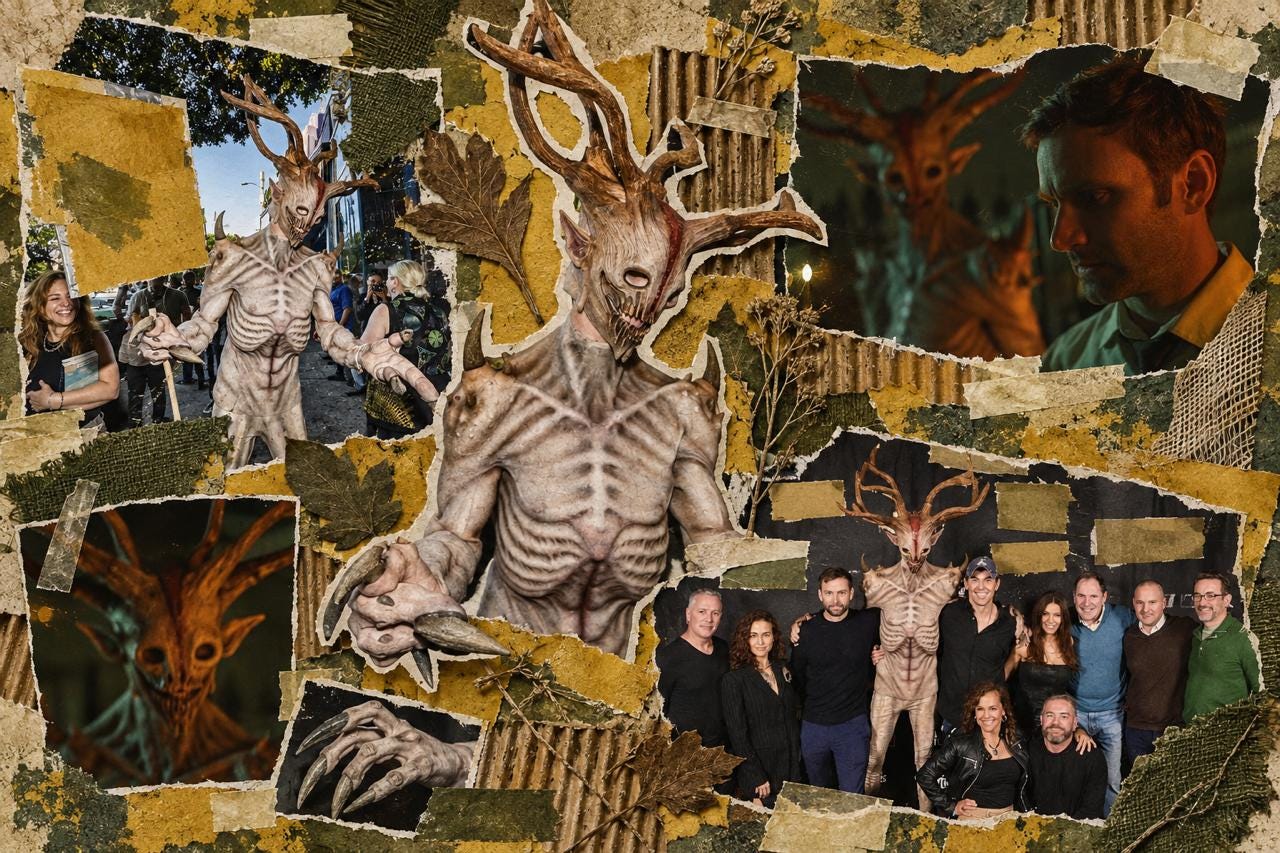
For his horror comedy Portal to Hell, filmmaker / DP Woody Bess spent a day taking the film’s eight-foot demon (played by creature actor Trevor Newlin) around Los Angeles. Lucas, Woody and the film’s star and fellow producer Trey Holland have been building a DIY theatrical release plan across North America inspired by Hundred of Beavers (2022 silent self released silent movie) and Iron Lung.
“We filmed him walking around Venice Beach, going to Pink’s, and sitting on a park bench. One of those videos did nearly a million views. It was fun, and it came directly from the movie.”
Yes but he wasn’t just extending the confines of the movie. As I’ve written: To sell a product, you can’t mention the product. Pulling the scary creature out of the movie and sticking him in mundane settings, breaking the fourth wall of the movie. Simple. Smart and the right mindset for a producer today.
Lucas sees this as another part of understanding the audience.
“There are a lot of different ways to expand beyond the movie. You can tell stories behind the scenes. There can be a through line through the marketing, but each format tells a different story. It’s a question of finding the way in that makes people care.”
The question is how the movie’s DNA can carry across different surfaces, with each expression standing on its own. That isn’t merely marketing.
I’ve been making this point for a while. Producers need to think differently about what storytelling and marketing mean and how they’ve become intertwined and evolved.
For Lucas, it’s just a natural part of producing.
Technology Serves Instinct
Lucas approaches AI with the same lack of ceremony. It can help him pre-visualize a film, build production systems, extend a physical world, or complete mechanical work more efficiently.
“I think a lot about systems—how to keep doing the job, how to scale, and how to build a good team. I don’t want to rely on AI for creative instinct and decision-making. I try to protect that and use the technology for the more mechanical parts of the job.”
On one project, Lucas used a combination of physical production and AI tools in a proof-of-concept test whether a story that might traditionally require a $150 million budget could be made for $10 million.
“We shot all the performers practically, on location, in costumes. Then we used AI to build out the world. We shot a proof of concept first because we wanted to prove the workflow as well as the film.”
But he has no interest in outsourcing the fundamental decision of whether an idea deserves to exist.
“You have to protect whatever excited you in the first place. Nothing beats the feeling of seeing something and thinking, ‘This is the most amazing thing ever.’”
Amen, Lucas. Amen.
Repetition
Hollywood is searching for a creator-economy formula. Lucas is building a body of work. The internet changes where he looks, what he notices, how he works with filmmakers, and how he reaches an audience. The producer’s job remains the same: recognize something special, protect it, and find a way to get it made.
It’s an evolution, not a revolution.
None of this works if Lucas’s discovery of The Backrooms is treated as a lightning strike. His approach depends on doing the same work repeatedly: searching, watching, meeting people, developing projects, and placing bets that may lead nowhere.
“You’re not waiting to take one shot. It’s repetition. You’re constantly scouring. I have a routine of looking through different sources, seeing what conversations are happening online, and translating that for people in the studio system.”
When he left 21 Laps to produce full time, he did not begin by trying to reproduce the scale of The Backrooms.
“My first plan was to make two very small, low-budget movies, get the experience of making something, and scale from there.”
That may be the most traditional thing about him.
“I’m trying to bring together my experience inside the studio system, the scrappy independent side, and my awareness of the conversations happening online. I want to be able to work between all of those spaces.”
The reality is Lucas will be judged not on being the assistant who found Backrooms, but on the movies and other media projects he makes, and how they fare in the marketplace. Right now he is operating on promise and potential. Producers are judged on a body of work over time. But to meet him is to root for him.
In him and his peers is the future of cinema.