


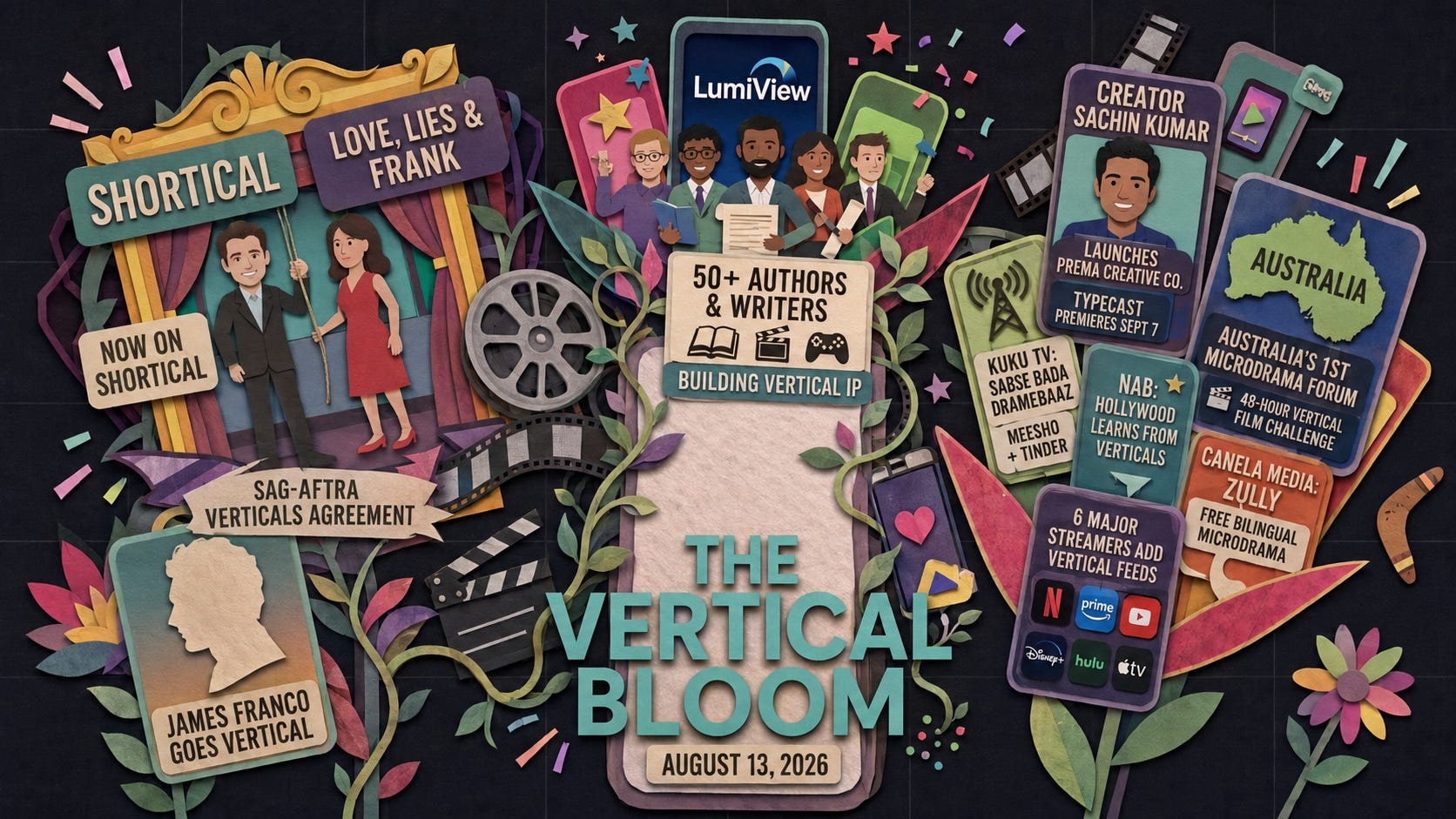
Welcome to The Vertical Bloom, a weekly dive into the fast-growing world of microseries and vertical storytelling. Here, we unpack the platforms, creators, and deals shaping the format that’s quietly redefining what it means to make, and watch, scripted content in the mobile age.

This week, James Franco goes vertical under SAG-AFTRA’s new Verticals Agreement, LumiView signs more than 50 writers and authors to build vertical IP, and creator Sachin Kumar launches a studio around his own voice and audience. Then, we dig into The Great Convergence and what it will actually take for legacy entertainment and the creator economy to understand each other, collaborate, and build something new.
But first…
Notable names continue to enter the MicroSeries space. (And by the way… are we officially calling them MicroSeries now? Because if so, I’m all in.) We’re covering one of the latest examples in our news roundup below. While the names keep changing, it feels like the conversation around “big names entering the space” really hasn’t.
One of the things I love most about this sector is the community that has grown around it. It reminds me of the early creator economy: ambitious, collaborative, and built by people who believed in something before the rest of the world caught on. I understand why established stars entering the space can feel threatening to some. But I think it’s a sign of success, not danger. A healthy creative medium should attract great storytellers from every corner of entertainment.
We humans aren’t particularly fond of change. It introduces uncertainty, and uncertainty is uncomfortable. But as the old saying goes, “The only constant is change.” The people who resist it often get left behind. The people who embrace it are usually the ones who help shape what comes next.
The real challenge isn’t preventing change. It’s making sure that growth is inclusive. The creators who built this medium deserve to stand shoulder to shoulder with the talent that’s only now discovering it. Those shouldn’t be competing stories. They should be the same story.
I’m excited for the day when some of the best actors from film, television, and yes, MicroSeries all share the same set, learning from one another and pushing the medium forward together. I think there will be a unique kind of electricity in that collaboration. That’s a future worth building toward.
Alright, let’s get into it.

James Franco Goes Vertical With Love, Lies & Frank
James Franco stars in Love, Lies & Frank, a new 50-episode microdrama now streaming on Shortical. Like PLAYBACK, it’s also among the first productions under SAG-AFTRA’s new Verticals Agreement, meaning Hollywood talent and its labor infrastructure are arriving together.
LumiView Signs 50+ Writers and Authors to Build Vertical IP
LumiView has brought more than 50 authors and screenwriters into its LumiCreator network, with multiple books already headed for vertical adaptation. The bigger bet: using vertical not just as an endpoint, but as an incubator for IP that can expand into film, publishing and games.
Creator Sachin Kumar Launches His Own Vertical Studio
Creator Sachin Kumar has launched Prema Creative Co. alongside Typecast, a 14-part vertical comedy premiering September 7 on Instagram. Rather than plugging a creator into an existing microdrama machine, Kumar is building one around his own voice and audience.
Australia Is Getting Its First Microdrama Forum
Australia will host its first dedicated Microdrama Forum on August 30, followed by a 48-hour vertical filmmaking challenge in September. It’s another sign that local production ecosystems are beginning to form around the format globally.
Kuku TV Turns the Acting Competition Into a Microdrama
India’s Kuku TV has launched Sabse Bada Dramebaaz, a 50-episode vertical acting competition with Meesho and Tinder attached as brand partners. It’s a useful reminder that vertical storytelling grammar can extend well beyond scripted melodrama.
NAB: Hollywood May Have Something to Learn From Verticals
NAB Show argues that vertical production is becoming a testing ground for faster, lower-risk development and creator-economy thinking, with insights from Susan Rovner, Jana Winograde, Dhar Mann Studios and Scott Brown. Increasingly, the question isn’t how vertical can become more like Hollywood, but what Hollywood can learn from vertical.
Six Major Streamers Have Built Vertical Feeds in Six Months
The Ankler notes that Netflix, Prime Video, Peacock, Disney+, Paramount+ and HBO Max have all introduced some form of vertical short-form feed. Much of it is still clips, but vertical viewing is clearly moving from social platforms into the architecture of traditional streaming.
Canela Media Bets on Free, Bilingual Microdrama
Canela Media announced Zully, a free, ad-supported microdrama app launching this fall with English-, Spanish- and Spanglish-language programming. The model is worth watching for its bilingual focus and advertising-first alternative to aggressive episode paywalls.

Editor’s note: This week, Second Rodeo’s own Franziska Harms wanted to write about her observations on the friction as Hollywood and the Creator Economy collide. I’ll let her take it from here.
Dear Hollywood: Creators Aren’t What You Think
(A.K.A. The Great Misunderstanding of the Great Convergence)
For me, one of the biggest sources of friction in the convergence of legacy and digital is a fundamental misunderstanding of each other. The key to navigating this moment is learning how to translate between two systems that grew up very differently.
If you’re coming from legacy and looking to work with creators, I want to offer a few ways of thinking about them that I believe can help you get more out of those partnerships.
My time working at Second Rodeo has given me a front-row seat to the growing pains on both sides. Overall, I’m incredibly optimistic, and I hope these thoughts resonate with players on both sides.
Throughout, I’ll aim to emphasize what I think you stand to gain from this understanding, and what I think you risk leaving on the table if you don’t reframe. Let’s dive in:
Both sides know their own machine works, because it does.
Legacy built a process that has reliably produced great film and television for decades. Digital built theirs a little differently. The Creator Economy was built through trial by fire at 2x speed. From the outside, that can look confusing, even scary, and therefore easy to misunderstand. But out of those constraints, it has reliably produced massive, engaged audiences with a fraction of the resources.
Both systems produce extraordinary results.
The friction starts when either side assumes the best way to collaborate is to slot the other into the machine it already has, instead of asking whether the machine itself needs to flex.
This moment, mid-convergence, is a prompt to be equally open to building the bridge while we’re standing on it.
I think the clearest place to start untangling this is with how we talk about, and talk to, creators. There are still some understandable assumptions about what a creator is and where their value lies, and those assumptions can leave a lot of the picture out.
It’s worth looking more closely at the categories we’ve inherited, unlearning some of their limitations, and building a more complete understanding of who creators actually are. The earlier we do that, the more value there is for everyone at the table.
Creators ≠ Talent (In the Traditional Sense)
A lot of legacy, and a lot of people making microdramas who came up in legacy, default to treating creators as a talent booking: cast them like you’d cast an actor, slot them into a role, done.
That makes complete sense inside a system built around specialization. But it can also obscure what makes digital-native people valuable in the first place.
Look at almost any working creator’s origin story and you’ll find some version of a one-person company.
They didn’t start with a department for that. They were the writer, director, DP, editor, colorist, graphics person, marketing team, and the one reading every comment. Then they made the executive decision to change the next video based on what they learned, knowing they would also have to implement those changes themselves.
That’s not a stack of resume lines. That’s just what it took to get to the next video.
And even when a creator scales, builds a team, and steps away from that day-to-day execution, that experience doesn’t disappear.
Their instincts tend to be unusually cross-functional because they were formed before the functions were separated.
Their thoughts are many: the edit while they’re writing, the marketing while they’re shooting, the thumbnail as they develop the idea, and always, what the audience will say before the thing even exists.
If you understand this: you gain access to a collaborator whose value may extend far beyond the role you originally hired them for.
If you don’t: you risk using only a small part of what they can actually do.
The Sum > Its Parts
I get the instinct to see this as jack-of-all-trades, master of none. But I don’t think it’s about stacking hats and then measuring the height. It’s in the synthesis.
A creator holds all of that understanding at once. It’s not sequential, it’s simultaneous. Everything happening everywhere, all at once.
That instinct, the ability to hold the whole machine in your head at every step, is the actual asset.
The person I keep coming back to here is Dhar Mann. I don’t know how hands-on he currently is with the day-to-day execution, but he has the understanding that comes from synthesized, soup-to-nuts experience, and that’s what interests me.
The closest legacy comparison might be an auteur filmmaker, and even that undersells it, because an auteur usually has a studio’s infrastructure behind them. Creators built theirs, so they’re used to owning the whole machine.
If you understand this: you get the benefit of integrated thinking. Decisions about story, audience, packaging, production, and distribution can inform one another much earlier.
If you don’t: you risk breaking the person into their component skills and missing the synthesis that made them successful in the first place. You price and hire for individual skills in isolation, potentially missing the full commercial upside of a creator’s existing audience and creative ecosystem..
The Value You Might Be Leaving on the Table
So if you’re a legacy producer bringing a creator into a microdrama, I’d ask: are you casting them, or are you leaving value on the table by only casting them?
And that question isn’t unique to acting. If you’re bringing a digital person on to direct, are you only slotting them into the traditional director’s chair? If you’re bringing one on to edit, are you just handing them a timeline and a deadline?
Whatever the role, there’s often far more interconnected experience sitting at the table than the job title suggests.
It’s worth asking why Hollywood is turning to creators in the first place. They’ve unlocked something the traditional system hasn’t been able to replicate on its own.
Here’s a small exercise: pick up your phone right now and try to post something that performs well online. If that makes you uneasy, I’d gently push you to sit with why. If it doesn’t scare you at all, I’d challenge you to actually try it. (...and lowkey, if it does well, shoot me a DM and I’ll eat my words and start picking your brain on how we can collab.)
Creators also understand their own audience in a way nobody else in the room does. That knowledge isn’t just useful for the creative. It’s enormously valuable when it comes time to actually reach that audience.
If you understand this: you gain a live source of creative, audience, packaging, and distribution intelligence while you’re actually building the thing.
If you don’t: you risk hiring a creator for their ability to reach an audience, without giving them a voice in the decisions that will determine whether that audience actually shows up.
Buy-In, Not Just a Booking
The way to unlock all of that is buy-in, not just a booking.
That buy-in might come through creative authority, participation in development, ownership, backend, or another clearly defined stake.
The exact structure will vary. The principle doesn’t.
If you’re bringing someone in because of the ecosystem they’ve built, give them enough agency and responsibility to actually apply what they know.
A creator who’s bought in will fight for the project like it’s their own. Because, in some meaningful way, it is.
That’s worth more than any marketing budget trying to recreate the reach and trust they’ve already earned.
Get this right, and you gain deeper commitment, access to the creator’s real expertise, and a partner invested in the project’s success long after their contractual deliverable.
Get it wrong, and you risk buying the creator’s face while leaving their audience insight, creative instincts, and entrepreneurial energy outside the room.
The Translators
This is part of why people who have worked deeply in both systems can be particularly useful right now.
It’s something we think about a lot at Second Rodeo, and something I’m learning from Scott Brown, who I consider an authority on the subject of how to translate between traditional production culture and digital-native production without assuming either side has a monopoly on the right answer.
But I don’t think translators are the permanent solution.
If this convergence keeps accelerating, eventually we all have to become a little more bilingual.
The questions I’m asking are: which parts of each system are essential, which are contextual, and which can evolve? Because it’s…
A Two-Way Street
There is plenty digital can learn here too.
Legacy production has decades of hard-won knowledge around development, collaboration, labor, safety, financing, legal structures, craft specialization, large-team coordination, and maintaining quality at scales many creators have never managed.
Those systems didn’t appear arbitrarily.
But creators may not automatically understand the reason behind a process developed for a very different production environment. And the same can be said the other way around.
We need to distinguish between a hard-won best practice and an inherited habit.
Digital shouldn’t reject structure simply because it came from legacy. Legacy shouldn’t reject a different process simply because it doesn’t look familiar.
Both sides should be able to ask the same question:
What problem is this solving?
If you understand this: you get to combine decades of institutional knowledge with the speed, feedback loops, audience intimacy, and adaptability of digital.
If you don’t: you risk importing the weaknesses of one system into the other while accidentally filtering out the strengths.
Bottom Line
The convergence isn’t a hostile takeover in either direction, and it isn’t something we can permanently hand off to a few translators fluent in both worlds.
It’s the blueprints of two machines that both work, meeting in the middle to build something new together.
If we can get better at seeing what each side actually brings to the table, the next generation of entertainment doesn’t have to choose between the two systems.
That’s it for this week’s Vertical Bloom.
We’re excited to keep building this into a weekly home for the ideas, experiments, and creative voices shaping vertical storytelling in real time.
We’ll be back next Thursday with more headlines, more analysis, and another look at where this medium is headed.
See you then.
Editor: Scott Brown
Writer: Franziska Harms