


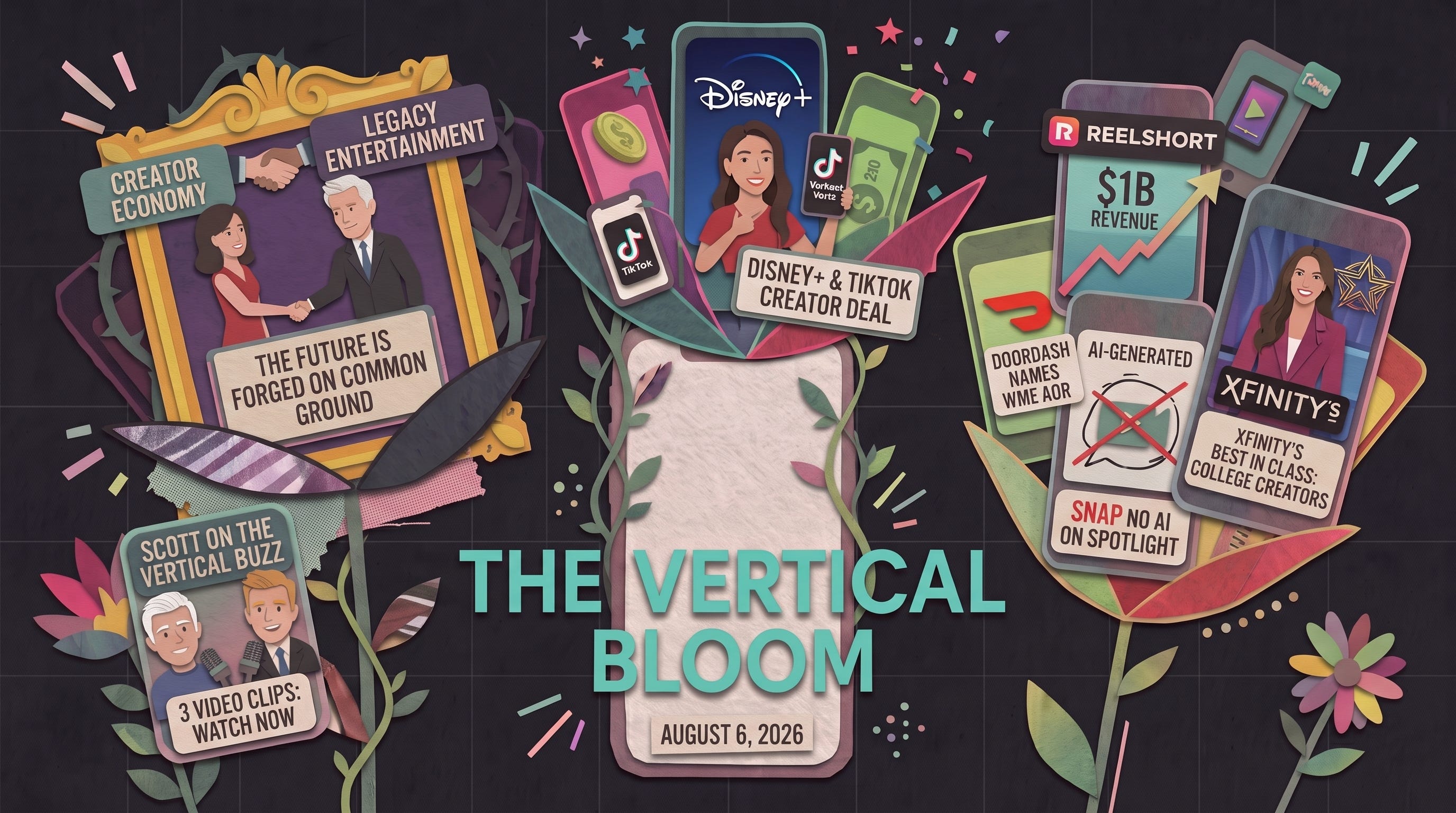
Welcome to The Vertical Bloom, a weekly dive into the fast-growing world of microseries and vertical storytelling. Here, we unpack the platforms, creators, and deals shaping the format that’s quietly redefining what it means to make—and watch—scripted content in the mobile age.

This week, Disney brings creator-made vertical video into Disney+, consumer brands push further into original entertainment, ReelShort is projected to cross $1 billion in annual revenue, and Snap draws a firmer line around fully AI-generated content. Then, we dig into Scott’s time on The Vertical Buzz, where he and Buzz took a deep dive into the vertical industry.
But first…
I’ve been thinking a lot about collaboration lately.
It’s a word that has always been at the heart of the creator economy. And really, it’s at the heart of every movie that’s ever been made.
But I think collaboration has a new importance right now, because the collaboration that matters most may be the one happening between two worlds.
Ben Odell has been documenting this “great convergence” incredibly well for quite some time. And as we prepare to see more companies enter digital, vertical, and the creator economy in new ways, I think it’s important that we approach those partnerships as true collaborations, with the staunch belief that both sides have something the other needs.
The best partnerships are the ones where each side brings something the other cannot. We can go so much farther together than we can alone.
So, to the legacy entertainment readers of this newsletter, I’d just offer a question to consider as you embark on these deals: Are the structures in place making it easy for creator-economy collaborators to bring all of their wisdom to the table? And is there anything holding you back from receiving it?
And to those of us in the creator economy: Are we entering these collaborations with the same openness? Are we ready to learn from the enormous body of craft, knowledge, and tradition that has been built by the American entertainment industry?
I believe the future is going to be forged on that common ground.
An extraordinary amount of innovation and knowledge has accumulated on both sides. In some ways, as much has changed in the last ten years as in the hundred before them.
So, to everyone making deals, building companies, creating shows, and trying to win in an uncertain future, I think it’s worth asking ourselves, myself included: Are we being the best collaborators we can possibly be? Across creative execution, business, strategy, and all the moments in between?
Because if the creator economy has taught me anything, it’s that the biggest winners are often the greatest collaborators.
All right, let’s get into it.

Disney and TikTok Bring Creator Videos Into Disney+
Disney and TikTok have struck a global deal giving participating creators access to assets from hundreds of Disney films and series. Opt-in fan videos will appear on TikTok and inside Disney+’s existing Verts feed, beginning with a U.S. pilot in the coming months.
For vertical, the bigger signal is that Disney is bringing creator-made content into its own streaming product, using social video to deepen fandom and drive discovery. Coming after its OpenAI agreement ended when Sora shut down, it also keeps human creators, rather than fully generated content, at the center of the experiment.
DoorDash Names WME Its Entertainment Agency of Record
DoorDash has hired WME to lead its entertainment marketing and advisory work as the delivery company expands its relationships across Hollywood.
It is another sign that consumer brands increasingly see entertainment as more than a sponsorship opportunity. Paired with Xfinity’s launch below, the move suggests original content and cultural partnerships are becoming a larger part of the brand-marketing toolkit.
ReelShort Forecast to Pass $1 Billion and Turn a Profit
Media Partners Asia forecasts that ReelShort will generate $1.05 billion in revenue in 2026, up 34 percent, while moving from an estimated $12 million loss in 2025 to roughly $40 million in net profit. The firm expects the wider microdrama market outside China to reach $3.6 billion this year and $9.5 billion by 2031.
These are projections, not audited results, but the proposed path to profitability matters: stronger franchises, cheaper subscriber acquisition through telecom partners, more direct billing, and faster creative testing. That is a shift from growth through paid acquisition toward retention, recognizable IP, and owned distribution.
Xfinity Builds a Vertical Reality Competition for College Creators
Xfinity’s Best in Class is a seven-episode reality competition made specifically for Instagram and TikTok. Hosted by Katie Feeney and produced by NBCUniversal’s Rock Studios, it follows six college creators competing for a six-figure Xfinity partnership.
The series is less a traditional campaign than an original entertainment format built around the product and released where its audience already spends time. It is a clear example of a non-entertainment brand using vertical storytelling as the marketing itself, rather than the material surrounding it.
Snap Removes Fully AI-Generated Videos From Spotlight Recommendations
Snap says wholly AI-generated videos are no longer eligible for recommendation on Spotlight. They can still be posted, while videos edited with Snapchat’s AI tools remain eligible and will carry transparency labels.
The distinction matters. Snap is not rejecting AI wholesale. It is drawing a line around fully generated volume inside its discovery system. That echoes YouTube’s push against low-quality, repetitive AI content, which we covered in July, and suggests platforms increasingly see mass-produced synthetic video as a recommendation-quality problem rather than a growth strategy.

Scott on The Vertical Buzz
This week, Scott joined Buzz Leer on The Vertical Buzz to talk about where vertical entertainment is headed and what the industry can learn from the creator economy.
Buzz is an actor, host, and vertical veteran who has worked across dozens of productions, and he’s built The Vertical Buzz into a great forum for the people shaping the space. Huge thanks to Buzz for having us.
You can watch the full interview here. Below are a few highlights that capture a lot of what we believe about the space, with takeaways for filmmakers and dealmakers alike.
Why Now?
Scott breaks down why he believes the scripted digital boom is happening now, using Dhar Mann as a case study. He also talks creative ambition, social platforms as a meritocracy for scripted content, and why sometimes the best creative move is taking a break.
The People Behind the Work
Scott talks about how much of his success comes from finding the right collaborators and empowering them. He and Buzz dig into directing actors and crews, boldness, pacing, and why retention ultimately comes down to creating a promise the audience wants fulfilled.
Storytelling Is a Technology
Scott gets into his love of Sidney Lumet, book recommendations, and his directing prep process. He also explores the difference between legacy and digital storytelling, breaks down a Project Hail Mary retention mechanism (spoilers!), and shares what he sees as the biggest opportunity in vertical today.
Thanks again to Buzz for having us. You can find more from The Vertical Buzz here, follow Buzz on Instagram and LinkedIn, or watch the full conversation on YouTube.
That’s it for this week’s Vertical Bloom.
We’re excited to keep building this into a weekly home for the ideas, experiments, and creative voices shaping vertical storytelling in real time.
We’ll be back next Thursday with more headlines, more analysis, and another look at where this medium is headed.
See you then.
Editor: Scott Brown
Writer: Franziska Harms