For nearly a century, advertising agencies occupied a privileged position in the cultural supply chain.
They sat between capital and culture. Between brands and audiences. Between money and meaning. Institutions like WPP, Omnicom, IPG, Publicis, and Dentsu built global empires by controlling access to scarce media inventory and arbitraging attention at scale. If you wanted to reach people, you went through them.
For filmmakers and creative talent, advertising became a parallel ecosystem. A place to experiment, pay overhead, and stay sharp between projects. At the highest level, it monetized reputation. Martin Scorsese and Alejandro Iñárritu used commercials to cash in on their names while keeping their tools sharp. For others, it was structural. Brady Corbet directed commercials to afford The Brutalist. Producers built commercial companies that later leveraged talent into film and television. Anonymous Content became the clearest expression of that model, a proving ground for directors with the Oscars and Emmys to prove it.
That world still exists. But it no longer sits at the center of gravity.
The problem is not that advertising lost its creativity. It’s that the structure that once gave it power no longer maps to how culture moves.
Attention is no longer scarce. Relevance is. Media inventory is infinite. Trust is not.
And culture no longer waits for permission.
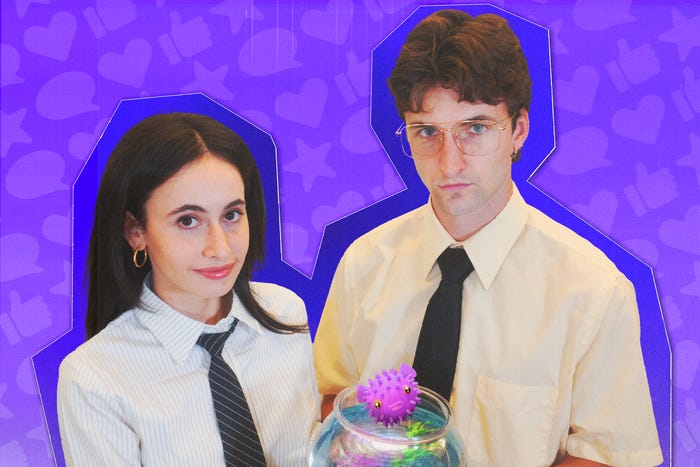
This is the context in which a small, creator-led agency called Pufferfish, co-founded by Anthony Potero (aka AnthPo) and Talia Schulhof, becomes interesting. Not because it is clever or young or disruptive in the Silicon Valley sense, but because it represents something more fundamental: virality itself becoming infrastructure.
How I Stumbled Into This Thread
Like anyone paying attention to the creator economy, I listen to the Colin and Samir podcast. It’s one of the places where creators talk seriously about process, not just output or growth.
That’s where I first heard Anthpo.
I was trying to figure out how to describe this guy. He reminds me of the best music video directors of the 90s. Michael Gondry. Spike Jonze. Chris Cunningham. But if they were gonzo performance artists. It would be banal and misrepresentative to call him just a creator. He is an online provocateur.
On the Colin and Samir podcast, Anthpo talked about experiments he had run outside his main channel. Anonymous projects. IRL moments. Things designed to exist without his face or his name attached.
One of those was the Timothée Chalamet lookalike contest in Washington Square Park. Another was the Crocs-on-statues project across New York City. Both happened before Pufferfish existed. They were Anthpo solo projects.
What struck me wasn’t the cleverness. It was the architecture.
These weren’t content drops optimized for distribution. They were environments. Situations people could stumble into. Each one created dozens, sometimes hundreds, of parallel narratives. The kid who didn’t look like Chalamet. The girlfriend who convinced him to go. The bystander cutting through the park who suddenly found herself inside an internet moment.
When the real Timothée Chalamet showed up, it didn’t end the story, it multiplied it.
Then Open Gardener, Mitch Camarda, wrote a piece reframing MrBeast as the modern equivalent of Hollywood’s mailroom. A place where people learn by doing, at speed, in public, with real stakes.
That article sent me down a different path. Who was coming out of that ecosystem? What were they building next? That’s when I realized Anthpo had partnered with someone named Talia Schulhof to start Pufferfish.
Former MrBeast creative strategist. Producer. Northwestern journalism grad. TikTok creator in her own right. Someone who had moved fluidly between internet culture and traditional media spaces.
I reached out directly on LinkedIn.
We scheduled a ninety-minute Zoom to talk about why they formed Pufferfish and where it was headed.
Whip smart. Driven. Open. The conversation with Talia was as illuminating as it was fun. You can find the full conversation here.
The Slow Collapse of the Legacy Advertising Model
But before getting into Pufferfish, it’s worth naming the broader shift.
The traditional advertising industry is not collapsing because it lacks talent. It’s collapsing because its core structure is misaligned with reality.
The signs are everywhere. Revenues contracting. Retainers evaporating. Layoffs accelerating. The Omnicom–IPG merger in late 2025 wasn’t a show of strength. It was a defensive maneuver. A consolidation of desperation.
For decades, the holding companies were stabilized by competition among giants. The moment two of them fuse, it signals not dominance but fragility.
At the same time, generative AI has hollowed out huge portions of the value chain. Strategy decks, copy, even visual concepts are now cheap and abundant. The result is not better advertising. It’s a sea of sameness.
Consumers feel it instinctively. They scroll past it. They mock it. They block it.
Trust has eroded. Authenticity has become the only remaining currency. And legacy agencies, staffed by people structurally removed from the cultural frontier, are bad at producing authenticity on demand.
Into that vacuum stepped creators.
From Influencers to Operators
The creator economy didn’t replace agencies overnight. It evolved in phases.
First, creators were distribution.
Then creators became talent.
Now we’re in a third phase. The interesting one.
Creators are becoming operators.
They don’t just distribute messages. They design moments. They don’t optimize for polish. They optimize for participation. They don’t ask what the brand wants to say. They ask how culture wants to play.
This is the era of the creator-led agency.
And this is where Pufferfish sits.
Anthpo: Not a Personality, a System
From early high school videos built on absurdist public interaction to college-era ensemble storytelling, Anthpo’s work consistently does one thing well. It creates conditions for other people to become part of the narrative.
His college videos weren’t just vlogs. They introduced a recurring cast. A loose universe. Watching them now, it’s clear he was learning how to build narrative ecosystems, not just grow an audience.
Then came the pivot.
In 2023, Anthpo stepped back from his main channel and began experimenting anonymously. Cheeseball Man. John Chungus. The Crocs statue project. The Chalamet contest.
These were not brand deals. They were stress tests.
The question he was asking was simple and profound: can internet culture be engineered without a central personality?
The answer, repeatedly, was yes.
That insight is rare. Most creators hit a ceiling because everything runs through them. Their face. Their availability. Their personal brand.
Anthpo was deliberately testing how to remove himself from the equation.
That’s the sign that creator agencies can scale.
Talia Schulhof and the MrBeast Mailroom
Talia’s background explains how that intuition becomes a business.
Right out of Northwestern, she faced a choice many young creatives still face. Traditional media or the creator economy. The mailroom or the unknown.
She chose MrBeast.
“If I had gone to the mailroom, I’d probably still be an assistant.”
Instead, she entered an environment where production is relentless. Ideas are tested in public. Failure is fast. Success scales immediately. Generalism is assumed.
What matters is the fluency she built across the creative stack. Strategy, producing, editing, distribution. Not to personally do every job, but to understand how decisions in one layer shape outcomes in another.
She describes picking up hands-on creative skills as part of that fluency, not as a pivot or a correction.
“I didn’t know how to use Premiere until about a year and a half ago, and now I use it every day.”
That fluency changes how feedback is given. How collaboration works. How leadership shows up.
This isn’t an outlier. Creator-led companies are increasingly run by leaders who look less like traditional executives and more like creators with managerial range. The ability to conceptualize, execute, and distribute is becoming a baseline requirement to participate in this new order.
What She Took. And Where She Wants to Differentiate
It would be easy to frame MrBeast as a finishing school for the creator economy. In some ways, it is. But what matters more is not just what people learn there. It’s what they decide not to carry forward.
Talia is clear-eyed about what that environment gave her. Scrappiness. Speed. A deep understanding of retention, metrics, and the psychology of a single view.
“I learned the power of scrappiness,” she told me. “I learned the power of exhausting all of your possible options.”
But she’s equally clear about where she wants to differentiate: focusing less on the raw number of views and more on the quality of those views. The priority is understanding what kinds of storytelling and creative choices make a view meaningful and turn a viewer into a fan.
Those distinctions explain why Pufferfish doesn’t feel like a growth-at-all-costs shop.
And when you look at how online behavior and trends are shifting, this approach reflects the moment. Depth over width.
When Metrics Become Identity
For all the talk about virality, Talia is unusually candid about its emotional cost.
“The value of a view is different now,” she said. “And the term ‘viral’ has lost its meaning.”
A MrBeast video and a Timothée Chalamet lookalike contest are both called viral, despite operating on completely different cultural planes.
Treating them as equivalent has consequences.
“It’s really difficult to be in a job where your perceived self-worth is directly attached to a number,” she said. “How many views is the project getting.”
The feedback loop is immediate. Public. Constant.
“You could resonate with one person on such a deep level,” she said, “and that so greatly outweighs resonating with a hundred people at a surface level. And the numbers don’t reflect that.”
This perspective sits at the core of Pufferfish’s work. It explains why their campaigns optimize for participation rather than reach. Why they prioritize physical reality over digital abstraction.
Why Pufferfish Exists
After Anthpo appeared on Colin and Samir, brand inbound exploded. Not for ad reads. For campaigns.
He didn’t want his personal channel to become a brand feed. He also recognized that what brands were asking for required infrastructure.
So he called Talia. They knew each other from the days when they both worked for MrBeast.
Pufferfish was born with a clean division of labor. Anthpo as creative gravity. Talia as operator.
Lean team. Project-based. Everyone creative. Everyone capable of execution.
And a focus on IRL reality.
In an internet saturated with AI-generated sludge, physical reality has become premium. Billboards. Crowds. Objects in space. Things that can’t be hallucinated.
That focus would define their first real campaign.
Launched with a Big Kock Kampaign
Pufferfish’s first major campaign was for Airlearn, a language-learning app entering an already crowded market.
Instead of promising fluency or productivity, they focused on something more basic. Language is funny.
They put up high-visibility billboards in New York with single words that looked crude in English but mean completely innocent things in other languages:
Kock
Pussi
Dik
Each billboard carried the same line: Learn a new language with Airlearn.
The ads weren’t designed to explain themselves. They were designed to be completed by the audience.
Why “Stunt” Is Still the Wrong Word
Calling this work a stunt misses the point.
As Talia put it:
“The value of a view is different now, and the term ‘viral’ has lost its meaning.”
Depth beats reach. Resonance beats frequency.
The Economics of the Displacement
What’s happening here isn’t just cultural. It’s economic.
Legacy agencies are high-fixed-cost institutions. Creator-led agencies are low-overhead, project-based, and fast.
The middle layer is being hollowed out.
What remains are two poles. Technocratic giants handling infrastructure. And creative militias handling culture.
My Prediction
Within the next few years, a Fortune 500 consumer brand will appoint a former top-tier creator or creator-operator as Chief Marketing Officer.
I don’t know that much about advertising but I’d bet on it.
Why This Matters to Legacy Media
This isn’t just a story about advertising. It points to where legacy media can go next.
If you want to be the Anonymous Content of the future, it’s no longer enough to manage directors who make great films. You also need to work with creators who understand how culture moves today. People who can design moments that live beyond the screen and spread across the internet through participation.
That doesn’t mean chasing virality for its own sake. It means recognizing that film and television can’t live in isolation anymore. They need to become part of larger cultural moments that travel through feeds, group chats, and remixes, the way Anthpo’s work does.
Legacy media already sees this. The Severance campaign that rebuilt the show’s office inside Grand Central Station worked because it invited people into the world of the show and let them carry it online.
That’s the shift. Not promotion alone, but integration.
Pufferfish isn’t a replacement for legacy media. It’s a glimpse of how creative fluency and cultural participation can help film and television live more fully inside the internet.
For the next film or television project I take to market, I’d want to bring Pufferfish in as a creative partner. Not to run a campaign, but to help extend the storytelling itself. Not after the show is finished, but while it’s being made. Designing moments that live alongside the work and travel through culture in real time.
Imagine what that could unlock.


The Pufferfish model feels like what happens when production fluency meets cultural intuiton. Traditional agencies got so focused on polish that they forgot participation matters more than perfection now. I've seen it in tech too, where the scrappy team that understands how people actualy behave online beats the well-funded consultants every time.