


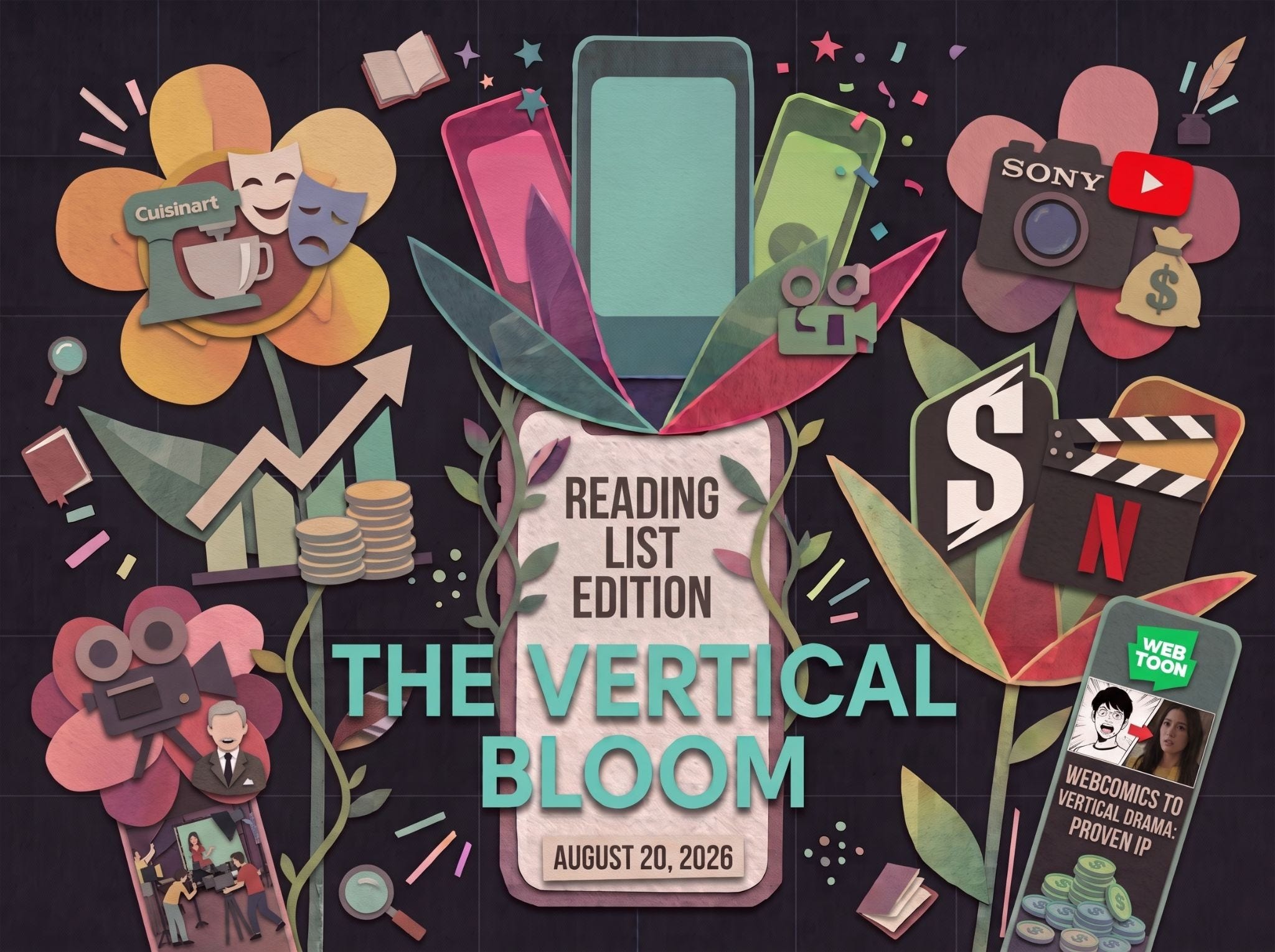
Welcome to The Vertical Bloom, a weekly dive into the fast-growing world of microseries and vertical storytelling. Here, we unpack the platforms, creators, and deals shaping the format that’s quietly redefining what it means to make, and watch, scripted content in the mobile age.

We’re doing things a little differently this week.
There has been a lot of good reporting recently about where these worlds are heading, and rather than summarize all of it into oblivion, we thought we’d point you toward the stories we think are worth your time, along with a few thoughts on why.
Consider this your Vertical Bloom reading list.
But first…
Do you feel that?
The gates are opening.
I think the namesake of Open Gardens, where The Vertical Bloom makes its home, is one of the best names Ben Odell could have chosen for this moment.
It speaks to something that has always been one of the best parts of this digital home, this vertical world, this creator economy: the gates have always been a little more open here.
When I worked at MrBeast, I was struck by the prevailing belief that a 17-year-old from Indiana might have just as much value to bring to the room as a seasoned producer from Los Angeles.
When it’s productive in a meeting, I’ll bring up the fact that legacy entertainment does not have the same expansive momentum that digital possesses. I honestly believe that it could. Maybe even that it should.
But it’s also true that wisdom’s a gift and you trade it for youth. That age is an honor, but it’s still not the truth. (Thanks, Ezra Koenig.)
When I think about my experiences in the creator economy, and the members of my team who keep me honest, I’m grateful I’ve been taught to keep an open mind. And I’m grateful Larry King’s words still rattle around in my head, in his booming, breaking baritone:
“Don’t knock the new.”
I sometimes fear that entertainment instills an unfortunate necessity in people: the feeling that you must always appear to know exactly what you’re doing.
And if you have to appear to already know, it becomes very difficult to admit that someone new might know something you don’t.
Thankfully, not everyone succumbs to that.
Every month there are more meetings on my calendar with people from companies that film-school-me dreamed of meeting. Stops on studio lots with showrunners with housekeeping deals, looking at the future and yearning for clarity.
The gates are opening.
And there are so many wonderful people on the other side with so much to share. Knowledge about taste, business acumen, and what is ultimately an incredibly well-guarded, mostly oral tradition: The accumulated knowledge of Hollywood.
We are about to see a lot of eyebrow-raising deals announced across the vertical world and beyond.
The gates are opening.
But what happens once we’re all inside?
There’s a quote I first read printed next to the spiral binding of one of my school notebooks, presumably placed there by some Scholastic employee trying to make a deadline, that has stuck with me ever since. It was attributed to Mark Twain, and apparently there’s actually quite a bit of debate if he actually said it, but it’s a truth for me nonetheless:
“Keep away from those who try to belittle your ambitions. Small people always do that. Only the truly great make you feel that you, too, can become great.”
The spirit of that quote is part of why I think digital has such expansive momentum.
We seek to raise each other. We don’t mind when others iterate on our work. We give wisdom freely. And if my experiences have taught me anything, it’s that all ships do indeed rise in the tide.
The gates are opening, and a lot of talented people are going to find themselves staring at each other inside a strange and wonderful world, wondering what to do.
And the answer will always be:
Create.
Courageously.
Together.
Alright, let’s get into it.

What We’re Reading
A $150 Billion Vertical Video Economy. With an Important Asterisk.
Deadline on Owl & Co.’s latest research into the vertical video economy
There’s a big number making the rounds: $150 billion.
Owl & Co. estimates that the global vertical-video economy outside China will generate roughly $150 billion in revenue in 2026, up more than 40% year over year.
But there’s an important distinction: that number represents the entire vertical-video ecosystem, not microdrama alone. Dedicated microdrama apps account for roughly $4 billion of the estimate. If you’d like to hear more about why Owl & Co. are including all verticals in this number, I would encourage you to check out our review of their summit a few months ago.
The research gets even more interesting beyond the headline number. On My Drama, men have grown from just 1.1% of monthly users to more than 30% in seven quarters, while heavy viewers now average 13.1 hours of viewing per week.
DramaBox Is Going Local in Latin America
DramaBox is expanding its original production footprint in Latin America, including a Brazilian series with regional production company Cimarrón and three Colombian originals.
As vertical platforms expand globally, localization doesn’t have to mean translating an American series or dubbing an existing hit. Increasingly, it can mean working with established local producers and talent to build stories for those audiences from the beginning.
Microdrama May Be One of the Few Parts of Hollywood That’s Growing
Reuters: “Microdramas boom in a shrinking Hollywood as studios chase a TikTok audience”
This one deserves your time.
Reuters took a much broader look at what the growth of microdrama is actually doing to the Hollywood production ecosystem, including the jobs, facilities, investment and new career paths forming around it while much of traditional production remains under pressure.
Research firm Omdia estimates U.S. microdrama revenue will reach $1.5 billion this year and nearly $2 billion next year, while the U.S. monthly audience more than doubled from 26 million in 2024 to 66 million last year.
There is a much bigger conversation here about what vertical production could mean for Hollywood itself, and we don’t want to cram it into three paragraphs.
So for now: read this. We’ll be coming back to it with some deeper thoughts soon.
YouTube and Netflix Are Starting to Fight Over Creators
Bloomberg: “YouTube Offers Creators Millions to Not Work With Netflix”
Bloomberg reports that YouTube is discussing multimillion-dollar incentives with major creators in exchange for giving YouTube a period of exclusivity before their programming appears elsewhere, as Netflix continues courting YouTube talent.
Those incentives could include direct financing for programming and participation in major brand deals. At the time of Bloomberg’s reporting, no deals had been finalized.
For years, the creator economy story was largely about creators trying to cross over into Hollywood. Now two of the biggest video platforms in the world may be bidding against each other to keep them.
Read Lucas Shaw’s Bloomberg report here.
WEBTOON Turns Proven Digital IP Into Vertical Video
WEBTOON has launched six live-action vertical adaptations of existing webcomics.
That combination is fascinating: digitally proven IP + an existing fandom + vertical adaptation + an existing digital monetization system.
It raises a much bigger question about whether the most natural source material for the next generation of vertical hits may already be sitting inside other digital storytelling ecosystems.
Again, we think there’s enough here for a much bigger conversation. Read the Variety piece now but expect us to be coming back to these ideas in a future Bloom.
The Sidemen Are Helping Train the Next Generation of Producers
Deadline: “The Sidemen & NFTS Team To Train Next Generation Of Unscripted Producers In UK”
Sidemen Entertainment is partnering with the UK’s National Film and Television School to give students studying unscripted development and production direct experience inside a creator-led entertainment company.
This isn’t just traditional producers going to work for creator companies, or creators being taught how television works. One of the UK’s most established film and television schools is now putting future producers inside a creator-led company as part of their education.
I love this one because it’s such a tangible example of The Great Convergence we always talk about.
Sony Wants Someone Who Speaks YouTube
Natalie Jarvey’s Like & Subscribe: “Sony Hiring a $500K YouTube Whisperer”
First, a quick plug: we’re big fans of Natalie Jarvey around here.
If you work anywhere near the creator economy, Like & Subscribe should be in your reading rotation. Natalie consistently surfaces the specific deals, hires and business moves that tell you where this industry is heading, often before they turn into much bigger conversations.
Her latest has a particularly fun one: Sony Pictures is looking for an executive to help the studio better understand and operate on YouTube, with compensation that can reach $500,000.
The same edition also includes scoops on First We Feast building new vertical shows for Instagram and TikTok and Oscar winner Travon Free producing an independent scripted series with YouTube as a potential distribution path.
We’ve written a lot here about Hollywood and the creator economy learning to speak each other’s languages and apparently speaking YouTube is now a half-a-million-dollar skill.
Read Natalie’s full edition of Like & Subscribe here. And while you’re there, subscribe.
The Mole Distributor Is Moving Into Microdrama
Broadcast: “The Mole distributor Primitives moves into microdrama”
Primitives, the international formats distributor behind The Mole and 99 to Beat, is moving into microdrama.
Traditional format distributors entering the market suggests another piece of the established television ecosystem is starting to see vertical not simply as content, but as IP that can be developed, packaged, sold and adapted internationally.
Read the Broadcast story here.
Cuisinart Is Making a Sitcom for Your Feed
Marketing Dive: “Cuisinart caters to thumb-scrolling consumers with short-form series”
Cuisinart has launched its first episodic campaign built specifically for social: a 14-part comedy about a modern home cook whose roommate happens to be a starving artist transported from the Baroque period.
The episodes were designed for TikTok, Instagram and YouTube Shorts, and importantly, they’re non-linear so viewers can encounter them through an algorithmic feed without needing to start at episode one.
Rather than chopping a traditional campaign into vertical assets, Cuisinart started with the behavior of the audience and built the format around it.
Worth a read if you’re interested in where branded entertainment is heading.
Read the Marketing Dive story here.
That’s it for this week.
Nine stories, several different corners of the industry, and one fairly consistent theme: the boundaries between vertical, creator-led entertainment and the traditional entertainment business are getting harder and harder to find.
And if a few of these stories sound like they deserve an entire Bloom of their own…
We agree.
See you next week.
Editor: Scott Brown
Writer: Franziska Harms