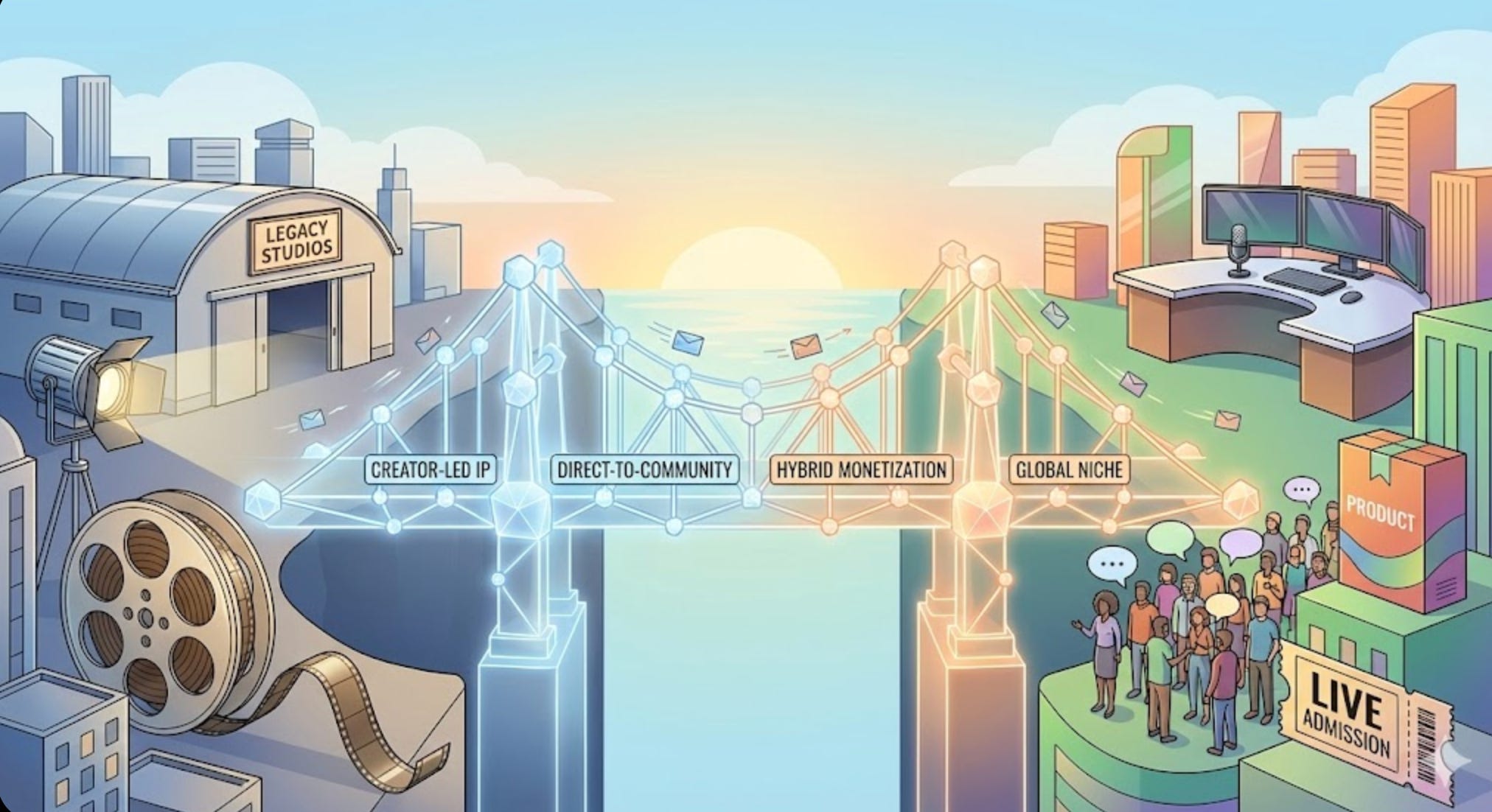
OG: Approved - 2025 Wrapped
Featuring the Next Generation of Storytellers Rising from the Creator Economy
Welcome to OG: Approved—where rule-breaking creators shape the future. Hand-picked by Open Gardens, they’re not following the playbook—they’re writing the next one.
When we started OG: Approved, the idea was simple. Build a weekly habit of spotting creators who feel like signals, not just “good channels.”
People building a world, a format, a business, and a point of view that could actually teach legacy media something.
By the end of 2025, it turned into a lot more than a list of favorites. It became a pattern library.
We covered AI-native filmmakers (Jason Zada, Particle Panic, Dave Clark, VK), craft-first storytellers (Munish Raghuwanshi, Hallie Tut, Gawx Art), community engines disguised as channels (Swissbeatbox), culture-access operators (Moses The Jeweler, Kareem Rahma), and flywheel builders across food, sports, education, and making (Robegrill, Reagan Rust, Melissa Maribel, Nerdforge, LOOK MUM NO COMPUTER, Shina Novalinga, JaDropping Science).
Different verticals. Same recurring patterns.
So instead of a best of list, this is the year-end wrap that actually matters: what kept showing up across the creators we could not stop talking about, and what that tells us about where this is all heading.
The Patterns That Kept Repeating
They Were Not Posting. They Were Running Formats.
Swissbeatbox is the cleanest example. It is not a beatbox channel. It is a league. Stakes, structure, seasons, rankings. Careers get made there. That is infrastructure.
But you see the same instinct in totally different forms. Kareem Rahma’s formats feel like recurring shows you can drop into anytime. Julien Cohen turned public performance into an episode machine. Eavesdropping looked at the romcom and asked a smarter question than most studios do: what if we built this like a social series from day one instead of trying to retrofit it later?
The thing these creators share is not consistency. It is architecture. They built containers that can hold infinite episodes without going stale, which is a fundamentally different skill than “being good on camera.”
And if you are an industry person reading this, here’s the uncomfortable truth: formats are what make creator businesses easier to bet on. A person is hard to underwrite. A format is a machine.
Craft Came Back As The Moat, But Not In The Way People Expected.
A lot of people assumed 2025 would be pure volume. More AI slop, shorter attention spans, just post more.
Not quite.
A bunch of our picks were craft-first in a very specific way. Not “high production value” as in expensive gear. Cinematic control. The stuff you cannot buy.
Gawx Art makes art videos that feel like short films because the pacing is intentional and the reveals land. Nerdforge structures builds like narrative episodes, with tension and payoffs. Hallie Tut and Kelly Boesch built visual languages you can recognize in half a second. Munish built an audience by teaching people how scenes work, which is really teaching taste, which is really saying: I’m going to make you better at noticing things.
Here’s the real tension: as tools get cheaper and more people can make “good-looking”, the middle of the market is going to get brutally crowded. The edge moves to what tools still cannot give you. Pacing. Structure. Rhythm. Sound. Emotional control. Knowing exactly when to cut.
Craft is back. But craft in 2025 is not about access to equipment. It is about taste and execution when everyone has access to everything.
“Build In Public” Stopped Being A Strategy And Became The Product.
Yes, “build in public” sounds like 2019 Twitter advice. Stick with me.
What we saw this year was different. A lot of creators stopped drawing a line between the work and showing the work. The process became the thing people showed up for.
With LOOK MUM NO COMPUTER, it is maker chaos. You are watching someone attempt ridiculous things and half the joy is not knowing if it will work. With Nerdforge, it is structured reveal after structured reveal. You know something cool is coming, and the craft is in the journey there. With education creators like Melissa Maribel, the magic is that she remembers what it feels like to be confused. She is not talking down. She is bringing you with her.
Even the AI creators we featured felt strongest when they made the process legible. Not “look what I generated,” but “here’s how I was thinking, here’s what I tried, here’s what failed, here’s what I learned”.
The process is the proof there is a person in there.
And business-wise, this is how trust gets built now. The audience is not just consuming results. They are joining the journey. That shifts the relationship from customer to participant.
The Real Growth Move Was Off-Platform.
If you only take one thing from this piece, make it this.
The creators who felt most durable had an off-platform layer that made the whole thing real. The channel was the top of the funnel, not the business.
Robegrill is not just content. It is products, culture, and a real-world food identity that exists whether or not you have ever seen a video. Moses The Jeweler turns access into a business engine, not just views. Reagan Rust turns content into pathways: camps, community, pipeline. JaDropping Science takes a recurring bit and turns it into something you can own and play in your living room.
These creators understand that views are exposure, not durability. The durability comes from what you build underneath: products, services, access, experiences, community layers that do not disappear when the algorithm changes.
Creators who are only chasing views in 2026 are going to feel like they are running in place. The ones building ecosystems are going to feel like they are compounding.
Specificity Won. Relatability Lost.
A lot of internet advice still screams “be relatable”. The creators we kept approving went the opposite direction.
They were specific enough to feel like you were stepping into a real world. Not a vibe. A place.
The Diamond District with Moses. Inuit tradition and family with Shina. A very particular backyard grill culture with Robegrill. A very particular comedy character universe with Jenny Lorenzo, Johnny Hilbrant, Julia DiCesare, Aimee LaJoie.
And here’s the counterintuitive part that kept proving itself: the more specific the world, the more universal the obsession. People do not share “relatable”. Relatable is comfortable. People share portals. They share things that make them say: you have to see this.
Trying to appeal to everyone usually means you end up being nobody’s favorite. The creators who committed to a world built audiences who actually cared.
AI Stopped Being The Headline And Started Becoming Plumbing
The best AI-adjacent picks this year did not feel like “AI content”. They felt like creators using new tools to expand what a small team could do.
Jason Zada is a clear example of that mindset. Same with Dave Clark. Same with Particle Panic when the work leans toward cinema and taste instead of novelty.
Then you get someone like Kelly Boesch, where AI is part of the workflow, but the point is the aesthetic and the application. Visuals for phones, venue screens, loops that feel designed, not randomly generated.
This is the shift that matters: AI is moving from spectacle to pipeline. “Look what AI can do” is going to age fast. Quietly using it to punch above your weight class is the move.
What 2026 is going to look like
If 2025 was the year creators proved they could build worlds, 2026 is the year those worlds start behaving like real media companies.
Here’s where we’re placing our bets.
More Seasons, Fewer Endless Feeds
People want shape. Chapters, finales, event drops, scheduled moments that feel like appointments.
Trap to avoid: Do not slap “Season 2” on something that is just more of the same.
More Live And Experiential Layers
More creators will treat the real world as the multiplier, not the afterthought. Live shows, tours, pop-ups, community events, physical installations.
Trap to avoid: Live is expensive and operationally hard, so partner early or learn an expensive lesson.
More Products That Feel Like Extensions Of The World
Not random merch. Products that make sense inside the universe. Robegrill is the model. JaDropping Science is the model. Nerdforge is sitting on a kit-and-blueprints goldmine if they ever want it.
Trap to avoid: Audiences can smell a cash grab.
More Craft-Led Channels Winning Over Pure Volume
As the middle tier floods with AI-assisted sameness, taste and execution will stand out harder, not less.
Trap to avoid: “Craft” does not mean disappearing for six months. You still have to ship.
More AI In The Workflow, Less AI In The Pitch
AI will be everywhere backstage: pre-pro, iteration, assets, editing, research. But fewer creators will sell AI as the reason to watch.
Trap to avoid: Using AI to make more mediocre stuff faster.
And so…
OG: Approved was never meant to be a scoreboard. It was meant to be a radar.
In 2025, the radar kept pointing to the same signals: format over one-offs, craft as a moat, process as trust, off-platform economics, and worlds specific enough to feel like portals.
That’s what we’ll keep tracking in 2026. More systems. More storytelling. More creators building things that last.
Thanks for being part of the hunt this year. See you next year.


Mitch... your thoughts, including the ones that may be false starts, are providing the fertilizer sparking multi-hued solutions... leading to wonderful new stories. 'Thanks'. Brian Couch